Key Takeaways
- Corporate-owned portfolios across the United States are showing widespread signs of habitability failure that threaten long-term investor returns.
- Moisture, ventilation problems, and deferred repairs are turning units into financial and legal liabilities for owners.
- Investors who prioritize certified maintenance, oversight, and tenant safety protect their net operating income and long-term portfolio stability.
Corporate landlord neglect. Mold infiltrating units. Investors caught off guard.
This shocking report exposes how unchecked decay inside national portfolios is threatening long-term cash flow and creating hidden financial risks across the United States.
What dangers are investors missing as habitability failures spread nationwide?
- Mold-fueled structural decay
- Expanding legal pressure
- Investor risk rising
- Building-level failures accelerating
- Oversight weaknesses hidden in large portfolios
A Mold Nightmare That Shocked Las Vegas
The Family Forced to Breathe What Should Never Be Breathed
How does a family paying rent end up living inside a toxic construction failure that threatens their lungs and their lives?
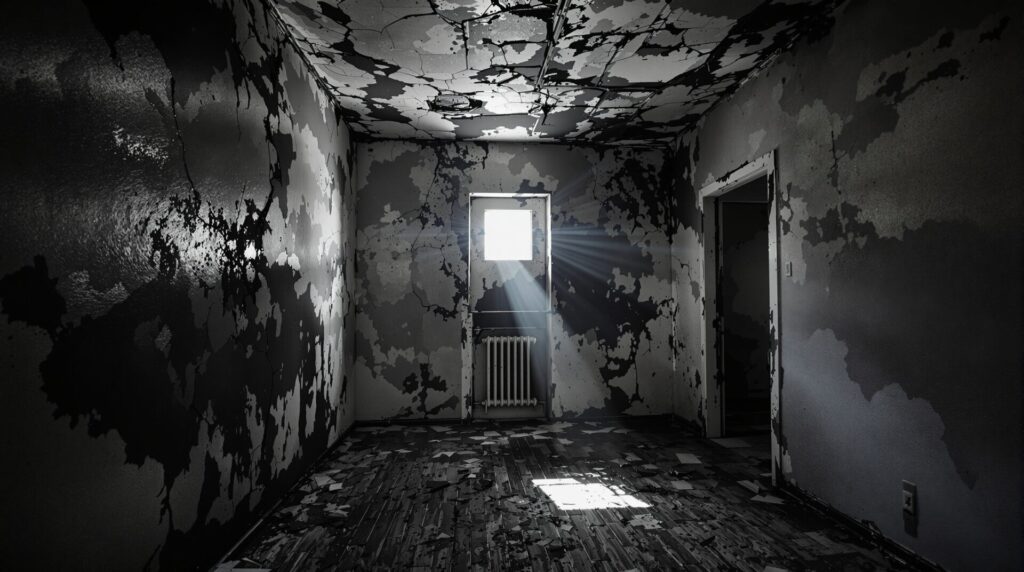
The Higuera family’s unit in the Wood Ridge Villas complex did not simply develop mold. It rotted from the inside out, swallowing ceilings, walls, and flooring until their home became a health hazard so severe that a certified inspector warned of major fungal growth throughout the structure.
The children woke up with rashes.
Their breathing tightened.
Coughs lingered for weeks.
One daughter with asthma watched her symptoms spike to frightening levels as black mold crept across the ceilings above her bed.
The worst moment hit when a water soaked, nail studded sheet of ceiling crashed onto Alejandro Higuera’s head while he was showering. He staggered out bruised, dizzy, and terrified that the entire structure might collapse on top of him.
The family lost the use of one bathroom completely because the mold growth was so heavy that entering the room required caution.
Hidden leaks behind appliances fed the infestation day after day, buckling the floors and bubbling the walls like a slow moving disaster.
Corporate ownership changed hands, but the suffering did not.
Instead of receiving certified mold remediation that follows national safety standards outlined by the Centers for Disease Control and Prevention, the family watched a handyman cover contaminated drywall without fixing the source of the problem.
The inspector’s warning was clear.
The repairs were improper, unsafe, and likely to make conditions worse.
Every signal from the unit pointed to a reality no investor can ignore.
When a building is allowed to rot, the people inside pay first.
The owner pays next.
The Corporate Machine Behind the Rising Complaints
When Scale Outruns Responsibility
Across the United States, large ownership groups have spent years buying aging multi family communities that were already strained by deferred maintenance.
Once inside these portfolios, problems that were once isolated begin to spread property to property. Units with leaking pipes, broken ventilation, soft ceilings, and moisture trapped behind walls start generating identical complaints.
Tenants report the same hazards in different cities. The pattern becomes the warning.
Corporate real estate operators often manage thousands of units at once.
That scale promises efficiency, yet it also creates blind spots where habitability issues grow unchecked. When hundreds of work orders stack up, repairs shift from proactive to reactive. Quick patches replace full remediation.
Handyman fixes take precedence over certified environmental corrections. What should have been a simple moisture repair evolves into a structural infection that reaches entire buildings.
These conditions do not stay quiet.
They surface in clogged drains, rotting subfloors, malfunctioning exhaust fans, and discolored ceilings.
They show up in units with recurring leaks that never fully dry.
They appear in online tenant forums where residents of different properties describe the same failures almost word for word.
This is not coincidence. It is systemic strain within a corporate model that prioritizes scale over oversight.
For investors, this trend signals a dangerous reality.
When large property owners fall behind on habitability, the cascade reaches every part of the operation. Repairs become emergency scale. Insurance premiums rise. Vacancy increases as tenants flee unsafe units. Reputation damage spreads quickly through public records and digital platforms.
Most dangerous of all, regulators and legal advocates begin to target the entire portfolio rather than one address.
This is the moment when corporate neglect stops being a single property issue and becomes a national real estate threat.
The Systemic Breakdown Hidden Behind Corporate Branding
When Cost Cutting Becomes a Silent Catalyst for Disaster
Behind the polished websites, curated mission statements, and investor focused language is a reality many corporate owners never admit.
Habitability failures do not erupt overnight. They grow in the dark, fed by unresolved leaks, aging infrastructure, and repair strategies that address appearance instead of cause.
Drywall can be replaced quickly, but moisture trapped behind it continues to spread. Fans that never worked remain broken.
Plumbing that drips day after day creates an unending supply of water for mold colonies that reach deeper into walls with every passing week.
The breakdown accelerates when staffing decisions turn complex maintenance needs into low cost handyman tasks.
Certified environmental remediation is replaced with quick cosmetic fixes meant to keep units rent ready rather than truly safe.
These shortcuts may save money in the moment, yet they create conditions that erode the integrity of the building from the inside.
Floors buckle. Paint bubbles. Ceilings sag. Ventilation becomes ineffective. Every surface becomes a symptom of a deeper structural problem.
Once this cycle begins, corporate branding becomes a shield rather than a standard. Residents see one thing. Ownership sees another. The disconnect widens until the property can no longer hide the damage.
By then, the cost to reverse the problem far exceeds what routine maintenance would have required.
Emergency responses become the norm. Tenants feel unheard. Inspections reveal widespread contamination that could have been prevented months earlier.
This is not mismanagement at the edges. It is a systemic failure pattern inside high volume portfolios that chase efficiency at the expense of livable conditions.
The more properties involved, the faster the neglect compounds.
When a portfolio reaches this stage, investors are left holding the consequences: accelerated deterioration, rising legal exposure, and an operational crisis that threatens long term cash flow.
A Crisis Now Erupting Across Corporate Owned Properties
When One Building’s Problems Reveal a Nationwide Pattern
Across the country, tenants in large multi property portfolios are reporting the same conditions that once seemed isolated.
Moisture intrusion, pest infestations, ventilation failures, and unchecked water damage appear repeatedly in buildings operated by corporate owners with thousands of units spread across multiple regions.
These issues share a common thread. They thrive in environments where oversight is diluted and maintenance teams are overwhelmed by the scale of responsibility.
Residents from different cities describe nearly identical problems. Toilets backing up without repair. Water heaters leaking for months.
Ceilings stained with moisture rings that grow wider each season. Kitchens where sinks overflow because aging pipes have never been replaced. Bathrooms where damp air sits stagnant because fans have been broken for years.
Outdoor areas filled with standing water that seeps into ground floor units every time it rains. These conditions are not random.
They signal a structural failure inside a system that expands faster than it can maintain itself.
Digital tenant communities amplify these experiences, creating a mosaic of shared stories that expose weaknesses across entire portfolios.
Advocates track these patterns and document them as evidence of widespread neglect.
Regulators monitor rising complaint volume and begin to investigate clusters of properties rather than individual addresses.
This creates momentum toward sweeping action that targets ownership groups instead of isolated landlords.
For real estate investors, this is the moment to pay attention.
When portfolios show recurring habitability failures across multiple properties, it reflects operational cracks that could lead to regulatory pressure, legal scrutiny, increased oversight costs, and forced remediation.
These outcomes hit directly at net operating income.
They push vacancies higher.
They weaken property values.
They create an environment where even well intentioned owners can be dragged down by the failures of large institutional operators.
The crisis unfolding within these corporate portfolios is not simply about poor conditions.
It is about the growing recognition that widespread neglect is beginning to shape public perception, regulatory momentum, and long term financial performance across the entire multi family sector.
The Investor Reality No One Can Ignore
When Neglect Turns Every Dollar of Cash Flow Into a Risk Multiplier
In real estate investing, mold, leaks, and structural decay are not just unpleasant tenant complaints. They are financial detonators.
Once water intrudes into a property and remains unaddressed, every component of a building begins to degrade.
Moisture saturates drywall, softens flooring, corrodes metal fixtures, and creates an ideal environment for fungi that spread silently behind walls. What starts as a minor repair becomes a compounding liability that expands with each passing month.
For investors, the math is ruthless. Deferred maintenance on moisture and ventilation issues is one of the fastest ways to destroy net operating income.
Emergency remediation is far more expensive than timely repair. Tenant turnover spikes when units become unsafe. Vacancy rises as word spreads through local communities and review sites.
Insurance claims increase, which triggers higher premiums or coverage restrictions. Lenders take note when buildings show repeated habitability issues, and that scrutiny can weaken refinancing terms or stall future acquisitions.
These failures ripple through a portfolio.
A property that once promised stable cash flow becomes a financial drain, absorbing capital reserves at a pace that undermines long term performance. Investors who believed they purchased a safe, income producing asset find themselves funding expensive rebuilds while watching equity evaporate.
The numbers reveal a truth many overlook. Mold and maintenance neglect are not cosmetic problems. They are balance sheet threats that reduce valuation, limit liquidity, and lower exit appeal.
This is why responsible owners treat habitability as a core investment strategy rather than an afterthought.
Proactive inspections protect revenue. Proper ventilation and moisture control guard against structural decay. Certified remediation shields investors from liability.
Consistent oversight prevents small defects from becoming catastrophic losses.
The investors who survive problematic markets are the ones who recognize that every leak, stain, or soft ceiling panel is not just a repair. It is a potential threat to the entire financial structure of the property.
The Legal Crackdown Targeting Corporate Landlords
When Regulators Decide Neglect Is No Longer a Private Matter
Across the United States, housing authorities, attorneys general, and local enforcement agencies are sharpening their focus on widespread habitability failures inside corporate owned multifamily portfolios.
What once passed as routine maintenance oversight is now being documented as potential negligence. Regulators are no longer approaching these issues as isolated disputes between landlords and tenants.
They are treating them as indicators of systemic breakdown inside large ownership structures that affect entire regions.
Complaint data flowing into state and county records is revealing clear clusters of repeated violations.
Moisture damage, ventilation failures, pest infestations, and structural hazards appear more frequently in institutional portfolios with high unit counts and rapid acquisition histories.
As these clusters grow, oversight agencies shift from reactive enforcement to proactive investigation. Inspections become more comprehensive.
Deadlines become stricter.
Penalties increase when owners fail to correct issues within mandated timeframes.
Legal advocates amplify this scrutiny by tracking patterns across units and properties.
When multiple buildings show the same problems, the narrative shifts from “unfortunate condition” to “evidence of systemic neglect.” Cases that once involved a single tenant now escalate into broader challenges that question the integrity of the owner’s management practices.
Courts take notice. Judges scrutinize records more closely when owners seek evictions after residents report unsafe conditions.
Public sentiment strengthens enforcement pressure as news coverage exposes the human impact of unsafe housing.
For corporate landlords and investors, this legal momentum carries real financial consequences.
Mandatory remediation orders can drain reserves. Fines accumulate quickly when deadlines are missed. Litigation risk expands as more tenants document health issues tied to environmental hazards.
Insurance carriers reassess policies when buildings show repeated claims related to water, mold, or structural decay. Lenders review compliance records before approving refinancing, and poor track records can stall or kill deals outright.
This phase of the crisis signals a turning point. Neglect is no longer an invisible cost buried in operations.
It is a regulatory target. Investors operating inside this environment must recognize that compliance is not optional. It is the line between stable cash flow and cascading legal exposure.
What Smart Real Estate Investors Must Learn Now
Why Habitability Is Not Just Ethics, It Is Capital Preservation
Every investor wants predictable income, stable occupancy, and a property that grows in value over time. Yet none of those outcomes survive in an environment where basic habitability is ignored.
Moisture problems, ventilation failures, and structural decay do not remain isolated. They spread through adjoining walls, shared plumbing lines, and common ventilation pathways.
A single leak can compromise multiple units.
A neglected bathroom fan can raise humidity across entire sections of a building.
Small oversights multiply into large operational failures, and those failures hit investors directly.
The path forward requires a shift in mindset. Habitability is not a tenant benefit.
It is a foundational investment strategy. Responsible investors build routine inspections into their operating model, documenting every leak and monitoring moisture levels before they trigger major structural damage.
They hire qualified remediation teams instead of opting for cosmetic repairs. They track repair timelines, knowing that delays increase long term costs.
Most importantly, they remain vigilant about warning signs that reveal deeper systemic problems inside aging buildings.
Investors who follow this approach gain a competitive advantage.
Their units stay occupied longer.
Their operating expenses stay manageable.
Their properties maintain stronger reputations in their markets. Lenders respond favorably when compliance records show meticulous oversight.
Insurance carriers offer better terms when claims are rare and documentation is strong. These outcomes add up to stronger net operating income, higher property valuations, and more favorable exit opportunities.
The lesson is simple…
The market is shifting toward greater accountability, and owners who stay ahead of habitability standards protect their portfolios while others face mounting losses.
Neglect is no longer a private operational issue.
It has become a public, financial, and regulatory risk.
Smart investors recognize that protecting tenant safety is not just a responsibility. It is the most reliable path to long term stability and wealth in real estate investing.
The Rot Beneath America’s Rental Housing Market
The crisis unfolding across large scale rental portfolios is not an accident. It is the predictable result of years of aggressive acquisitions, thin operating margins, and repair strategies that treat homes like expendable inventory.
When corporate owners chase efficiency instead of integrity, the buildings themselves reveal the truth.
Moisture spreads unchecked. Units deteriorate behind closed doors. Failures multiply across entire communities. And the people living inside those walls become the first casualties of cost cutting.
The consequences now reach far beyond tenant discomfort. Unsafe conditions trigger regulatory intervention, create legal vulnerabilities, and erode the financial stability of properties once marketed as safe, passive income assets.
Investors who ignore these warning signs risk watching their cash flow collapse under the weight of emergency repairs, lawsuits, vacancies, and rising insurance costs.
The portfolios that survive the coming scrutiny will be the ones led by owners who understand that habitability is not compliance theater.
It is the core of long term profitability.
Responsible investors have a choice.
They can continue building portfolios on a foundation of proactive maintenance, certified remediation, and transparent oversight. Or they can mirror the corporate operators who allowed their assets to decay until every hidden problem became impossible to ignore.
The market is sending a clear message. Neglect carries a price far higher than any repair bill.
The investors who thrive in the years ahead will be the ones who choose diligence, safety, and accountability before the damage begins.