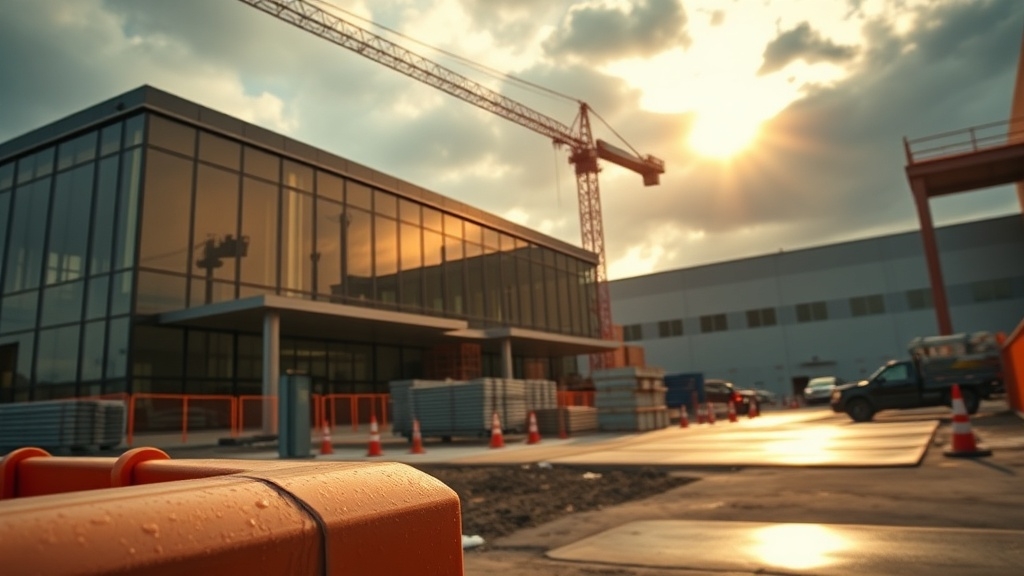
Rising Vacancy Rates Transforming the Lab Space Landscape
The lab space market in Silicon Valley is at a critical juncture. Dramatically rising vacancy rates are reshaping the landscape.
The Bay Area is experiencing a lab space availability rate of 35%. This creates formidable vacancy challenges across the region.
Recent construction surges in Q1 2025 have intensified these issues. New lab and industrial projects are increasing supply faster than demand. Collapsing venture capital investment in life sciences, with its drop to $24.9 billion through September 2025, highlights the funding challenges exacerbating the demand for these spaces even further.
Even traditional incubator facilities, once considered resilient, are feeling the strain. These haven-like spaces are not immune to rising vacancy rates.
Landlords are seeking conversion strategies to repurpose vacant spaces. AI applications and drug manufacturing are popular adaptations.
Despite these efforts, high vacancy levels require a fundamental transformation. Silicon Valley’s lab space environment is undergoing a significant reshaping.
Potential recovery signs in areas like San Jose offer hope. These could hint at more favorable future possibilities.
Economic and Market Dynamics Shaping Demand
In a climate filled with economic uncertainty, Silicon Valley’s lab space environment faces unprecedented challenges.
The contraction in the economy has resulted in a 26% vacancy rate for lab spaces, surpassing that of traditional office spaces. Domestic and Global Economic Uncertainty has further destabilized lab space demand, driven by tariffs and trade imbalances impacting overall market dynamics. Declining capital from venture sources and reduced federal research funding have hindered growth in life sciences, slowing down lab space leasing.
Lease activity has plummeted from over 300 annual leases to just 100 by 2024, demonstrating reduced market participation.
High interest rates further complicate expansion efforts, pressuring landlords to adjust their financial projections.
Newly completed lab projects face a 48% vacancy rate, signaling an oversupply in a market with weak demand. With availability rising 0.2% quarter-over-quarter to 12.8%, Silicon Valley’s R&D market stability is cautiously under threat.
Landlords are under increasing pressure as rental rates decline over consecutive quarters.
Industry players must navigate the ripple effects of these economic forces, reshaping Silicon Valley’s once-thriving lab space sector.
New Developments and Construction Challenges
Amid an unprecedented wave of urban transformation, Silicon Valley faces a troubling paradox in its lab construction sector.
Despite the completion of 2.42 million square feet of new commercial space in Q1 2025, construction trends indicate significant challenges ahead.
A critical concern is market saturation.
The oversupply has led to a staggering 24.6% vacancy rate by Q3 2024.
This surplus strains developers and landlords as demand levels stabilize post-pandemic.
Adapting to construction challenges, such as declining funding and supply chain disruptions, requires strategic shifts.
Moreover, diversification efforts, including AI applications and pharmaceutical manufacturing repurposing, could ease market tensions.
Evolving Leasing Strategies Amidst Surplus
Facing a labyrinth of challenges, Silicon Valley’s lab leasing market is undergoing strategic evolution. It grapples with surplus space amidst vacancy rates reaching 26%.
Landlords adapt their strategies to entice tenants. Tenant incentives, such as reduced rents and concessions, are increasingly offered to attract long-term commitments.
Leasing flexibility becomes a focal point. This enables landlords to accommodate technical specifications that potential tenants demand.
The rise in sublease availability further necessitates innovative approaches. Many tenants prefer direct leases due to bespoke infrastructure requirements.
Landlords pivot towards individualizing leases to secure occupancy. They target high-quality lab users who seek technically-advanced environments.
In a similar vein, burgeoning inventory levels within the U.S. housing market suggest potential stagnation, mirroring challenges as supply exceeds demand.
Future Projections and Adaptation Pathways
The future of Silicon Valley’s lab space market hinges on adaptation and strategic foresight. Despite ongoing challenges, innovative approaches are crucial for maintaining relevance. Landlords grappling with significant vacancy must explore enhancements such as smart technology integration to boost tenant satisfaction and attract new occupants seeking modern amenities and energy efficiency.
Assessment
The Silicon Valley lab space market is undergoing a significant transformation. Rising vacancy rates and economic pressures are reshaping the landscape.
Landlords are facing increasing challenges with new developments. Construction constraints and surplus inventory are pushing them to rethink leasing strategies.
Looking ahead, stakeholders must navigate uncertainty and adapt to changing demands. Survival in this volatile environment will require agility.
Strategic thinking and a keen understanding of market dynamics will be essential. Thriving amidst change demands adaptability and foresight.