Key Takeaways
- Prioritizing deal-chasing over system-building can jeopardize both financial stability and mental health.
- Regularly pursuing quick wins may lead to increased anxiety and decision fatigue.
- Focusing on a strong foundational strategy can alleviate stress and offer surprising benefits.
The Hidden Costs of Always Chasing Deals
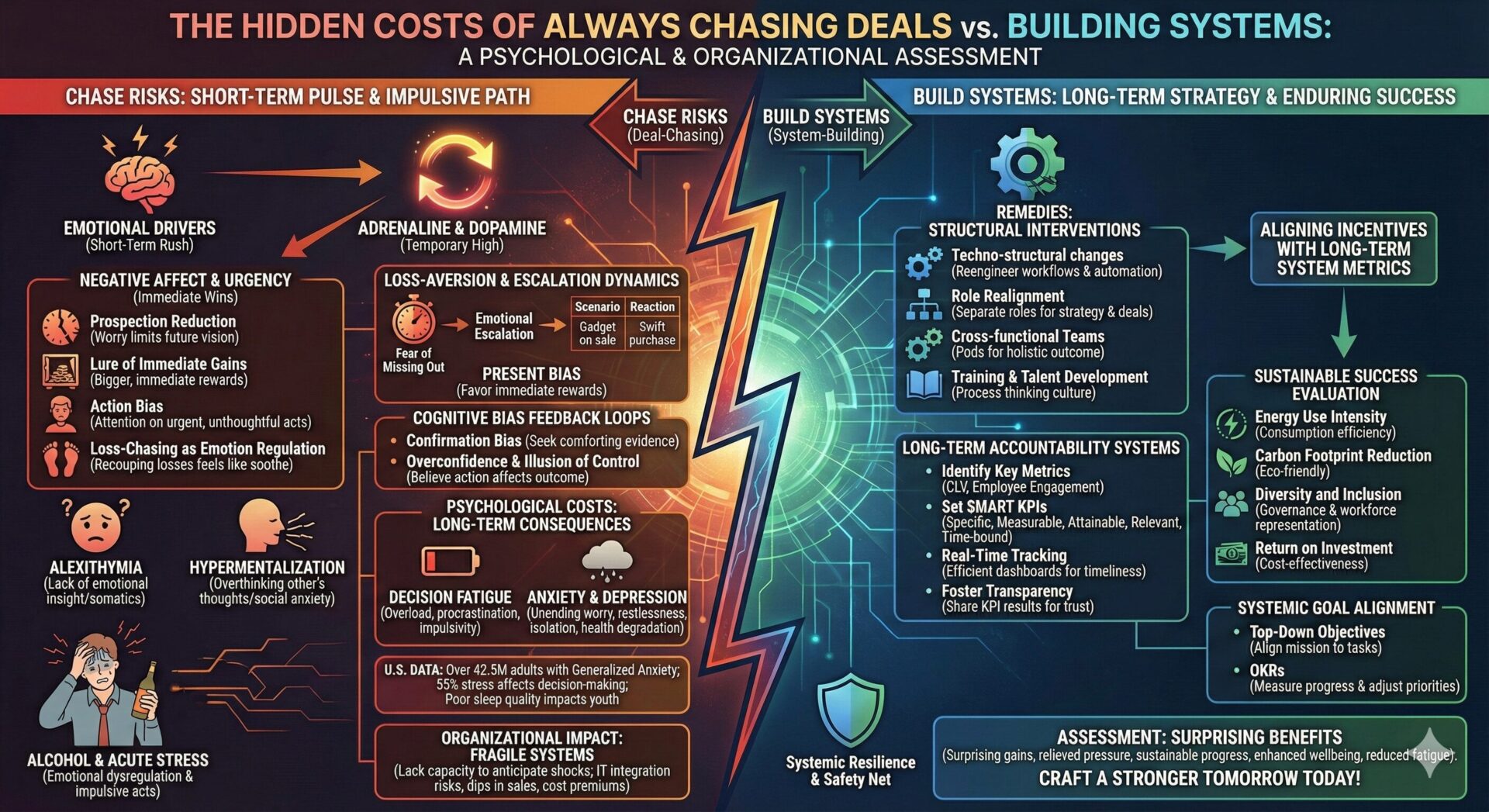
When you chase deals instead of building systems, you’re not just risking financial stability—you’re putting mental health on the line.
The psychological cost of constantly searching for quick wins can lead to anxiety and decision fatigue, like juggling too many balls at once.
Just imagine how different it would feel to focus on a strong foundation instead.
Wouldn’t it be nice to relieve that pressure?
The benefits of a system-focused strategy might surprise you.
Emotional Drivers of Short-Term Risk-Seeking
When you chase a new deal or risky decision, your brain might feel a rush of excitement. This rush is an emotional trigger that floods your system with adrenaline and dopamine, offering a temporary high similar to addictive cravings.
It’s a thrill that colors your risk perceptions, making even the craziest ventures seem appealing. In the U.S., many crave these dopamine surges, especially if mundane activities don’t satisfy emotional needs.
You might find yourself seeking new, intense experiences—be it social, financial, or physical—that promise similar rewards as other life joys. Understanding the surge of dopamine, which follows the adrenaline release, is crucial as it links to the pleasure felt during these thrilling activities. However, without realizing it, this cycle might lead to dependency.
To mitigate such impulsive risks, utilizing financial tracking software from the outset can provide a more stable and insightful approach to decision-making.
Understanding these emotional triggers can create a path toward strategic decisions instead of impulsive risks. Reflect on how you approach risks next time.
The Role of Negative Affect in Immediate Wins
A dizzying sense of urgency can take over when negative emotions like anxiety or worry hit you.
These feelings can spread through emotional contagion, making you focus on what’s right in front of you instead of the bigger picture.
Your reward sensitivity increases, and you might lean toward grabbing quick wins.
When this happens, consider the following:
- Prospection Reduction: You may struggle to see beyond today because worry overrides your decision-making.
- Lure of Immediate Gains: High worry pushes you toward bigger, immediate rewards, even if they’re not best long-term.
- Faster Responses Post-Loss: Losses make you react quickly, often impulsively, seeking immediate relief.
- Action Bias: Anxiety shifts your attention to urgent actions, bypassing thoughtful planning.
Recognizing these patterns can help you regain control.
Loss-Chasing as Emotion Regulation
Even though you mightn’t realize it, chasing losses often feels like the only way to soothe those overwhelming emotions. Your mind may tell you that recouping those losses is key to restoring your mood, but this pattern can actually undermine emotional resilience.
You’ll find that negative urgency, the urge to act impulsively when upset, leads you down this path. Your behavior shifts, influenced by affect-driven impulses, pushing you to chase even more.
Frustration from losses amplifies quickly, nudging you towards reckless bets. This escalation forms a cycle, where emotional reactivity traps you in constant pursuit of mood repair.
Instead, recognizing these behavioral patterns and building systems for emotional regulation can guide you towards recovery and healthier decision-making.
Alexithymia and Impaired Emotional Insight
Although you mightn’t think about it often, understanding your own emotions can be hard if you struggle with alexithymia.
Alexithymia awareness highlights how emotional neglect and interoceptive deficits contribute to this cognitive emotional disconnect. You might find decision making challenging because you don’t get the somatic feedback others might rely on. This lack of affective processing and limited emotional vocabulary can impact your life.
To maneuver through these challenges, consider these steps:
- Insight development: Focus on recognizing bodily signals.
- Expand emotional vocabulary: Learning emotion words helps processing.
- Build psychological resilience: Strengthen coping mechanisms.
- Engage in mindfulness: Improve interoceptive awareness.
When you improve these areas, you can enhance your emotional insight and find more fulfillment in daily decisions.
Hypermentalization and Chasing Susceptibility
When you try to figure out what people are thinking too much, you’re hypermentalizing. In social interactions, these hypermentalizing tendencies can distort your cognitive bias, impacting your emotional insights and decision making.
You might overestimate someone’s mental states, using theoretical reasoning to predict behaviors.
This leads to behavioral predictions based on assumptions, rather than facts.
Hypermentalizing is often linked to social anxiety, where fear of negative evaluation prevails. It relates to certain personality disorders, like Borderline Personality Disorder (BPD), where emotional regulation struggles.
You might feel convinced of your beliefs about others, despite lacking observable evidence. By focusing on others’ minds rather than concrete actions, you increase chasing susceptibility—endlessly pursuing answers instead of building systems grounded in reality.
The Impact of Alcohol Use and Acute Stress
In life, it’s easy to get caught up in overthinking, trying to guess what others are thinking and feeling.
Acute stress can trigger heavy drinking, making you rely on alcohol as a coping mechanism. This behavior can lead to emotional dysregulation and impulsive decisions.
Consider how these elements affect you:
- Stress-Induced Drinking: Acute stressors often lead to binge drinking episodes, increasing emotional turmoil.
- Alcohol Interaction: Alcohol compounds stress effects, impairing decision-making and self-control.
- Cognitive Deficits: Acute intoxication causes lapses in judgment and risk assessment, leading to poor choices.
- Impulsive Actions: Combined stress and alcohol can fuel impulsive actions, veering from goals.
Loss-Aversion and Escalation Dynamics
Imagine this: you’ve got your eye on a shiny new gadget, and it’s on sale. You feel the thrill but also fear missing out, thanks to loss aversion. You start thinking, “I can’t lose this deal!” Emotional escalation kicks in, and you might react rashly rather than wisely.
In the urge to avoid that feeling of loss, you begin to make decisions that emphasize immediate satisfaction over strategic growth.
| Scenario | Reaction |
|---|---|
| Gadget on sale | Fear of missing out |
| Emotional escalation | Swift decision to buy |
| Loss aversion | Avoidance of ‘losing’ a deal |
| Asymmetric valuation | More urgency in losses |
| Long-term strategy | Often overlooked |
In a world obsessed with short-term wins, remember: true success is a well-built system, not a repeated chase for quick deals.
Present Bias and Immediate Gain Temptation
The rush of grabbing a deal feels great, but there’s more at stake. You might enjoy the immediate reward, but present bias often leads you astray from long-term gains.
Think about this:
- Brain Wiring: Immediate rewards trigger stronger responses in your reward system than future benefits.
- Cognitive Load: Stress weakens your future evaluation ability, pushing you toward quick wins.
- Personal Sensitivity: Your unique reward-sensitivity influences your tendency to favor instant gratification.
- Life Stages: Younger age increases present bias as your prefrontal cortex is still maturing.
Recognize these drivers to counteract the temptation. Awareness can help you invest in systems supporting future success, rather than fleeting thrills.
Seek a balance between short-term delight and enduring achievements to enhance your wellbeing and reduce decision fatigue.
Confirmation Bias and Feedback Loops
Understanding present bias is just the start of making better decisions. You face another challenge: confirmation bias, where cognitive distortions lead you to seek evidence that comforts your current beliefs.
This belief perseverance can cause you to select only the evidence supporting what you already think, while ignoring the rest. When this happens, your interpretation is biased, strengthening your judgments with faulty knowledge reinforcement.
Decision shortcuts reinforce this bias, making it tempting to rely on quick thinking instead of weighing all options. As you plunge deeper into these feedback loops, you mistakenly feel more confident in your choices.
But this confidence often blinds you from the truth, leading to decisions that aren’t as informed or balanced as they could be.
Overconfidence and Illusion of Control
Even though it feels good to think you’re in control, overconfidence can trick you. You might believe your actions affect outcomes you actually can’t change. This illusion is fed by your desire for self-esteem and can cause cognitive dissonance.
Here’s how it often plays out:
- Selective Attribution: You take credit for wins but blame luck for losses.
- Overestimation and Overprecision: You think you’re better and more sure than reality supports.
- Increased Risk-Taking: You gamble more, ignoring real dangers because you feel invincible.
- Cognitive Shortcuts: You link actions to results, even when they aren’t connected.
Impulsivity and Emotion-Driven Choices
Have you ever caught yourself in the thrill of scoring a deal, only to realize later that you might’ve been swept away by the excitement?
It happens!
Chasing bargains can sometimes make us act on impulse, and before we know it, those decisions snowball into something bigger than we anticipated. When life throws challenges our way, it’s easy for those knee-jerk reactions to steer us off track, often driven by emotions like fear or frustration.
These feelings can really muddle our thinking, making those snap decisions seem like a good idea at the time.
Emotion-Fueled Decision Escalation
When you’re caught up in a deal, it’s easy to let emotions lead your decisions.
Emotion escalation, spurred by decision triggers, often overrides logic. As excitement swells, you might overspend or commit to unwise choices. Anger could amplify your commitment to failing projects.
Yet, emotions are influential allies if you recognize their patterns:
- Emotional Triggers: Emotions like excitement or FOMO prompt faster, less cautious decisions.
- Transient Emotions: Temporary feelings, such as a bad mood, could lead to regretful decisions.
- Reducing Escalation: Recognize negative emotion, like anger, which typically leads to abandoning failure sooner.
- Confidence’s Role: Declining confidence often slows escalation, a cycle that can prevent deeper losses.
Recognizing your emotional state helps steer away from poor decisions.
Impulsive Reactions to Setbacks
Although setbacks can feel discouraging, they often trigger impulsive reactions that challenge your resolve. Impulsive behavior can dominate your actions, fueled by emotional responses rather than logic.
This impulsivity clouds your risk perceptions and strains your setback management efforts.
You might notice reactivity patterns that elevate risk-taking, especially when you lack emotional regulation self-efficacy. Such reactivity can exaggerate minor setbacks, leading to choices you might regret.
Coping mechanisms become vital. They help stabilize emotions, reduce impulsivity, and reinforce your self-control. By understanding these patterns, you can shift focus from impulsive decisions to thoughtful actions.
Engage positively with setbacks, seeing them as learning opportunities. Strengthen coping skills to build resilience against future challenges. This approach can transform setbacks into springboards for growth.
Influence of Negative Affect
Setbacks are tough, often triggering impulsive reactions that can cloud your judgment. Negative emotions can disrupt emotion regulation, leading to impulsive choices over strategic planning. Cognitive appraisal gets skewed, prioritizing immediate relief over future gains.
Here’s how negative affect influences your decisions:
- Anxiety Triggers: Amplify impulsivity, risking short-term choices that block system growth.
- Decision Inertia: Keeps you from exploring new strategies, sticking with familiar, quick rewards.
- Feedback Awareness: Dims under stress, obstructing emotional intelligence and adaptive responses.
- Affective Forecasting: Misjudges long-term satisfaction, eroding emotional resilience and cognitive restructuring.
Building emotional resilience can help transcend implicit biases, enhancing risk tolerance.
Cultivating tools for mood repair and feedback awareness reignites mindful evaluation over impatience, lighting the path towards systematic success.
Neural Activation Patterns in Chasing
Imagine you’re watching a game of tag, where one player tries to catch another, and it triggers something deep in your brain.
The act of chasing fires up neural pathways, setting your goal activation and reward systems into motion. These chasing dynamics aren’t just about motion. They engage your brain in social cognition and emotional processing, weaving decision neuroscience into every step.
Your brain’s temporoparietal and pSTS regions light up, interpreting the chase as more than mere motion—it’s a social interaction. You’re not just observing; you’re absorbing how the brain’s reward structures link intent with action.
This isn’t just child’s play.
These patterns echo in adult minds ardently pursuing life’s rewards, illustrating the intrinsic psychological cost of relentlessly chasing deals over building solid systems.
Compulsivity and Habit Formation
You know how sometimes you can get caught up in a habit without even realizing it?
Compulsive tendencies can sneak in this way when habitual behavior takes over.
Environmental cues can trigger automatic responses, often outside your awareness. When these responses get reinforcement through reward feedback, they stick stronger.
Obsessions can lead you to rely heavily on habits for anxiety relief, sometimes reducing your goal-directed control. It happens like this:
- Reinforcement Schedules: Continuous feedback validates habitual behavior.
- Stimulus Response Contingencies: Environmental cues remind you of the habit.
- Competing Automaticity: You form new habits to crowd out old ones.
- Automatic Responses: Your surroundings activate habitual behavior automatically.
Focus on how reinforcement guides your habits, and you’ll understand the cost of chasing deals instead of building useful systems.
Psychological Costs: Anxiety and Depression
Imagine this: you’re always in pursuit of the best deals, and soon enough, the stress begins to weigh on you—both mentally and physically.
That constant buzz of anxiety from being perpetually on edge keeps you on high alert. It messes with your emotions and your resilience to handle everyday challenges.
Before you know it, you’re caught in a whirlwind of decision fatigue that saps your energy, making it tough to feel happy, calm, and in control of your life.
So, what can be done about it?
Well, let’s dive into some practical strategies to tackle this head-on in our next section.
Elevated Anxiety Disorders
Anxiety disorders, affecting millions, loom large when you chase constant deals, seeking success amid America’s fast-paced world.
Anxiety prevalence is rising, with over 42.5 million adults affected by 2025. Yet, treatment accessibility remains a hurdle, as only about 43.2% of those with generalized anxiety disorder receive help.
The pressure from rapid market changes and job insecurity fuels worry and stress.
You’ll find anxiety overtaking your life in many ways:
- Unending worry and restlessness – Constantly chasing deadlines takes its toll.
- Productivity loss – Anxiety reduces focus, impacting your work performance.
- Social isolation – Deal-focused lifestyles might limit meaningful interactions.
- Health degradation – Anxiety leads to poor sleep and increased healthcare costs.
Breaking this cycle requires strategic shifts and support.
Depression Correlation Factors
Chasing constant deals not only ramps up anxiety but plays into a bigger puzzle involving depression too. Socioeconomic factors like financial instability and chronic stress can boost depression rates, especially among youth.
You might notice how sleep quality suffers when you’re always on the move. Poor sleep often hits younger folks, dragging down their emotional resilience.
Social isolation can deepen the impacts of depression as fragmented work leads to less community support. Even with anxiety as a common comorbidity, you shouldn’t ignore treatment disparities that leave many without proper care.
Engaging in community support can be transformative. Don’t let deal-chasing isolate you—prioritize connections and youthful mental health. Building a system that values mental well-being helps fight depression’s hold.
Stress-Induced Decision Fatigue
Though decision fatigue might sound like a complex concept, it’s actually a common issue. You might notice decision stress when choosing everyday tasks becomes overwhelming. Cognitive overload makes you feel tired and foggy, impacting your ability to handle daily challenges.
Ever find yourself stuck, unable to choose?
Here’s why:
- Procrastination: When faced with cognitive overload, you end up delaying decisions.
- Impulsivity: Decision stress may cause snap judgments you might later regret.
- Avoidance: Sometimes, it’s easier to sidestep choices altogether.
- Indecision: You struggle with back-and-forth between options.
In the U.S., high stress affects decision-making for 55% of adults. Fatigue from cognitive tasks adds anxiety, turning simple choices into monumental tasks.
Cognitive Load and Decision Fatigue
Ever feel like your brain’s about to burst after a day of endless decisions?
You’re not alone.
Decision fatigue hits when your mind’s drained from relentless choices, taxing your cognitive resilience. It happens because your prefrontal cortex, key for decision making strategies, tires out. It’s a bit like running a marathon—only in your head.
Under pressure, you might notice you’ve less self-control. Instead of thoughtful decisions, impulsivity creeps in. Your working memory bows under overload, leading to procrastination or avoidance. It’s like your brain hits autopilot, overly relying on habits.
In the U.S., with adults making roughly 35,000 decisions daily, building strong decision making strategies becomes vital. This strengthens your cognitive resilience, helping steer through the cognitive storm more effectively.
Organizational Performance Consequences
While chasing the next big deal might seem thrilling, it often comes with hidden costs that can weigh heavily on your organization.
It’s crucial to prioritize organizational alignment and consistently conduct performance evaluations.
Here’s why:
- Integration Risks: Unforeseen IT issues can delay or inflate the costs of mergers and acquisitions, affecting your overall integration efforts.
- Performance Underperformance: Companies venturing into unfamiliar sectors frequently see a dip in sales and face challenges with adapting human capital.
- Cost Premiums: Hiring externally often costs more and takes longer for employees to reach peak productivity compared to internal promotions.
- Organizational Skill Deficits: Firms lacking necessary skills struggle more with scaling efficiently.
Short-Term Focus and System Fragility
Imagine focusing so much on short-term wins that you miss the bigger picture.
Your decision strategies might prioritize short-term gains, but at what cost?
Fragile systems crack under pressure, lacking the psychological resilience to endure uncertainties and shocks.
Behavioral economics suggests this focus on quick wins undermines risk management. You might overlook subtle cues that indicate potential weaknesses. Only 5% of resilience indicators assess your capacity to anticipate shocks, leaving systems exposed.
An impact assessment of current strategies reveals the fragility. Poorly managed systems can amplify vulnerabilities.
Strengthening emotional resilience and understanding the extended effects are vital. Short-sightedness doesn’t pay in the extended run; it’s essential to build stable systems that withstand changing dynamics for enduring success.
Regulatory and Compliance Risks
Navigating the labyrinth of regulatory and compliance risks can indeed feel like a daring adventure. You want to make those game-changing moves without stumbling upon hidden pitfalls.
It’s tempting to let controls and oversight take a backseat when chasing that big deal, but doing so might just pave the way for future compliance nightmares. Picture the stakes—not just financially, but the sleepless nights fretting over potential fines and tarnished reputations.
Taking proactive steps now can help you maintain your balance on this tightrope.
Now, let’s explore how you can gear up for the journey ahead and stay ahead of the curve.
Controls and Oversight Shortfalls
Despite the hustle and bustle of financial markets, keeping an eye on compliance and regulatory risks is vital. You need to focus on control effectiveness and tackle oversight challenges head-on.
– First, make certain AML procedures are written and adjust them as risks change.
Don’t let insufficient monitoring resources catch your firm off guard.
– Second, address surveillance deficiencies.
You’ve got to monitor manipulative trading and design thresholds that adapt to market shifts.
– Third, strengthen third-party risk oversight.
Relying on vendors doesn’t mean you can ignore your regulatory duties.
– Fourth, boost audit and assessment practices.
Don’t let inadequacies create legal and regulatory troubles.
Each step demands your attention and evolves your process.
In doing so, you’ll enhance security and align with regulations.
Risk of Noncompliance Escalation
As regulatory environments shift and grow more complex, tackling compliance becomes essential for financial survival.
You’re not alone if you feel compliance fatigue. Regulatory changes are coming at you faster, and without strong systems, the risk of noncompliance climbs.
With 85% of professionals noting complexity increases, it’s easy to become risk-averse. But sticking with ad-hoc solutions can backfire. Investigations now target weak spots quietly instead of through big headlines.
Don’t fall into the trap of off-channel communication and recordkeeping lapses—these amplify risks.
Automated systems cut compliance delays by 50%. That means less time worrying and more on business growth.
Structural Interventions and Remedies
While chasing deals can seem exciting, it often comes with hidden costs that weigh heavily on individuals and teams. Shifting towards a systems orientation requires structural redesigns to alleviate this burden. You can transform deal processes and set the stage for sustainable success.
- Techno-structural changes: Reengineer workflows and automate tasks to reduce errors and free up your team for systems work.
- Role realignment: Redesign org charts to separate short-term deals from systems roles, creating room for strategic focus.
- Cross-functional teams: Form pods combining product, operations, and sales enablement to promote a holistic approach to system outcomes.
- Training and talent development: Focus on process thinking and continuous improvement to build a culture ready for change.
These steps cultivate a workplace where systems flourish over deal-chasing chaos.
Aligning Incentives With Long-Term System Metrics
Imagine a workplace where everyone not only understands their role but also sees how their efforts tie into the long-term success of the organization.
By aligning incentives with these broader system metrics, we’re not just aiming for short-term wins; we’re building a resilient and future-ready framework.
It’s all about nurturing a culture that embraces sustainable success and real accountability.
And speaking of fostering growth, let’s dive into the next topic!
Long-Term Accountability Systems
Imagine walking through a maze where each turn holds a surprise, much like the journey of aligning incentives with long-term system metrics.
You’ll find that accountability frameworks provide the structure you need, setting performance metrics that keep everyone on track.
Here’s how to steer through this complex journey:
- Identify Key Metrics: Use metrics like Customer Lifetime Value and Employee Engagement to measure long-term success.
- Set SMART KPIs: Establish specific, measurable, attainable, relevant, and time-bound targets for clear guidance.
- Use Real-Time Tracking: Implement dashboards to monitor performance efficiently and make timely adjustments.
- Foster Transparency: Share KPI results openly with stakeholders, boosting trust and collaboration.
Sustainable Success Evaluation
When aiming for sustainable success, aligning incentives with long-term system metrics is essential. You need to focus on sustainable metrics that enhance both economic and environmental outcomes. These include energy use intensity, which measures consumption efficiency, and carbon footprint reductions, essential for eco-friendly operations.
Evaluation frameworks help you steer through various indicators like social and governance metrics. Diversity and inclusion are key, guaranteeing workforce representation aligns with social goals.
Financial metrics, like return on investment, assess the cost-effectiveness of green initiatives, while cost/benefit analysis balances expenses against environmental gains.
In the U.S., governance metrics rely on transparency and ethical practices within supply chains. This approach nurtures sustainable progress, keeping both economic growth and environmental stewardship in mind.
Building systems with these metrics secures enduring success.
Systemic Goal Alignment
Although it might seem challenging at first, aligning incentives with long-term system metrics is the key to thriving in today’s fast-paced world.
By focusing on systemic connections, you guarantee every person and department works toward common goals, enhancing overall efficiency and collaboration.
Here’s how you can do it:
- Set SMART Objectives: Define specific, measurable, achievable, relevant, and time-bound goals that align with your mission.
- Align Strategies: Use a top-down approach to communicate high-level priorities and integrate them into daily tasks.
- Promote Collaboration: Encourage communication across departments, connecting activities to a unified vision.
- Track Progress: Utilize management tools and frameworks like OKRs to measure progress and adjust priorities as needed.
Assessment
You’ve seen the cost of chasing quick wins, and it’s steep. Anxiety skyrockets, and long-term goals suffer. But here’s the thing—there’s hope!
Building systems isn’t just smart—it’s essential for your peace and success. By focusing on steady, strategic growth, you’re not just playing the game; you’re mastering it.
In the U.S., where risks are high, a resilient system could be your safety net. So, take a moment, breathe, and start crafting your stronger tomorrow today.