

Key Takeaways
- Mall loan defaults now at 14.6%, with key metros facing massive vacancy and tenant losses.
- Commercial investors are either redeveloping, buying debt, or fleeing retail exposure entirely.
- No federal rescue is on the horizon, creating a minefield for landlords and lenders.

Retail Real Estate Disaster Wildfire Spreading Across America
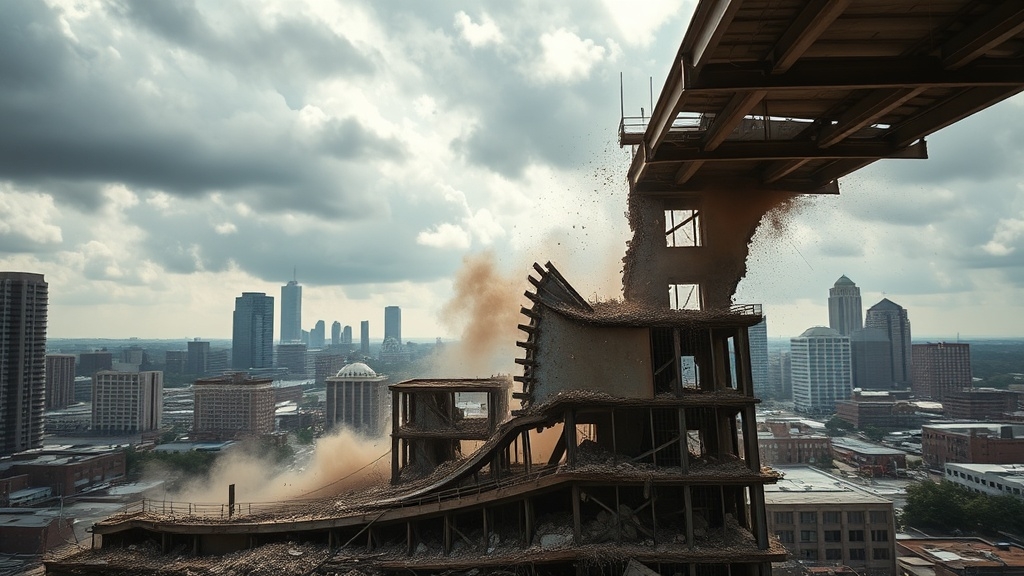
Once-vibrant shopping malls are becoming ghost towns as anchor tenants flee and landlords default in droves, exacerbating the commercial collapse.
The latest numbers paint a terrifying picture for investors tied to retail-heavy portfolios—and the fallout is just beginning.
Is your real estate portfolio about to implode under the weight of retail’s collapse?
Here’s how the dominoes are falling—and who’s bracing for the next hit.
- Shopping mall delinquencies have surged to 14.6%—the worst since 2010.
- Retail titans like Simon and Brookfield are shedding properties to avoid total collapse.
- Investors are abandoning ship—or flipping distressed malls into high-risk, high-reward redevelopments.
Hold on tight. The storm isn’t coming—it’s already here.
Retail Armageddon Rips Through the U.S. Market
U.S. mall loan defaults have entered a catastrophic freefall. In just the first quarter of 2025, shopping center delinquencies skyrocketed to 14.6%, fueled by vanishing tenants and inflation-battered consumers.
This is the highest level seen since the Great Retail Recession of 2010.
New data from Trepp and Fitch Ratings confirms the grim trend: traditional retail is bleeding out—and malls are the first to die.
High-profile landlords are running out of lifelines:
- Simon Property Group and Brookfield have begun deed-in-lieu negotiations on failing assets.
- Vacancy rates in Baltimore reached 42%, turning entire malls into shells.
- Cleveland reported five major mall defaults in just three months.
- In Sacramento, the exodus of anchor tenants has triggered loan covenant breaches.
And it’s not just the old guard. Even fresh tenants like Dick’s Sporting Goods are pulling out, joining the retreat with Macy’s and JCPenney closures sweeping through Tier 2 and Tier 3 malls.
Real Estate Investors Are Making Ruthless Moves
This collapse is triggering an aggressive reshuffling among commercial property investors—and not everyone is losing: This collapse is triggering an aggressive reshuffling among commercial property investors—and not everyone is losing: some are seizing opportunities to acquire undervalued assets in prime locations. Meanwhile, others are pivoting their strategies to adapt to emerging trends, navigating the coliving market challenges in America that come with changing consumer preferences and the need for flexible living arrangements. As a result, a new wave of investment strategies is taking shape, with a focus on innovations that cater to the evolving demands of tenants.
- Private equity firms are buying distressed malls at pennies on the dollar, eyeing industrial and mixed-use conversions.
- Note buyers are targeting defaulted CMBS loans, aiming to seize control through strategic litigation.
- Pension funds and REITs are quietly offloading retail-heavy holdings to limit exposure.
- Multifamily and flex-space developers are already converting dead retail into residential and warehousing hybrids.
For investors with cash and courage, these falling dominos are turning into doors of opportunity.
Federal Reserve Sits on Sidelines as Tax Revenues Risk Collapse
Despite the escalating crisis, neither the Federal Reserve nor the U.S. Treasury has stepped in.
Officials acknowledge the risk but have offered no financial backstop. Local governments and private markets are being told to solve it on their own.
Economists warn this could spill over into municipal bonds, triggering:
- City budget shortfalls
- Service disruptions
- Widespread local layoffs
As malls go dark, the tax base vanishes, leaving some city economies teetering on collapse.
Assessment
America’s malls are collapsing at breakneck speed.
Retail landlords still clinging to outdated income models are getting decimated in 2025, while nimble investors are carving up the wreckage into valuable long-term plays. These savvy investors are not only capitalizing on the missteps of traditional landlords but are also leveraging landlordfriendly market insights to identify emerging opportunities. As consumer preferences shift and e-commerce continues to flourish, these investors are adapting, focusing on mixed-use developments and experiential retail that draw in foot traffic. In contrast, those who remain tied to old income models are left struggling to fill vacancies, facing declining revenues and mounting operational costs.
This may be one of the last great land grabs of the modern commercial era—if you’re bold enough to step into the rubble.
No related posts.














11 Responses
Guys, isnt it time we embrace this retail apocalypse? Maybe its the universe forcing us to rethink our consumer culture. Just a thought. 🤷♂️
Or maybe its just capitalism adjusting to online markets. Everything evolves, not just consciousness. 🙄
Wow, maybe its time we considered converting these ghost malls into affordable housing units? Just a wild thought! #AdaptOrDie
Interesting idea, but whos going to pay for this massive conversion? #EconomicRealities
Is it just me or does this retail apocalypse kinda feel like karma for years of unchecked consumerism? Just a thought. 🤔
Or perhaps its a wake-up call for a more sustainable, conscious economic system? 🌍💡
Are e-commerce giants really to blame, or is this just natural evolution of consumer behavior? Maybe malls were a bubble waiting to burst?
Is it just me or is this retail apocalypse a smokescreen for gentrification? Theyre just paving the way for luxury condos, mark my words!
Apocalypse or not, gentrification isnt always evil. Progress cant be stopped, adapt or get left behind!
The Dead Malls Problem is caused by a combination of factors:
People shopping online. Companies like Amazon and the like are how many millennials prefer to shop.
Too many department store mergers over the years. Back in the early days, malls used to have a lot of uniqueness in stores to each town. Now, it seems like JCPenney, Dillard’s, Macy’s, Nordstrom, Belk, and a few others are left. Some examples of this:
The following chains have merged into Macy’s over the years: Abraham & Strauss, Allied Stores, A.M. Jensen’s, Associated Dry Goods Company, B. F. Ehlers, Bamberger’s, Barnes, Bullock’s, Bullock’s Wilshire, Carter-Hawley-Hale, C.C. Andersons, Capwell’s, Castner Knott Company (partial), Davidson’s, Dayton’s, Emporium, Famous, Motte & Specht, Famous-Barr, Filene’s, Filene’s Basement, Foley’s, G. Fox & Company, Goldsmith’s, H Hackfield & Company, Hale Brothers, Hahn’s Department Stores, H.S. Pogue & Company, Hecht, Henneger’s, Herpolshimer’s, Hess’s (some stores), Hudson’s, I Magnin, J. N. Adam & Company, John Taylor Dry Goods Company, Jordan Marsh, Joseph Horne Company, Kaufmann’s, Kaufman & Strauss, Lasalle & Koch, Lazarus, Liberty House, L.S. Ayres & Company, Maas Brothers, Maison-Blanche, Marshall Fields, Marston’s, May Company, May, Daniels & Fisher, McCurdy’s, O’Connor & Moffat Company, Powers Dry Goods Company, Rambaugh-Mclain, Rich’s, Rike’s, Robinson’s-May, Robinsons, Sanger-Harris, Shillito’s, Shillito-Rike’s, Sibley, Lindsay & Curr Company, Steiger’s, Stern’s, Stewart Dry Goods Company, Strawbridge & Clothier, Strawbridge’s, Strouss, Sycamore Shops, Thalheimers, The Bon Marche, The Broadway, The Denver Dry Goods Company, The Diamond, The Paris of Montana, The John Bressmer Company, The Jones Store, Wannamaker’s, Weinstocks, William Barr Dry Goods Company, William H Block Company, Wolf & Dessaeur, Woodward & Lothrop, Wren’s, and Zion’s Co-operative Mercantile Institution!
Over the years, Dillard’s acquired: Bacon’s, Blass, Brown-Dunkin, Cain-Sloan, Castner Knott Company (partial), Diamonds, De Lendrecies, Gayfers, Hemphill-Wells, Hess (partial), Ivey’s, Joslins, Leonard’s, Lowstein’s, Mayer & Schmidt, Maison Blanche, McAlpins, Mercantile Stores, Miller & Payne, Joske’s, John A. Brown, Joseph Pfeifer, and Selber Bros.
Bon-Ton bought Boston Store, Carson Pirie Scott, Elder-Beerman, Herberger’s, and Younkers. (Now defunct.)
Belk bought McRae’s, Migeobe, Parisian, and Proffitt’s.
Sears was run into the ground. Once regarded as the King of the Malls, Sears was ruined by Eddie Lampert running it like a hedge fund and not a retailer, the growth of specialization in the 1990s, a failed Sears investments division, and a failed merger with Kmart — as told by former executives, managers, and longtime shoppers.
The decline of electronics stores. Part of the reason people used to go to the malls was the presence of electronics stores and the excitement around their products. Smartphones and PCs have since replaced many of those devices, combined with online shopping and digital streaming. This impacted stores like Camelot Music, Musicland, Media Play, Circuit City, CompUSA, Egghead Software, Babbage’s, Electronics Boutique, RadioShack, Suncoast Motion Picture Company, FYE, Sharper Image, Fry’s Electronics, Montgomery Ward, Sears, original AT\&T phone centers (landline), Ritz Camera, and even big-box chains like Staples, Office Depot, OfficeMax, Captron Nintendo, and to a lesser extent Borders, B. Dalton, Toys “R” Us, and Kay-Bee Toys (toy stores used to carry computers and video games).
Leveraged buyout failures. Chains like Toys “R” Us, Payless Shoe Source, Bed Bath & Beyond, and others were looted by private equity firms, burdened with massive debt from leveraged buyouts, and forced into sale-leaseback deals for their real estate. This new debt load often caused the retailer to collapse. Some studies show over a 50% failure rate after a leveraged buyout.
Some chains were sold to real estate developers more interested in flipping or redeveloping the retail real estate assets than operating the stores. This frequently happened alongside leveraged buyouts.
Malls were sold to “mall slumlords” — companies that allow properties to rot before abandoning them. These include Namdar Realty Group, Moonbeam Capital Investments, Kohan Realty Investment Group, CBL, and others. Many of these malls have been demolished with taxpayer funds.
Private equity firms buying retail chains to flip their real estate rather than operate the stores, leading to widespread downsizing of mall retailers.
Changes in Millennial and Gen Z lifestyles — smaller homes, more mobility, and less formality — have influenced the merchandise stores carry and demand for in-person retail.
The COVID-19 pandemic severely impacted malls, closing many food courts and entertainment venues.
P.S. You can see the extent of the damage from America’s dead malls on YouTube channels like: “This is Dan Bell,” “Ace’s Adventures,” “Sal,” “Doomie Grunt,” “Fleabitten Adventures,” “Ray Out There,” “Unicomm Productions,” “Bright Sun Films,” “Company Man,” “Retail Archaeology,” “WallieB26,” and “Dead Malls.”
Stephen, you’re absolutely right! This collapse isn’t just about Amazon or COVID. It’s a long, tangled mess of online retail dominance, department store consolidation, reckless leveraged buyouts, and real estate vultures gutting chains for quick flips. Your rundown reads like a postmortem of retail America. Each merger, acquisition, and closure slowly drained the unique flavor and local charm from malls until they became hollowed-out replicas of one another. The rise of private equity and so-called mall slumlords only accelerated the decay. And you nailed it. This is a generational and cultural shift too. Malls weren’t just retail centers. They were social hubs. And now they’re relics. Thanks for your comment.