Key Takeaways
- Building wealth starts with structure, focus, and intentional systems before chasing deals.
- Long term leverage, inflation awareness, and disciplined thinking outperform short-term tactics.
- Generational wealth requires protection, planning, and clarity, not just acquisitiofn.
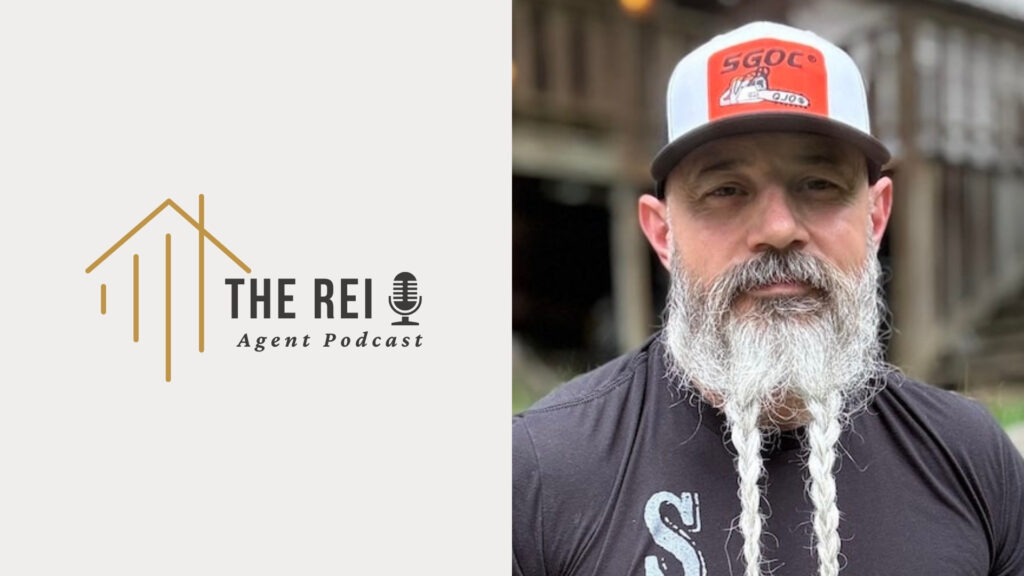
The REI Agent with Aaron Chapman
Value-rich, The REI Agent podcast takes a holistic approach to life through real estate.
Hosted by Mattias Clymer, an agent and investor, alongside his wife Erica Clymer, a licensed therapist, the show features guests who strive to live bold and fulfilled lives through business and real estate investing.
You are personally invited to witness inspiring conversations with agents and investors who share their journeys, strategies, and wisdom.
Ready to level up and build the life you truly want?
Follow and subscribe to The REI Agent on social


When Desperation Becomes the Doorway to Destiny
The episode opens not with hype, but with truth. Aaron Chapman’s journey did not begin in comfort or confidence. It began in desperation, humility, and a moment so raw it permanently reshaped his direction.
Once a hardworking man bouncing between physically demanding jobs, Aaron found himself unable to provide even the basics for his family.
That breaking point became the unexpected doorway into an entirely new world.
“I was dead broke. I couldn’t even afford diapers.”
That moment was not shared for shock value. It was shared to prove something essential. Rock bottom is not a verdict. It is often an invitation.
The Power of an Abundant Investor Mindset
Early in the conversation, a powerful theme emerges. The most successful investors do not treat business like war. They do not believe only one person can win.
Aaron explains that the investing world thrives on abundance, collaboration, and shared growth.
Over decades in the industry, he has watched two types of people take shape.
“The more people I help, the better off I always am.”
This mindset did not just guide his relationships. It shaped his outcomes. Helping others became the engine behind his own success.
Losing Everything and Choosing to Rebuild Smarter
Aaron’s rise was not linear. After building substantial wealth, everything collapsed during the 2008 financial crisis. A devastating motorcycle accident left him unable to walk and stripped his memory. His net worth swung from millions to deeply negative.
Instead of quitting, he rebuilt. Slowly. Intentionally. And this time, with structure.
“I’ve gotten my ass kicked the entire way.”
That honesty matters. It reframes success not as luck, but as resilience paired with learning.
Building the Foundation Before Stacking the Floors
One of the most impactful lessons from the episode is Aaron’s insistence on foundation first thinking. He believes most investors fail not because of bad deals, but because they never build the system beneath the deal.
This includes entity structure, financing strategy, asset protection, and long term planning before buying property.
“If they get started wrong, they never continue.”
He emphasizes that wealth without structure is fragile. Wealth with structure can last for generations.
Infinite Banking as the Quiet Engine of Growth
Aaron introduces infinite banking not as a theory, but as a lived strategy. After rebuilding his credit and saving capital, he redirected his money into properly structured life insurance policies instead of deploying it directly into property.
That move allowed him to borrow against his own capital, invest repeatedly, and create a self reinforcing financial engine.
“This thing became a machine.”
The takeaway is not the product itself. The takeaway is control. Control of capital. Control of timing. Control of risk.
Trusts, LLCs, and Protecting What You Build
As the conversation deepens, the focus shifts from growth to protection. Aaron shares real examples of investors losing everything due to poor entity setup.
His approach layers trusts, holding companies, and state specific LLCs to create separation and legal insulation.
“You can put in all that energy just for it to vaporize to legal issues.”
Protection is not paranoia. It is respect for what you have worked to build.
Leverage, Inflation, and the Myth of Playing It Safe
One of the boldest segments of the episode challenges conventional wisdom around debt. Aaron makes the case for long term leverage, slow paydown, and never rushing to eliminate mortgages.
His reasoning is rooted in inflation and currency devaluation.
“You are paying your mortgage back with cheaper dollars.”
Rather than fearing leverage, he teaches investors to understand it, respect it, and use it intentionally.
Why Cash Flow Is the Cherry, Not the Sundae
A major mindset shift appears when Aaron reframes how investors evaluate deals. Cash flow matters, but it is not the whole picture.
Amortization and appreciation quietly work in the background year after year.
“Cash flow is the cherry. Amortization and appreciation are the sundae.”
This perspective encourages patience and long term thinking over short term gratification.
Focus as the Ultimate Competitive Advantage
Toward the end of the episode, the conversation moves inward. Aaron shares how focus became the deciding factor in his ability to rebuild and create at a high level.
He credits The Master Key System with teaching him disciplined thought and intentional concentration in a distracted world.
“The greatest achievement of distraction is getting people to drift.”
In an age of constant noise, focus becomes a form of power.
Closing Thoughts on Building Wealth That Outlives You
The episode concludes not with tactics, but with legacy. Aaron speaks about children, grandchildren, and the responsibility of those who build wealth to ensure it survives beyond them.
He introduces tools designed to preserve clarity, documentation, and continuity so families are not left confused or fractured.
“You could be the person that changes everything for the rest of the history of your family.”
The Real Definition of Success
This conversation is not about becoming rich quickly. It is about becoming deliberate. About building systems that support life, family, and purpose.
Aaron Chapman’s story reminds listeners that focus beats frenzy, structure beats speed, and legacy beats ego.
For anyone standing at the beginning or rebuilding after a fall, this episode delivers a simple but powerful message.
Start with intention. Build with care. Protect what matters. And never drift.
Stay tuned for more inspiring stories on The REI Agent podcast, your go-to source for insights, inspiration, and strategies from top agents and investors who are living their best lives through real estate.
For more content and episodes, visit reiagent.com.
Articles Related to The REI Agent
- 10 Shocking Truths From the 2025 Global Housing Storm (And How Agents and Investors Can Thrive Through It)
- Shocking Balance Before Wealth (How Erica Clymer’s Holistic Practices Help Agents and Investors Thrive in Global Housing)
- Global Housing Storm (Holistic Solutions to Million-Dollar Dreams, Desperate Sellers, Rising Rents, and Shifting Wealth)
- Top 20 Terrifying Reasons Agents Will Never Be Investors (And How to Fix It)
- 10 Ways to Kill Real Estate Agent Burnout in 2025 (The Holistic Fix)
- Mattias Clymer is Silently Leading a $70M Movement That’s Changing Agent Lives
- Therapy You Didn’t Know You Needed (Holistic Wisdom for Real Estate Professionals)
- From For Sale Signs to Life Design (How The REI Agent Transforms Real Estate Into Holistic Wealth)
- Achieving Holistic Wealth and Success Through Real Estate (Insights from The REI Agent)
- Partnering with Investors (How Real Estate Agents Can Exponentially Maximize Profits)


Contact Aaron Chapman
Mentioned References
Transcript
[Mattias]
Welcome back to the REI Agent. We are here with Aaron Chapman. Aaron, thanks so much for joining us today.
[Aaron Chapman]
Good, I appreciate the invite. I’m one of those types of guys, one of my friends told me, hey, regardless of how you feel about it, you should always take the meeting. And I appreciate that some people give me an opportunity to take the meeting.
[Mattias]
I love it. I love that attitude. And you know, people that, I find that the space, especially in the investing space, doing this podcast now for over a year, I’ve just been blown away with how abundantly mindsetted the people are, that are in the, especially in the investing space.
It just really blows my mind. Like they’re kind of open to opportunities and wanting to share everything they can to help other people. And they kind of, I guess, have learned that it comes back to them.
So I really appreciate you being on.
[Aaron Chapman]
Yeah, in the investing space, I’ve learned over the years is as you, it’s that whole old saying, right? The rising tide raises all boats.
[Erica]
Yeah.
[Aaron Chapman]
And if you’re part of that raise, right, you definitely benefit. But I’ve watched the people who believe that business is like war, who only one person wins, but they don’t win either. They suffer just as much.
They just suffer a little bit less destruction than the other person. Then they go after another person and another person till they don’t have anything left. So I’ve found over the 20, I’ve been doing this since 97.
So over this period of time, I just found the more people I help, regardless of how many times I get screwed, the better off it always is.
[Mattias]
I love it. I could go down a tangent on that, but I’m gonna start off by asking Aaron, who are you? What do you do?
Give us a bird’s eye view of your impact in the real estate world.
[Aaron Chapman]
So I, honestly, I’m just a normal average son of a bitch as far as I’m concerned. But I started off my life in, when I started really working, it was cattle ranching in Utah. Then from there to the oil fields of Wyoming, to running heavy equipment, to driving truck, to the mines of Northern New Mexico.
And then they shut down that project because the market was not paying enough for the mineral to get it to the surface. So I went back to Arizona from New Mexico. I had a wife and infant son.
I’d be gone for 13 shifts, back for six, and thought I could find a job easily anywhere. And I couldn’t. I kept getting hit with this thing called overqualified.
I didn’t understand this word at 23 years old. And the day that I finally broke, I was going to attempt to get a $10 an hour truck driving job to haul landscape rock. And at this place, I was met with the same response, overqualified.
And I asked this guy, I’m like, what does that mean? I’ve been told this over and over and over again. I don’t understand it.
He goes, it just means that you can basically get a job anywhere. And that I might give you the job in a week, you’ll quit and go get a better one. I’m like, dude, that’s not what’s happening.
He goes, I know I get it, but I just can’t take the risk. I left there, you know, wiping tears from my face, heading to a grocery store for a coupon, with a coupon for free diapers, because I was dead broke. I couldn’t even afford diapers.
As I’m driving there, my gas light comes on in my truck. So then I found the closest grocery store that had a gas station outside. This is 1997.
All I had was a debit card. I pulled up to the pump. I swiped my debit card, and I’m saying a quick prayer, hoping that it would work, knowing I was overdrawn.
And I got a decline. So I had to rifle through my truck, thinking I’d find a dollar, maybe. I found a couple of coins.
I locked the doors. I walked out of the parking lot for what seemed like a couple of hours to find enough change to get a couple gallons of gas so I could get home. Went inside, found my diapers.
I stood in line. With that embarrassing situation, I hurried up and paid for them. I got out of there as quick as I could.
And then as I’m leaving, I heard the worst word I could ever hear was my own name. Somebody recognized me in that position I was in. And as we got to talking, he invited me to dinner.
And it was at that dinner, he introduced me to the industry I’m in in 1997. And I haven’t looked back. I mean, I started off as a telemarketer.
Miserable as all hell, telemarketing was just not an easy thing for me, but I got to learn the lingo. And now, however many years later it is now, what, 28 years later, I’ve achieved, at one point, the number one person in the industry of over nearly a million people that do real estate investment loans. And in the number, actually, number one in real estate investment lending, and then number seven in the industry as a whole for transactions closed.
So I’ve been very, very blessed, but I’ve also got my ass kicked the entire way.
[Mattias]
Wow. So you are, your niche is primarily investor loans then as a lender?
[Aaron Chapman]
Yes, and so that was a long story to even not even answer the question, right? So yeah, so primarily as an investment lender, I mainly focus on the people trying to get into it and then expand their holdings, especially in the single family, duplex, triplex, fourplex space, smaller apartment complexes, eight to 16 units. And the reason I focus there, because that’s where people are trying to start.
And if they get started wrong, they never continue. And I’m all about making sure that people get a good start, they get their foundation laid, where they know how to have the right financial structure, the right entity structure, the right, and I’m big into infinite banking. When you set that up front before they even buy, get a solid foundation all the way to bedrock.
So that way they can stack those floors to their skyscraper and it not fall down on top of them. Think about those folks that build all this stuff and then something happens to them and their family doesn’t know where it’s at. And they don’t know how to access any of the things and then they lose it to probate or they lose it to taxes or to mortgages that have to foreclose because they didn’t know who to make the payment to.
That happens. It happens a lot. There’s millions of probate cases every year.
I’m solving that problem too. I’ve actually already solved it. So for less than 99 cents a day, I can prevent that from happening to anybody.
So there’s a lot of things we’re working on for the sake of the real estate investor to build that and then pass it on to the coming generations because I don’t think the next generation, my children or my grandchildren, I have three of them, have a shot at it if I don’t do something about it.
[Mattias]
Yeah. Wow, that’s powerful. And so then on top of the lending side, you invest as well yourself, right?
[Aaron Chapman]
I have investments in six different states, different properties. I have ownership interest in over 200 doors, multiple projects going on right now. I started investing in 2003, I think it was I bought my first investment property.
I lost everything in 2008 and ended up in a position where I had gotten a motorcycle accident in 08. I woke up in the hospital with the inability to walk. Wow.
My memory was wiped out. I lost everything. I went from a net worth of nearly 4 million to a network of negative 1.5 million and had to crawl back in the industry in 2009. It was quite the endeavor.
[Mattias]
Wow. I don’t even know where to start with you, Aaron.
[Aaron Chapman]
But… It can’t be at the beginning because it branches off. It’s like a glitch the way my story goes because it goes so many directions.
What’s interesting, people will get into a conversation. Be like, how did all that happen to you? Like, you’re not that old.
I’m like, I don’t know. I just thought I lived a normal life. I just thought broken bones and busted this and going broke four or five times and battling these things was a normal person.
Come to find out it’s not.
[Mattias]
Yeah. Well, I mean, the first thing that if anybody’s watching this is I wanna know where you’re at because you’re in like this log cabin looking place with bows and some deer heads mounted. Are you in an old cabin?
[Aaron Chapman]
I am. This is actually a cabin. This used to be a little church in the Ozarks that a pastor would come and have people come in.
They call it the little Sistine of the Ozarks because he had all his paintings hanging there. But these logs here are original hand-drawn logs from the early 1800s. I’ve got another cabin right next to me.
There’s a deck between them that was in the late 1800s and they’ve been here for, I don’t know how long of this, eight acres. And I ended up coming across this because of something I did. I wrote down to myself what I wanted to accomplish in 2017.
And I made a sentence in there that referenced the Ozarks, a porch and a rocking chair. And within two months and two days, I was forced into having to come into Missouri to find a location to buy it, to get my license back online because I needed brick and mortar to the state. I ended up owning these two cabins and here it is.
It’s an amazing place to be.
[Mattias]
So speaking of being licensed in states, are you a nationwide lender then or are you focused on certain areas?
[Aaron Chapman]
30 states, the ones where people are still buying and building their business up at.
[Mattias]
Okay, awesome. Yeah, okay, so I do, some of the things that you just mentioned makes me want to ask for you to maybe lay out a blueprint, a roadmap, if you will, for someone. So in the book I’m writing or in the editing rounds, I know that you’ve written a book, we can talk about that as well.
I’m encouraging agents to invest in real estate or it’s really geared towards somebody that’s kind of getting started in real estate and they’re wanting to become an agent and wanting to invest along the way. I think that so often agents don’t really invest in what they sell. They might own their own house but they don’t often own property as well as rentals.
Lay us out a blueprint because you had some clear steps that sounded like that to have that rock solid foundation. And if that’s starting with infinity banking, please, but what would be a good way for somebody to kind of get rolling?
[Aaron Chapman]
I love to share stories, if that’s cool.
[Mattias]
Yeah.
[Aaron Chapman]
So the infinite banking thing, so I referenced the crash I had in 08 where I was in a wheelchair for a window of time. I had to do like everybody else, negotiate with your creditors, right? But I was lucky in the sense that I’m sitting in a wheelchair, I’ve got a memory that recycles every three minutes and I had a just one, my first bill was $1.7 million for my first week in the hospital. So I could fax that to a creditor and they would back off real quick and they’d be like, how can we help? So I got to keep my house and a couple of cars but I lost all my investment real estate and a lot of my other things. And as I started to build back up from all that, I went from that 460 credit score with a negative net worth of 1.5 million in 2009 from my August of 08 crash to 2016, I had paid everybody off, got a 740 credit score with 90 grand ready to invest. I’m like, I’m going back into the real estate investing. And as I was doing contracts, I had heard this rumor that one of my favorite clients who was also the captain of the USS Tucson nuclear submarine, he was an instructor at the Naval Academy and then at the time I was working with him, was worked for the chairman of the joint chiefs at the Pentagon overseeing all weapons for the military. I’d heard he’d retired from the Navy early before becoming an admiral because he was on his way to sell life insurance.
And all I knew about life insurance at that point is that’s the way they screw you. Because I got screwed every time I did life insurance before that, got sold on it and lost money. And it was just, it was always a bad move.
Well, I called him up to ask him what the hell is wrong with him? Because that made no sense to me. Why would you leave an amazing career to do something so stupid?
And he said, do you mind if I just share this whole thing with you, but I won’t share it with you till you get your wife on a video conference call. So October, 2016, I’m in a cabin in Northern Arizona with my family over my birthday weekend. And he shared with me how infinite banking works.
And I took that 90,000 I was going to invest in real estate and I ended up buying it a life insurance policy on me for $2.7 million. And then from there, that 90,000 I put in to buy that policy, I had about 83,000 available to me. Well, I didn’t need the full 83,000 to buy those 3,000.
So I took what I needed, bought those three houses. Then I took the cash flow from those homes plus 10% of my income. I started knocking down the balance on that 83 grand, right?
Till it got down, you know, 20, 30 grand. I borrowed again and bought another place and another place that turned into this machine. It continues to grow.
So from there, my bank, this thing’s the holy grail. So I got a policy against each one of my children, a policy on my wife, and then another policy on me. And so we set the foundation of our family to be sure that we had insurance policies that would protect the family from any loss within any member of the family.
So from there, I decided, okay, what do we do from here? So I create a family trust, the first in my family’s history. And we create the trust and then holding company in Wyoming and then LLCs to handle all the assets.
Well, then I opened it up to my children to show them what we had and what we were doing. So they became part of the board and they have to do certain things to be part of that board. You have a vote on what we invest in as long as you maintain certain things.
We set those requirements. And now I have three married children and one who’s left in the house who just graduated. I’ve got three grandkids.
Three of my kids live in, with their spouses, live in houses owned by the trust. They pay rent to the trust. I pay rent to the trust.
In fact, this house, it’s property we rent from the trust on top of my others. But we also put $200 per property into the middle as a warranty. So that way we build up that asset.
So if an AC breaks on a house, we already know where the money’s coming from. So that’s one starting point where I help people get looking at this from this perspective of, set the foundation of infinite banking. Then let’s look at a family trust, holding companies, at least a holding company, at least a trust and a holding company.
If not a trust, at least a holding company. And then at that point, when you go to buy investment real estate, let’s get an LLC in that state that’s owned by the holding company or started by the holding company. So if you have a Wyoming holding company, let’s say that starts an LLC in Tennessee, that buys a house in Tennessee, and something happens, when they go to look into who owns that home, it’s owned by an LLC.
They look to see who is the member of that LLC. It’s another LLC. They try to crack into who is the member of that LLC.
You don’t know. It’s not published. You have to actually get a court to determine that it’s worth cracking into.
So you put some barriers in there. Well, then it gets to the point of financing. So if you built that out, now let’s finance that property in that LLC.
I’m big into leveraging it as high as you possibly can. Leverage it long, pay off slow. Never pay extra.
Never do the debt snowball. Pay exactly what the mortgage payment is because of what’s happening with inflation. We can get into that later.
Well, the type of loans that we do, the DSCR loans are the most popular loan we’ve got right now. So you can get 80% loan to value to your LLC with interest rates in many cases, as good or lower than what Fannie or Freddie would do. So now you’ve got an LLC that’s financed the property that doesn’t appear on your credit in most cases, not all the time.
So you can keep building this up. And then I’ve got a software that I had developed so that way families can keep track of this. It looks like an org chart.
So when you log into it, you have yourself, your trust, your holding company, and then every entity, just like an org chart tied to it. You can click on it, open it up, all the paperwork’s in there. If you click on the assets associated with it, whether it be a bank account or whether it be a property, it has all the paperwork there too.
Nothing ever gets lost. It protects your family from losing what you built and protects you from putting all that energy in just for it to vaporize to legal issues. So that to me is the best start point.
I know I ripped through that real quick. I know some people will say, how do I find the attorneys in different states? Well, I’ve solved that problem.
I’ve got a relationship with a law firm that’s in all 50 states that cuts my clients a very, very big break. They will take one of my clients and they’ll set up unlimited LLCs. Start with your holding company, then any LLC you want, any property, any state in the United States for one flat retainer fee, a one-time retainer fee of like 3,680 bucks.
You pay in the retainer, they will keep doing your LLCs in perpetuity. And then if you want to do a trust, they’ll do a trust for you that’s less than half what I paid for my trust. So I’ve got a great relationship there.
They got a sister company, which is an accounting firm. And the awesome thing about this is the accounting firm talks to your law firm. Your law firm talks to your accounting firm and they both talk to your lender and you to make sure you remain bankable and continue to grow.
Too often I see people, here’s my accountant over here and I got multiple different attorneys and nobody talks to each other. I’m the middle man. I don’t understand their two different languages and they just create messes and spend money unnecessarily.
I got sick of watching that. So I’m changing it.
[Mattias]
Yeah. Yeah, I mean, getting started myself in real estate sales and investing, one of the things I read about over and over again was assembling your team and how important that was. And it wasn’t really until I had some good players in those roles, I didn’t really understand how valuable it is.
And I really agree that that stuff is huge and having them talk to each other is great. Being able to have maybe a meeting where they’re all together, for example, could be an awesome thing too.
[Aaron Chapman]
Oh, we do that all the time with Zoom. That’s when we’ll get like whole families on, right? Somebody says, oh, this is great.
I want my dad and my husband to hear this and my oldest son and my daughter. So we’ll bring on whole families with the law firm and with the accountants. We’ll talk it all out.
We’ll lay the whole thing because I want everybody to feel confident in it. And you said something very, very big that a lot of people don’t realize, it’s the team. No successful CEO has ever built a successful company because the other members of the board and the other members of the executive team were willing to take minimum wage.
They got the best they could and what they could afford to make it happen. And that’s the same thing when it comes to what you’re doing here in investment real estate. Shopping lenders, because if you go online and see who’s got the cheapest rate, you could be setting yourself up for a very, very poor experience and a really poor outcome because they’re not helping you coach your way through what might be a bad investment.
And you’ve got somebody like myself with 28 years experience working with investors. I got staff members that have been doing this for over 40 years and that you get to tap into for virtually free because you’re not paying any more to tap into that to us than you are any other lender. On top of that, what other resources can I get you?
The other lenders don’t have this relationship with these lawyers. These other attorneys might charge you $1,000 per LLC. You get five deep, you’re already five grand into it.
With these guys, you do 10 of them and still be the same flat fee of 3,680 bucks.
[Mattias]
Yeah, yeah, no, it’s true. And when you’re dealing with things like, I’ve often heard about tax strategy as a way of giving yourself a raise. So ultimately, if you think about earning more money or paying less in taxes, paying somebody to streamline your tax strategy I think is invaluable.
Saving yourself from the pains of lawsuits if somebody discovers that you own this property that they slipped and fell and broke their hip at or whatever, they’re gonna come after the property that you come after you if they figure out how much, if you have a lot of assets, et cetera. I mean, it’s worthwhile to pay for these things. So it makes a lot of sense.
[Aaron Chapman]
I’ve got a friend of mine that she had multiple properties. She had three different LLCs. She got busy.
So she’s putting multiple properties in the LLCs. She had one LLC that she put three free and clear properties and two leveraged properties and then bought a lot in Florida and stuck in that same LLC. And she meant to start a new LLC in Florida but just got busy.
And then the contractor who’s supposed to build the house in Florida ended up building a third of it but not paying the subcontractors. They came after her because she benefited from what he did when he disappeared. They sued her for over 600 grand.
They leaned all the properties that were in that LLC. That’s why different LLCs is an absolute necessity. She worked her way through it, but man, they had liens on her three free and clear properties up to 600,000 bucks.
It’s protect yourself and it’s a small price to pay because we live in a world where people want what you have and they don’t wanna put in the time, the pain or the energy that you did to get it.
[Mattias]
Yeah. So are you in the camp of having an LLC per property?
[Aaron Chapman]
If you’re highly leveraging them, maybe three per LLC at maximum, but I also am big on levering, levering, levering. Don’t ever let all that equity sit in the house. Unused equity is useless equity.
People fail to realize that you’re also giving yourself a raise by leveraging the house or the investment asset to the maximum and keeping that capital for yourself because somebody else pays it off, right? And they’re paying it off in the deflating instrument like the US dollar. If you recalculate paying your payment on your mortgage based upon the value of the dollar as it declines over the 30 years, you actually pay back less than what you borrowed.
You know, when you do look at the amortization table, say on $160,000 loan, you’ll pay 400 grand in $160,000 loan. But the value of the dollar declines. Go back 30 years ago.
I walked into my very first Taco Bell. I could buy two crunchy tacos, two bean burritos and a drink for $1.99. And I remember this because it was 1994. So it’s 31 years ago.
Now that exact same thing is 14 bucks. The tacos didn’t get bigger and they didn’t discover them to be a superfood. It’s because the dollar’s worth that much less.
If you apply the exact same math to your mortgage, you won’t pay $402,000 on $160,000 loan. You’re paying $154,000. There’s a big difference when you understand the value of the instrument you’re returning the payment with.
So leverage high, leverage long, payoffs low and never, ever pay extra on your payment. Just don’t do it.
[Mattias]
That’s good. Okay, so what about, and one of the things that you’re talking about there is the return on equity. I think people often don’t factor that in.
I think they might do cash on cash analysis, just kind of return in general. But if they have a large amount of equity in a property that let’s say it’s $200,000 of equity in a property, they’re not really thinking about what’s the return they’re getting on that $200,000 because if they deployed that somewhere else, yeah, they could maybe get 7% if they’re only getting less than 1% depending on how that all works. So walk me through if somebody is in a position where they have high equity on a property and they have a really low interest rate and why does it make sense to tap into that through a HELOC, a RELOC or refinancing money out?
What’s your thoughts on that?
[Aaron Chapman]
So I get where people are with their, with the low interest rates they got, right? I’ve got somebody, I’ve got clients that come to me and say, hey, I’ve got this $75,000 loan at 4% and I’ve got literally 200,000 equity. I don’t wanna tap into that because I don’t wanna lose my interest rate.
I’m like, it’s $75,000, right? When you tap into that $200,000 in equity, what are you gonna do? Now we can only go to 80%, but if we’re tapping in, we’re pulling 120 grand out, what can we do with that 120,000?
Well, we can redeploy that into what? Probably five, let’s say four properties, you put that into. Well, if you’re levering all these properties up, what we’re failing to look at, so I think the biggest failure people have in calculating the value of leveraging real estate is they’re so caught up in what you mentioned, the cash on cash return, right?
Instead of looking at what they’re getting, let’s just break it down to one deal. One $200,000 property, you’re gonna put 20% down, that’s $40,000, right? So you’ve invested 40 grand.
You have a $160,000 loan. Well, if you take 160,000 divided by 30, which is how long it takes your tenants to pay it off, that means your investment of 40,000 is going up by however much it pays down on the average over that 30 years, which is $5,333 per year. That there is equivalent to 13% of what you put down.
So literally, your down payment investment of 40 grand is growing by 13% per year just because somebody’s paying off the mortgage. Well, if you factor in costs, even $10,000 in costs, like between the lender fee, title fees, appraisal, taxes, insurance, even if it’s that high, that’s 50 grand, that’s still a 10.6% increase in what you’re getting every single year because somebody’s paying down the mortgage. That’s not factoring in that that now the house is, say, appreciating at 2.5%. 2.5% of 200,000 is another five grand. You invest at 50,000, that’s another 10%. Before any cashflow, you’re at 20.6% return on investment. So when they look at what can be done by leveraging and spreading that out, now you’ve got, instead of one house with all this equity, just making you a little bit of a return because you only have a $75,000 loan, but spreading over four more properties that are now making 20-plus percent just in the amortization and the appreciation of the property, plus the one your in’s got appreciation and amortization on the one you borrowed, you can see that it’s almost incalculable what your return is. That one loan, when you pulled that cash out, that 120,000, spread it over four other properties, whichever that might be, or 200,000, I’m not doing the math in front of me, but if you bought multiple properties with that, you can see that you’re getting 20-plus percent on every single property.
But 20-plus percent would mean that that’s your money that you invested. But you borrowed that money on property one, so in reality, it was the bank’s money, and the tenant in property one is paying it back, and you invest it in other properties that’s being paid by the tenants. In reality, there is no way to calculate that.
It’s an incalculable return because you didn’t put a single dollar up of your own money.
[Mattias]
That’s amazing. And then on top of that, if you’ve successfully done the BRRRR method to begin with, then you really, really have.
[Aaron Chapman]
Dude, get me started on the freaking BRRRR, man. And I’m doing a lot of those right now with people, where you go in there, and you get hard money to pay for the property, and then you refinance it, get the hard money loan paid off, and you have no money tied up in it, maybe three, four, 5,000 bucks. I have some guys, maybe nine grand on a $200,000 house.
You’re 4.5% in the deal. The return is something stupid, like you’re making like 180% return per year. It’s insane.
[Mattias]
Yeah, so not to go down a crypto rabbit hole too much, I got interested in it the last bull cycle, like a lot of people did, and was interested in it, listening to a lot of YouTube videos, trying to wrap my head around all the different things, and it was just this bull market craze happening, right? And at one point, I added up how much return I was getting on my real estate investments, because that’s all we talk about in the crypto space. And I was realizing that with the Burr properties factored in and how little, my first property was the house I lived in, put 3.5% down and asked for closing costs, and how I have basically had like a 700% return at that time for what the money I invested in real estate. And I was like, why am I watching all these YouTube videos? Not that I don’t think there’s a space for crypto. I just was like, this is obviously what I should be focusing on if you just look at the rate of return.
It’s amazing.
[Aaron Chapman]
I have crypto, I’m with you, I’ve got it, right? I’ve got crypto, I’ve got precious metals, I own other businesses, I’ve got stocks, my stocks are getting just crushed right now, and I’ve got real estate. And to me right now, cash flowing business is where it’s all at.
When I go to the grave, I’m coming in hot. I’m not stopping, but I’ve got hopes for crypto. We’ll see what happens.
I’m loving what Silver is doing right now. I’m more than tripled by what I’ve put in it, which is awesome. So it’s an interesting, fun thing, and I tell people when you’re doing it, do it for the love of it.
Don’t expect it to be, the passive real estate investing I think is one of the most mislabeled things. The other mislabeled thing I think that is people going off of cash on cash being the one thing that you’re gonna be focused on. That’s the cherry on the sundae.
That’s not the sundae, right? The sundae is the amortization and the appreciation. The cherry is getting the cash flow.
[Mattias]
When I think there’s also, I mean, one of the problems I have or one of the things I would wanna talk to you about with what you laid out is what people should do if they are starting off and they don’t really have money just to buy a property outright, like in an LLC. So I mean, we talked about the BRRRR method. So that could be an option, right?
If somebody’s able to, that might be scary for some to start off with to take on basically a flip, use other people’s money to fund the deal and then refinance it after it’s done. And instead of realizing the profit by selling the house that you’ve created through the flip process, you would actually refinance the money and then the profit would basically just be the down payment or the equity in the deal and you would finance the rest of it. And you’d now have this rental ideally for no money, like invested down yourself.
You’d pay off your lenders, et cetera. That might be an advanced strategy. I think the house hack, the getting an FHA loan, getting some sort of loan where you’re the primary resident to begin, maybe renting out part of it, maybe renting or just living there until you have enough money saved for the next one and then turn that into a rental might be a way to go for some people just to kind of get started.
They could start tapping into the equity once that’s built up to do more advanced strategies like we’re talking about. But what should they do? I mean, if they were to then, they can’t buy that property in an LLC if they’re gonna live in it, right?
Correct. Am I wrong? I mean, with that kind of loan.
[Aaron Chapman]
Well, you can’t use that particular type of loan if you’re gonna live in it, right? Because there is restrictions. And one of the big restrictions comes from the Dodd-Frank Act, right?
We have to, if it’s a person’s primary residence, you have to have to show the ability to repay. If you can’t, don’t show the ability to repay what should be their income to service the debt, then anything we do would be considered predatory because of all the people that complained about getting these loans that they shouldn’t have gotten because they couldn’t afford it. And the lender knew they couldn’t afford it.
No, you guys freaking demanded it, right? The market demanded. And the government demanded that we got people in houses.
That doesn’t mean that the bankers weren’t greedy as hell. I’m not giving them a pass, but it was a combination of everybody. But now we have to say, you have to qualify to pay for this or have somebody else who’s gonna vouch for you and put their name on the deal too.
We have to show income. Now, when you’re talking about the DSCR products or the products we can do your LLC, it has to be a true investment. You can’t move into it.
Otherwise, it ends up being referred to as fraud for occupancy. That’s the two big things that the federal government’s looking at, fraud for occupancy and fraud for profit. So they’re watching those two things.
I am very, very big into the flipping thing. If you have the ability to get in with a good group to teach you how to flip, but understand which ones you wanna keep. Every flipper out there has a list of houses, like, damn it, I should have held on this one and this one and this one.
So what we do is we help you structure the system. I’ve helped people do that. You get your flipping entity, you’re gonna be buying and flipping with this one, but then you wanna have your holding entity that’s gonna buy it from you.
So you’re gonna be flipping from LLC, flip LLC is buying and flipping houses, but hold LLC, like, I like that house. So flip LLC can sell it to hold LLC and carry a note that hold LLC refinances, it pays it off, owns this one practically for nothing, right? So you can literally do your own births if you set up a structure properly.
I do that with folks, I help them keep those. Now, you may not be able to do that out of the gate, and especially an unseasoned investor, they wanna keep all of them. No, you gotta learn to let go of them, be very, very, very agnostic to what you hang on to until you get some underneath your feet, get your, earn your chops a bit, and then say maybe property, make sure you get it done by property 10.
Property 10, that’s when you start looking at those numbers. Does this one make sense to keep? Nope, let’s go to property 11.
Nope, oh, property 12, that’s the one. But you’re in a position now, you can do that deal, carrying notes, setting up the note and the deed of trust, and we can refinance that note and deed of trust from one entity to the other.
[Mattias]
And the person probably, if they do have a bit of a portfolio, let’s say they’ve house hacked, they’ve gone, they bounce around three different properties. They have two rentals, they’re living in the third. They shouldn’t really necessarily put those properties into an LLC that’s then owned by the holding company either, right, because then that’s kind of traceable to them?
[Aaron Chapman]
Oh, it is traceable, but it can’t, yeah, I mean, I would put it to a different company. I’d have them independent, not necessarily tied to the holding company.
[Mattias]
Okay, yeah, okay. Okay, that makes sense. But no, that’s interesting, because I mean, I think a lot of times, especially if your primary objective, if you’re not like a, I’m gonna be a real estate investor, that’s my main thing.
If you’re like, I think there’s a lot of people out there that should probably just get into the game, right? I mean, like if they’re a real estate agent, they’re really doing well with sales and they wanna start building up a rental portfolio, for example, or like a doctor or a successful pharmacist in town. They just wanna kind of start investing in property.
I think there’s just, I forget exactly where I was going with that, but I think it’s a- I think where you’re heading is people just need to get off their ass and do it.
[Aaron Chapman]
Quit jerking off and just do something, right? But don’t just say, I wanna invest in property, go buy one. You’ve gotta make that determination.
I’m gonna go invest in property, I’m gonna get a minimum of five and then I’m gonna see what happens from there. And that’s what I was gonna- Doing just one doesn’t work.
[Mattias]
Yeah, that’s what I was gonna get at too, is like, you know, if you’re, especially if you’re in a market, this is what we were talking about earlier, like, you know, if you’re in an appreciation heavy market, the numbers may not work quite as well as far as cash flow goes. And, you know, I think it is wise to try to make the business sustain itself at least. But it may be a little bit lean at the beginning until things move a little bit along and rents go up, et cetera.
But I think, you know, if you’re in a cash flow heavy market, tapping into buying, like having five, and if you have them managed and you just kind of forget about them, I think there is advantages and you should, you can look at what you could do with your equity above. But just even just having five property by the time you retire, I mean, that’s a huge game changer, a huge difference. And that doesn’t necessarily take a ton of focus from you.
I mean, you could maximize it way further, like you’re talking about, but that’s certainly better than not having any rentals.
[Aaron Chapman]
Agreed. I think people need to just, you know, set their bare minimum, decide that I’m gonna move forward regardless of whatever happens till I get that bare minimum, then I’ll decide at that point if this is for me. And just, I just tell them to quit, don’t listen to the people say this is passive.
There’s no such thing as passive anything. Any business you’re gonna do has to have activity in it. And that activity is what’s gonna make sure that one, you’re learning, you’re gonna be more discerning about it.
You don’t just take any deal that comes along, understand the deal. The problem with focusing on cash on cash is you’re gonna look at houses, they’re gonna be showed just awesome cashflow, but most of the time they’re in a neighborhood it’s gonna take every bit of that cashflow just to keep the property alive and maybe a little bit from your pocket and they don’t appreciate, they’ll barely amortize because you’re only buying $80,000 homes. So you’re not seeing that real, real big amortization.
There’s gonna be a sweet spot you’re gonna have to be able to go out there and find and there’s always deals. The one main reason I tell everybody you got into it now is because we’re going into a high inflation period. They just stopped quantitative tightening in December 1st and Powell yesterday was saying, we’re gonna start quantitative easing again.
By doing that, we’re pushing inflation higher and inflation is gonna get more and more out of hand. What that does is it makes your buying power continue to shrink and it has the assets that you have continue to grow. I have right here, I keep this to kind of illustrate to people, right here is a one ounce gold coin.
Is a 19, excuse me, an 1888 gold Liberty. Is minted for $20. So I also have 20 bucks right here.
What’s interesting is I can’t buy this with this 20 bucks. They’re not the same. Even though it says $20 on it, it’s not the same $20.
Back in the early 1900s, I could walk in with this 20 bucks into a department store, get a hand tailored suit, a hat, a shirt, a tie, a belt, a pair of socks and a pair of shoes. I can’t buy my socks with this 20 bucks. They’re nice socks, but still it’s a pair of freaking socks.
What’s interesting is the clothing has not become more expensive and the gold does not become more valuable. This has become worth less. That’s why.
So over that period of time, as this is devaluing, the assets you have are continuing to grow or at least have value that you will get more of this for it. So people need to wrap their head around the fact that having those assets, when you get the tax deductions, you get somebody else paying the asset off for you. You acquire it, but somebody else pays for it.
You get the appreciation, you get the amortization, you get the tax benefits and you get the cashflow. It’s kind of hard to screw that up unless you buy just some, forgive me, but St. Louis shit box that you should never have picked up to begin with. So you gotta be careful where you go and what you buy.
I’m not saying St. Louis is a bad place. I’ve just used that because it rhymes a little bit better.
[Mattias]
No, it’s so true. Yeah, that’s a really good metaphor and a really good, it really helps explain that in easy terms that follow. Real quick, before we get into your golden nugget, I do want to, I mean, that was kind of a golden nugget, literally.
[Aaron Chapman]
Yeah, you can’t get much more golden than that nugget right there, right?
[Mattias]
Can you just briefly explain to people who may not understand what a DSCR note is? Can you just kind of quickly explain that to somebody who may not have heard of it?
[Aaron Chapman]
So that is the debt service coverage ratios, what DSCR stands for. So what they do is they take the ratio of the debt service, which is debt service would be your principal and interest payment, plus the taxes, plus the insurance. And then they figure out what is the ratio of income to that debt or expense.
As long as it’s one-to-one, if you got $1,000 a month payment between the principal, interest, taxes, and insurance, and it rents for a thousand bucks, that’s a one-to-one ratio, we can get that loan done all day long. If it’s more than that, let’s say you’re making $1,200 on that thousand, now you’re at a 1.2-ish, right? So that’s even better.
So it actually improves the terms, the rates, or costs, right? We’re doing 30-year fixes, two-year LLC. What makes that awesome is, like I said, I’ve been at this for 28 years.
And for 25 of it, people are like, why can’t I get a 30-year fixed loan to my LLC? Because it’s not you, it’s a separate entity. There’s a reason why, it’s limited liability.
We can’t go after you. It muddies the ability to get paid back. Well, now they’ve found that if you got this debt service coverage ratio right, and they’ve been testing it over the years, about a decade now, for like five-year loans and 10-year loans, now they’re doing 30-year loans on it because they’re that confident in it.
So take advantage of that fact that as long as you’re finding properties that’ll rent for more than what the payment is, it’s definitely worth looking closer into. It’s another level of underwriting for you. Why would you wanna buy a property that’s not gonna at least rent out for more than what you’re paying for?
Let the lenders look at that too, because we’re gonna be really, really detailed about that. You’re gonna end up taking somebody’s, if you’re newer, you’ll see a pro forma, which in my opinion is an old Greek word for bullshit. If somebody makes up numbers that they’re guessing is gonna work, the lender wants to understand that those numbers will work before we end up funding on it.
So it’s a level of protection for you.
[Mattias]
Yeah, and that involves typically an appraisal that will look at rent comps as well as the sale comps. Is that accurate?
[Aaron Chapman]
Exactly, because often you might be buying a house that just got rehabbed or just got built. You don’t have a tenant yet. So we’ll have the appraiser do a rental income survey in the area, so Form 1007, and they will tell us what comparable rentals are out there and give us an average, and we’ll use that as the basis for doing the loan.
[Mattias]
Awesome. Well, let’s go ahead and ask about the golden nugget. If you have another one, did you bring any more gold coins for us?
[Aaron Chapman]
No more gold coins, unfortunately, but I will say, if you’re listening to this, this is definitely a huge gold nugget. And if you’re thinking about building your investment real estate and building your entities, I talked a little bit about that software. Go right now, type it in right now to the QJO Entity Vault, and we’ll put that link in the show notes, I hope.
The QJO Entity Vault, and I have a video on there. You can watch how it’s built out. It’s simple, it’s intuitive.
If you grew up like I did in the 70s and 80s, you remember Sally Struthers talking about for less than a dollar a day, you can save a child from hunger. Well, for less than 99 cents a day, you can save your own children and grandchildren from losing out on everything that you built. And you could be the person that changes everything for the rest of the history of your family just with that particular software alone.
[Mattias]
I love it. And what about a favorite book that you think is either fundamental for everybody to read or maybe one you’re just currently enjoying?
[Aaron Chapman]
The greatest book in history, in my opinion, outside of scripture, is called The Master Key System. Have you ever heard of that one?
[Mattias]
No.
[Aaron Chapman]
So if you’re reading Napoleon Hill’s books, he talks about the master key. Well, there was a correspondence course created in 1910 by a guy named Charles Hamill. I have that book in my backpack here.
I’ve carried it everywhere with me for about 10 years now. And I’ve carried it hunting in New Zealand and in Alaska and all over the place. And I’ve been through this system several times.
And what it was, this correspondence course, you would write in, get your lesson. And you would read that lesson every day for a week and do the mental exercise associated with it. And then go on to the next lesson for another week.
It was 24 weeks of training your brain on how to focus. Now, if you’ve ever read the book, Outwitting the Devil by Napoleon Hill, that was a transcription, supposed to be a transcription of Napoleon’s actual conversation with Satan himself. And in that conversation, the devil tells him that his greatest achievement is influencing man to drift, meaning they don’t focus on anything.
So the ability with the master key system to be able to focus your mind and push out all other thought and then understanding that the way that the devil wins with 98% of the population is to influence them to drift and not concentrate on any one thing, you start to understand how valuable it is to go through that system and understand how to get your mind to focus.
[Mattias]
What an antidote to the TikTok real world that we’re in.
[Aaron Chapman]
Oh, no kidding. And I’m just as guilty. This damn thing, I can sit there and scroll as good as anybody.
It’s amazing what grabs our attention. But when you go through that system, you understand how to focus the creativity that comes because we are creative beings, right? We think it just like Napoleon Hill said, right?
Whatever the mind of man can conceive and believe it can achieve. I was told that in seventh grade, I’ve never forgotten that phrase. It’s always been lurking in the background, just like what I got here.
So I was told by, you know, Robert Allen, correct? Remind me. He wrote the book, Nothing Down back in the 80s and become a monster coach on people to buying houses without any money out of their pocket.
Well, he convinced me to write this. So this is the book that I’ve got, Read Economics, you can get it. You go to quitjerkingoff.com is the website that I sell it from or it’s on Amazon now. It’s available January 13th. It’s got over $100,000 in hand painted illustrations in here. The cover was hand painted by my brother.
It was an amazing bit of work, but that took immense focus because I went to the Master Key System eight times. And then when Robert said, you’re writing this book and he helped me do the outline, but turned me loose from there. I wrote it in five months, but it took two and a half years to get the illustrations done.
It was a three-year endeavor and it was all about the focus. And it is hard. It’s not just hard to write, but then it’s hard to decide what images go into it.
And then where do the images go? And then rereading it and rereading it to place those images. And then doing the audio book.
The audio book was freaking just the hardest thing I did of all of it, because how I wrote it is how I talk, but how I read it was different because of the way the punctuation was. You’ll have to get it to understand what I mean, but it was something. I got Robert when he wrote the forward, Dolph DeRusso wrote my afterward.
They’re doing the audio on it. I did the audio on mine. It’s gonna be a really, really, really cool outcome.
[Mattias]
That’s awesome. I’m sure that feels so good to have that thing that you’ve been working on for so long. Oh, yes.
Get out there.
[Aaron Chapman]
Extreme expense. Extreme expense. And it’s finally done and getting ready to go out in, call it less than a month.
It’s gonna hit the shelves.
[Mattias]
Awesome. Awesome. Well, if people want to learn more about anything that you talked about, are you on social media?
Where’s the best place for them to follow you?
[Aaron Chapman]
Best place you can follow me is you can go, I’ve got a YouTube channel, @AaronChapmanSGOC, “Silverback Gorilla on Coke,” is the best way to go about that. That’s how I go about my life. You’ve got @sgoc_aaron is my Instagram, or you just go to aaronchapman.com.
That’s probably the easiest way to find me. If you want to email me, info@aaronchapman.com. The book, you can get it, quitjerkingoff.com.
And if you want the entity vault, it’s the qjoentityvault.com, which is the Quit Jerking Off Entity Vault, because anytime you’re doing nothing but focusing on your value, that’s all you’re doing is wasting time on things that don’t matter.
[Mattias]
Wow, I love it. I feel like we could talk for hours more, but I really appreciate your time. Thanks so much, Aaron, for being on the show.
[Aaron Chapman]
It’s an absolute pleasure. I’m looking forward to another opportunity.
[Erica]
Thanks for listening to the REI Agent.
[Mattias]
If you enjoyed this episode, hit subscribe to catch new shows every week.
[Erica]
Visit REIAgent.com for more content.
[Mattias]
Until next time, keep building the life you want.
[Erica]
All content in this show is not investment advice or mental health therapy. It is intended for entertainment purposes only.