Key Takeaways
- The 2026 housing market is not collapsing but is experiencing a prolonged stall driven by high capital costs and buyer hesitation.
- Flat prices and rising inventory signal a leverage shift, not a crash, forcing smarter underwriting and strategy.
- Waiting for perfect conditions in 2026 often costs more than acting with discipline and structure.
The housing market feels off in 2026.
Prices are not falling, rates are not easing, inventory is rising, and decisions feel heavier than they did just a year ago.
So what is actually happening right now, and why does it feel worse than a crash to so many people?
In this breakdown, we will clearly explain:
- Why the 2026 housing market is stalling instead of collapsing
- What the data says about prices, rates, and inventory right now
- Who is being quietly squeezed by this market, and who is positioned to benefit
- How to make smarter decisions when the market stops doing the work for you
This is not a crash story.
This is a clarity story.
The 2026 Housing Market Question Everyone is Asking, but Few Are Answering Clearly
Is the housing market crashing in 2026, or is it just stalling?
That single question is dominating search engines, social media threads, dinner table conversations, and investor group chats as the new year begins and minds gravitate to the thought of when to buy real estate. People are not asking this out of curiosity.
They are asking because they feel stuck. Buyers are frozen. Sellers are hesitant. Investors are second-guessing moves they felt confident about just a year ago.
Headlines are not helping. One article screams that prices are about to collapse. Another claims a rebound is already underway.
A third says the market is simply “resetting,” without explaining what that actually means for real people making real decisions right now.
United States Real Estate Investor® exists for moments like this. Not to hype. Not to scare. But to explain what is actually happening, why it feels so uncomfortable, and how to think clearly when the noise gets loud.
So, let’s answer the question directly, with data, structure, and context.
No, the housing market is not crashing in 2026. But it is also not recovering the way many people were promised.
What we are experiencing instead is something far more frustrating and far more misunderstood: a prolonged stall driven by high capital costs, uneven inventory growth, flat pricing, and broken assumptions carried over from the last cycle.
Understanding that distinction changes everything.
Why 2026 Feels Like a Crash Even When It’s Not
Before we look at charts or forecasts, we need to talk about psychology. Markets do not move in a vacuum. They move through people, expectations, and emotional memory.
For most Americans, the last clear reference point for housing stress is the 2008 financial crisis. When uncertainty rises, the brain looks for familiar patterns. Any slowdown starts to feel like the beginning of another collapse.
But the structure of the 2026 housing market is fundamentally different from 2008.
In 2008:
- Lending standards collapsed.
- Inventory flooded the market.
- Forced selling dominated.
- Prices fell rapidly and nationally.
In 2026:
- Lending standards remain tight.
- Inventory is rising slowly and unevenly.
- Most owners are not forced sellers.
- Prices are flattening, not free-falling.
Yet emotionally, a flat market can feel worse than a declining one.
Why?
Because people do not feel relief. They feel trapped.
Buyers feel priced out even though prices are not rising. Sellers feel stuck even though their equity still exists. Investors feel pressure even though deals technically still work.
A stall creates uncertainty without resolution. And uncertainty is uncomfortable.
The Core Misunderstanding Driving the Crash Narrative
The biggest mistake people are making in 2026 is assuming that price direction alone defines market health.
It does not.
Crash vs Stall: What the Data Actually Shows in 2026
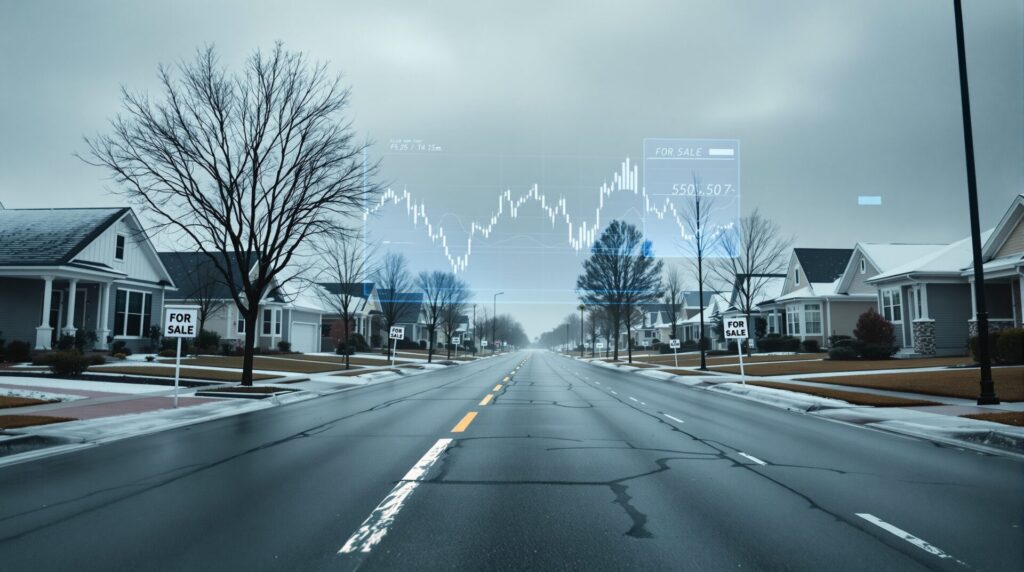
Most people think price direction alone defines a housing crash. In reality, crashes are liquidity events driven by forced selling and credit failure, while stalls are pressure environments caused by hesitation, high capital costs, and slow-moving inventory.
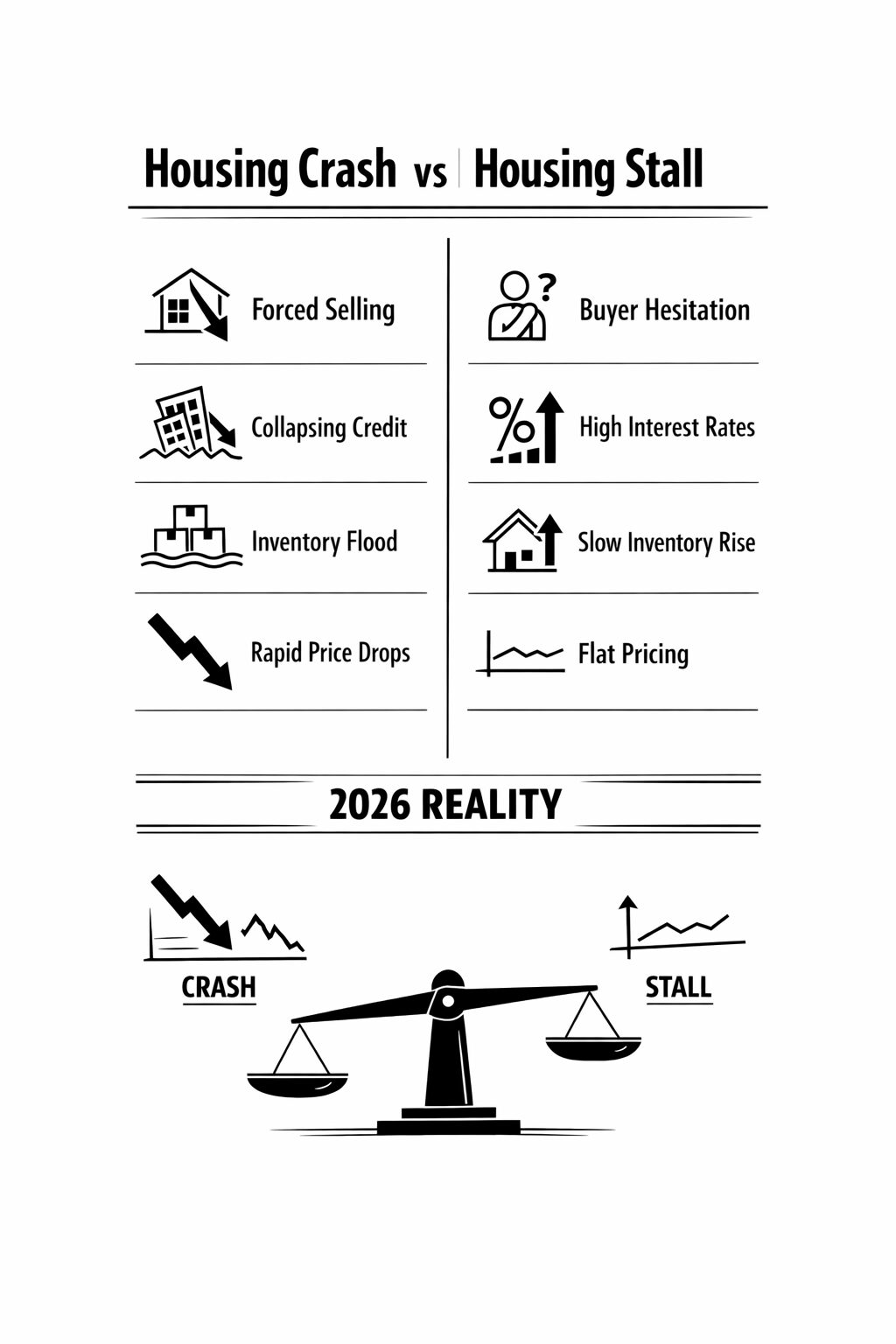
A crash is not just about prices going down. A crash is a liquidity event. It requires forced selling, collapsing credit, and a rapid imbalance between supply and demand.
That is not what the data shows today.
Instead, we are seeing:
- Transaction volume suppressed by rate volatility.
- Inventory normalizing, not exploding.
- Price growth compressing toward zero.
- Capital becoming expensive and selective.
This is not a collapse. It is a pressure chamber.
What the January 2026 Mortgage Rate Shock Really Changed
If there was one moment that reignited crash fears, it was the sudden jump in mortgage rates at the start of January.
Many buyers entered the year believing rates would drift gently lower. Instead, they spiked. That single move shook confidence more than any price chart could.
But it is critical to understand what that spike represents.
It does not signal a housing collapse. It signals capital volatility.
Mortgage rates are tied to bond markets, inflation expectations, and global risk, not directly to housing demand. When rates jump, affordability tightens immediately. But that does not automatically force prices down unless sellers are compelled to sell.
In 2026, most sellers are not compelled.
They are inconvenienced. They are frustrated. They are waiting.
That distinction matters.
Inventory is Rising, but Not the Way Crashes Are Made
One of the loudest crash arguments centers on inventory. People hear that inventory is up and assume a flood is coming.
But inventory needs context.
As Months’ Supply of Inventory (MSI) rises toward balanced-market levels, pricing pressure increases without triggering the forced selling that defines a true housing crash.
Yes, months’ supply of inventory has increased compared to the extreme scarcity of 2021 and 2022. That was inevitable. A market cannot function at historic lows forever.
However, today’s inventory levels resemble normalization, not distress.
Key observations:
- Inventory growth is driven by slower sales, not a surge of new listings.
- Days on market are rising, which signals buyer resistance, not seller panic.
- New construction remains constrained by financing costs and permitting delays.
- Many listings are sitting, not being dumped.
In a crash, inventory spikes because sellers must exit. In a stall, inventory rises because buyers hesitate.
Those are very different dynamics.
Inventory Signals: Crash Conditions vs. 2026 Market Reality
This table reflects national-level structural trends observed entering 2026. Market conditions vary by region and metro area.
| Indicator | Housing Crash Environment | 2026 Market Reality |
|---|---|---|
| Months Supply of Inventory (MSI) | Spikes rapidly above balanced levels due to forced selling and collapsing demand | Gradually rising toward balanced levels due to slower buyer activity |
| New Listings Behavior | Surge in distressed and forced listings entering the market | New listings remain constrained while existing listings sit longer |
| Days on Market | Shortens rapidly as sellers rush to exit at any price | Lengthens steadily as buyers hesitate and affordability tightens |
| Seller Motivation | High urgency driven by job loss, credit stress, or foreclosure risk | Low urgency with most sellers financially stable but rate-sensitive |
| Price Movement | Sharp, fast declines across most markets | Flat to modest price compression with localized softness |
| Credit Conditions | Lending standards collapse or freeze entirely | Lending standards remain tight but functional |
Data Notes: Data comparisons are conceptual and explanatory, not predictive. Inventory behavior, price movement, and credit conditions are influenced by interest rates, employment stability, lending standards, and buyer affordability. This content is for informational and educational purposes only and does not constitute financial or investment advice.
Why Flat Prices Are the Real Story of 2026
If you want to understand 2026 in one phrase, it is this:
The era of easy appreciation is over, but the era of forced depreciation has not arrived.
Prices are not soaring. Prices are not collapsing. They are flattening.
For homeowners, that feels like stagnation. For speculators, it feels like failure. For disciplined investors, it is a recalibration.
Flat prices expose weak assumptions.
Deals that relied on appreciation no longer work. Rent growth is no longer guaranteed. Exit timelines stretch.
This is why so many people feel uneasy. The market is no longer forgiving.
The Role of the Lock-In Effect and Why It’s Fading Slowly
From 2023 through 2025, one factor dominated housing conversations: the lock-in effect.
Millions of homeowners held mortgages below 4 percent. Selling meant giving up cheap debt for expensive debt. So they stayed put.
That effect is still present in 2026, but it is weakening.
Life events do not wait for interest rates:
- Job changes happen.
- Divorces happen.
- Deaths happen.
- Relocations happen.
Each year, more homes trade at higher rates. Over time, the market slowly resets its baseline. This creates more inventory, but not panic inventory.
That slow unwind supports a stall, not a crash.
Why This Market Punishes Waiting More Than Acting
One of the most searched questions right now is whether it is better to wait.
Waiting feels safe. Waiting feels responsible. Waiting feels like avoiding risk.
But in a flat market with volatile rates, waiting carries its own cost.
When prices are flat:
- You gain no appreciation by waiting.
- You lose time paying down principal.
- You lose potential tax advantages.
- You risk re-entering at a higher rate environment.
This does not mean everyone should buy immediately. It means waiting is not neutral. It is a decision with tradeoffs.
The market is not rewarding patience. It is rewarding preparation.
The Growing Divide Between Headlines and Reality
Many media outlets still speak in broad national averages. But 2026 is not a national market. It is a fragmented one.
Some areas are stable. Some are softening. Some are quietly correcting.
Migration patterns, insurance costs, taxes, and job markets matter more now than ever before. Two cities in the same state can behave very differently.
This is another reason the crash narrative spreads. People see weakness in one area and assume it applies everywhere.
It does not.
Why This is Not 2008, Even If It Feels Uncomfortable
It is worth stating clearly.
This is not a leverage-driven collapse. This is not a credit meltdown. This is not a foreclosure wave.
Household balance sheets are stronger. Equity levels are higher. Loan quality is far better.
The pain of 2026 is not destruction. It is adjustment.
And adjustment is slower, quieter, and more confusing.
What 2026 Really Is: A LEVERAGE SHIFT
If there is one accurate label for 2026, it is this:
A leverage shift.
Power is moving:
- Away from sellers who relied on urgency.
- Away from buyers who relied on cheap debt.
- Toward operators who understand structure.
Financing matters more than ever. Underwriting matters more than ever. Patience paired with action matters more than ever.
This is not a market for shortcuts.
Who is hurt most by a stalling market?
A stall does not affect everyone equally.
Most affected:
- Highly leveraged investors with thin margins.
- Buyers waiting for unrealistic rate drops.
- Sellers anchored to 2022 prices.
- Landlords facing flat or declining rents.
Least affected:
- Owners with long-term horizons.
- Buyers focused on payment stability, not timing.
- Investors using conservative assumptions.
- Those flexible with structure and strategy.
This is a sorting mechanism, not a purge.
The Opportunity Hiding Inside the Frustration
Stalling markets are uncomfortable, but they create openings.
Negotiation returns. Creativity matters. Terms matter.
The absence of frenzy allows thoughtful decisions again.
This is how long-term wealth is actually built, not during manic booms.
Frequently Asked Questions
Is the housing market going to crash later in 2026?
A true crash would require forced selling and collapsing credit. Current data does not support that scenario. Localized corrections are possible, but a national crash remains unlikely without a major economic shock.
Why does it feel worse than the data suggests?
Flat prices combined with high rates create emotional stress. People feel stuck even though values are holding. That frustration often gets misinterpreted as collapse.
Will home prices drop in 2026?
In some markets, modest declines are possible. Nationally, prices are more likely to remain flat or slightly positive, adjusted for inflation.
Is now a bad time to buy a home?
It depends on your time horizon, finances, and local market. The decision should be based on payment sustainability, not short-term price guesses.
Should I wait for rates to fall?
Waiting is a strategy with costs. Rates may move, but timing them is unreliable. Focus on affordability and structure instead.
Are investors pulling out of the market?
Some speculative investors are stepping back. Long-term investors are adapting rather than exiting.
Is inventory going to surge?
Inventory is rising slowly due to longer selling times, not mass selling. That supports balance, not collapse.
How long will this stall last?
Stalls can last years. Markets do not owe anyone quick resolutions.
2026 Is the Year the Market Stops Carrying You
The housing market in 2026 is not crashing.
It is forcing honesty.
Honesty about affordability. Honesty about assumptions. Honesty about strategy.
This is the year where passive optimism stops working, and intentional decision-making begins.
Those waiting for chaos may wait a long time. Those expecting easy gains may be disappointed. Those willing to understand the shift will find opportunity.
2026 is not loud. It is not dramatic. It is decisive.
And the people who recognize that will look back on this year very differently from those who froze.