
Key Takeaways
- Fraud tied to public assistance programs is distorting housing markets and creating hidden investor risk.
- Oversight failures, not community identity, explain why the same geographies and networks keep surfacing.
- Rental income tied to unstable subsidy systems can collapse quickly once enforcement accelerates.
Somali fraud cases tied to public assistance programs are no longer isolated events.
What started as emergency aid has exposed systemic weaknesses that keep surfacing in the same places, the same programs, and the same housing pipelines.
Why are Somali-linked cases appearing repeatedly, and what does that mean for rent stability, cash flow, and investor risk across U.S. markets?
This report breaks it down in clear terms:
- Why these cases keep emerging in specific geographies
- How housing and rental assistance programs became exposed
- What real estate investors could face next as enforcement accelerates
Here is what every serious investor needs to understand before the aftershock reaches their portfolio.
Framing the Investigation
What This Article Does and Does Not Claim
This investigation examines why alleged fraud cases tied to housing and public assistance programs are repeatedly associated in public reporting with Somali immigrants, and how those allegations, prosecutions, and oversight failures could intersect with United States real estate and real estate investing.
The focus is on systems, incentives, and market effects, not on assigning collective blame to a community.
This article does not claim that the Somali immigrant community is responsible for fraud.
Criminal liability rests with specific individuals and organizations, and only where charges, convictions, or sworn court findings exist.
Throughout this investigation, distinctions are maintained between accusations, indictments, convictions, audits, and unresolved inquiries.
The reason the Somali immigrant community must be discussed is not because identity determines criminal behavior, but because media coverage, court filings, nonprofit structures, and demographic concentration repeatedly place Somali-led organizations at the center of current high-profile cases.
Ignoring that reality would misrepresent why these stories exist and how public perception has formed.
Addressing it directly, carefully, and with evidence is essential to understanding the full picture.
From a USREI® perspective, this is a capital integrity and market signal issue.
When large volumes of public funds move through housing-adjacent programs with weak verification, the effects can ripple into rental demand, occupancy data, cash flow reliability, and investor underwriting.
These distortions can impact investors regardless of whether they participate in subsidy programs or operate in Somali-dense neighborhoods.
This investigation asks three foundational questions that guide every section that follows:
- Why are Somali immigrants and Somali-led nonprofits repeatedly named in fraud accusations and prosecutions tied to housing and public assistance programs?
- What policy, oversight, and governance decisions allowed this pattern to emerge and scale?
- How could these failures affect United States real estate markets, landlords, and investors as enforcement accelerates?
The answers lie not in cultural generalizations, but in program design, emergency funding structures, nonprofit ecosystems, political oversight gaps, and enforcement timing.
Understanding those factors is the purpose of this investigation.
The Nick Shirley Phenomenon: How Social Media Video Ignited National Outrage and Political Attention
In late December 2025, a 42-minute video by American YouTuber and self-described independent journalist Nick Shirley thrust alleged fraud in Minnesota’s federally funded programs into the national spotlight.
Shirley’s video, posted on X (formerly Twitter) and YouTube, quickly went viral — exceeding 135 million views on X and millions on YouTube — and drew attention from federal officials, political leaders, and social media audiences alike. (Wikipedia)
Shirley, a 23-year-old content creator from Utah with a large online following, used his footage to visit multiple Minnesota daycare centers he claimed were receiving millions in public dollars despite appearing vacant or inactive.
In his narration, he tied these facilities to broader fraud concerns, especially involving publicly funded childcare and assistance programs.
His reporting style blended on-the-ground footage, public records, and personal commentary as he questioned whether taxpayer dollars were being misused. (KOMO)
The video was amplified by high-profile figures on social media, including political leaders and business personalities, which pushed the topic beyond niche online circles into mainstream political discourse.
Federal agencies such as the Federal Bureau of Investigation (FBI) and the Department of Homeland Security (DHS) publicly acknowledged ongoing fraud investigations that overlapped with the issues highlighted in Shirley’s footage.
FBI Director Kash Patel described the fraud already uncovered as “just the tip of a very large iceberg,” and Department of Health and Human Services moved to freeze childcare payments to Minnesota to allow for enhanced oversight. (Reuters)
While Shirley’s video did not itself initiate formal prosecutions, it coincided with — and helped crystallize national attention on — existing and expanding fraud investigations, many of which predate the viral footage.
Prosecutors have charged dozens of individuals in multiple schemes involving misuse of federal funds, and many of those charged have been described in public filings or media reports as being of Somali descent.
Responses from local government and community organizations underscore the sensitivity around how media narratives intersect with demographic identities. (AP News)
The public reaction has been intense. In some cases, allegations and heightened public scrutiny have led to real-world consequences for individuals and businesses unrelated to confirmed wrongdoing.
Reports emerged of threats directed at Shirley himself and increased threats or harassment toward Somali-owned daycare centers following the spread of the video. (Sahan Journal)
From an investor perspective, the Nick Shirley phenomenon illustrates how social media narratives can accelerate political scrutiny, shape public policy responses, and influence enforcement direction, particularly in sectors where government funding and real estate intersect.
The episode highlights the modern landscape where independent online reporting can amplify systemic issues, prompt political reaction, and raise questions about how public dollars flow into community-based service providers — with potential downstream effects on markets, regulatory oversight, and program compliance.
This section anchors the article’s core exploration of why this is happening, tying the viral social media amplification to political and regulatory attention, while preparing to link these developments back to larger patterns of oversight failures and market implications in the sections that follow.
Why the Somali Immigrant Community Appears Repeatedly in These Cases
Concentration, Not Coincidence
The repeated appearance of the Somali immigrant community in fraud accusations tied to housing and public assistance programs is not random, nor is it evidence of community-wide wrongdoing.
The research shows it is primarily the result of geographic concentration, program design, and administrative exposure, rather than ethnicity as a causal factor.
During the governorship of Tim Walz, Minnesota hosts the largest Somali population in the United States, with particularly dense settlement in Minneapolis and surrounding metro areas, fueled by ongoing unrest in Somalia since the early 1990s.
These same areas became major recipients of federal emergency funding during the COVID-19 period, including nutrition assistance, Medicaid-funded housing services, and rental aid.
As federal dollars surged into these jurisdictions, oversight responsibilities were delegated to state agencies and community-based nonprofits that already served immigrant and refugee populations.
When fraud emerged within these programs, investigators naturally encountered clusters of providers, nonprofits, and individuals operating within the same geographic and social networks.
This concentration created a visible pattern that, in public reporting, became associated with Somali immigrants as a group, even though the underlying cases involved specific actors and organizations.
Program Targeting and Accessibility
Federal and state programs implicated in the largest fraud cases were intentionally designed to prioritize access for populations considered at high risk of hardship, including immigrants, refugees, and low-income households.
During the pandemic, policymakers explicitly removed barriers to participation to accelerate aid delivery.
Eligibility standards were broadened, documentation requirements were relaxed, and self-attestation became the dominant method of verification.
In Minnesota, these policy choices intersected with an existing ecosystem of Somali-led nonprofits and service providers that already had language access, cultural trust, and deep community reach.
Programs such as federally funded nutrition assistance and Medicaid-funded housing services relied heavily on nonprofit intermediaries to deliver services and submit reimbursement claims.
This structure placed Somali-led organizations at the center of program execution, visibility, and oversight exposure.
Low barriers to entry allowed entities with limited operational history to register as providers.
Oversight agencies failed to validate service delivery, attendance claims, or billing accuracy, even as reimbursement volumes expanded rapidly.
Resulting Visibility
When fraud occurred, it occurred inside dense, interconnected nonprofit ecosystems. Investigators uncovered repeated use of shared addresses, overlapping leadership, common vendors, and recycled documentation across multiple entities.
In several cases, dozens or hundreds of affiliated sites were tied back to a single sponsoring organization, many of which were incapable of delivering the services claimed.
Because these networks were socially and operationally interconnected, enforcement actions inevitably surfaced recurring surnames, organizations, and community ties.
Media coverage often compressed these structural realities into simplified narratives that emphasized identity rather than system failure.
Political sensitivity further complicated enforcement. When agencies attempted to halt payments, some organizations alleged discrimination, triggering litigation and political pressure that delayed corrective action.
Courts, acting on procedural grounds and without full visibility into emerging fraud, ordered payments to resume, allowing exposure to expand.
As a result, the Somali immigrant community became repeatedly named in headlines not because fraud is inherent to the community, but because policy design, emergency governance, nonprofit concentration, and delayed oversight intersected in the same places, involving the same networks, at the same time.
This distinction matters.
The research consistently shows that fraud is individual and organizational, while the visibility of the Somali community in these cases is a byproduct of structural conditions that amplified both opportunity and scrutiny.
The National Pattern 2016 to 2026
The Decade of Acceleration
The pattern that ultimately produced large-scale fraud cases tied to housing and public assistance programs did not begin with the pandemic.
From 2016 through 2019, oversight weaknesses already existed across multiple federal and state programs, particularly those relying on third-party administrators and nonprofit intermediaries.
Verification systems were fragmented, audits were slow, and enforcement relied heavily on post-payment review rather than pre-approval controls.
The period from 2020 through 2022 marked a decisive shift. Emergency legislation and executive actions dramatically expanded funding while simultaneously relaxing eligibility and verification requirements.
Policymakers prioritized speed of disbursement to prevent economic collapse and mass displacement. Documentation standards were lowered, income verification tools were suspended, and self-attestation became widely accepted as sufficient proof of eligibility.
These changes increased participation but also removed the primary barriers that had previously limited abuse.
From 2023 through 2026, the emphasis shifted again.
As audits, whistleblower reports, and law enforcement investigations accumulated, enforcement agencies began focusing on recovery, prosecution, and structural reform.
This period has been characterized by indictments, convictions, clawback efforts, and the creation of new oversight bodies.
The lag between rapid funding and delayed enforcement explains why many cases only surfaced years after the alleged conduct occurred.
National Assistance Program Risk Pattern 2016 to 2026
| Period | Oversight Characteristics | Funding Behavior | Verification Standards | Enforcement Status | Market Impact Signals |
|---|---|---|---|---|---|
| 2016 to 2019 | Fragmented oversight, routine audits, limited analytics | Stable funding tied to historical program size | Documentation required, third-party verification common | Reactive enforcement, isolated cases | Normal vacancy patterns, rent tied to income |
| 2020 to 2022 | Emergency governance, relaxed controls, payment-first policy | Rapid funding expansion, unprecedented volume | Self-attestation widely allowed, documentation waived | Enforcement delayed, payments continued | Artificial occupancy strength, phantom demand |
| 2023 to 2026 | Post-crisis audits, data matching, centralized oversight | Funding freezes, clawbacks, program shutdowns | Documentation reinstated, retroactive review | Aggressive investigations, indictments, convictions | Cash flow shocks, NOI compression, rent recalibration |
Data Notes: This table reflects national policy and enforcement phases observed across multiple public assistance programs between 2016 and 2026. It illustrates systemic conditions rather than individual behavior. Market impact signals describe observable investment-level effects reported during each period.
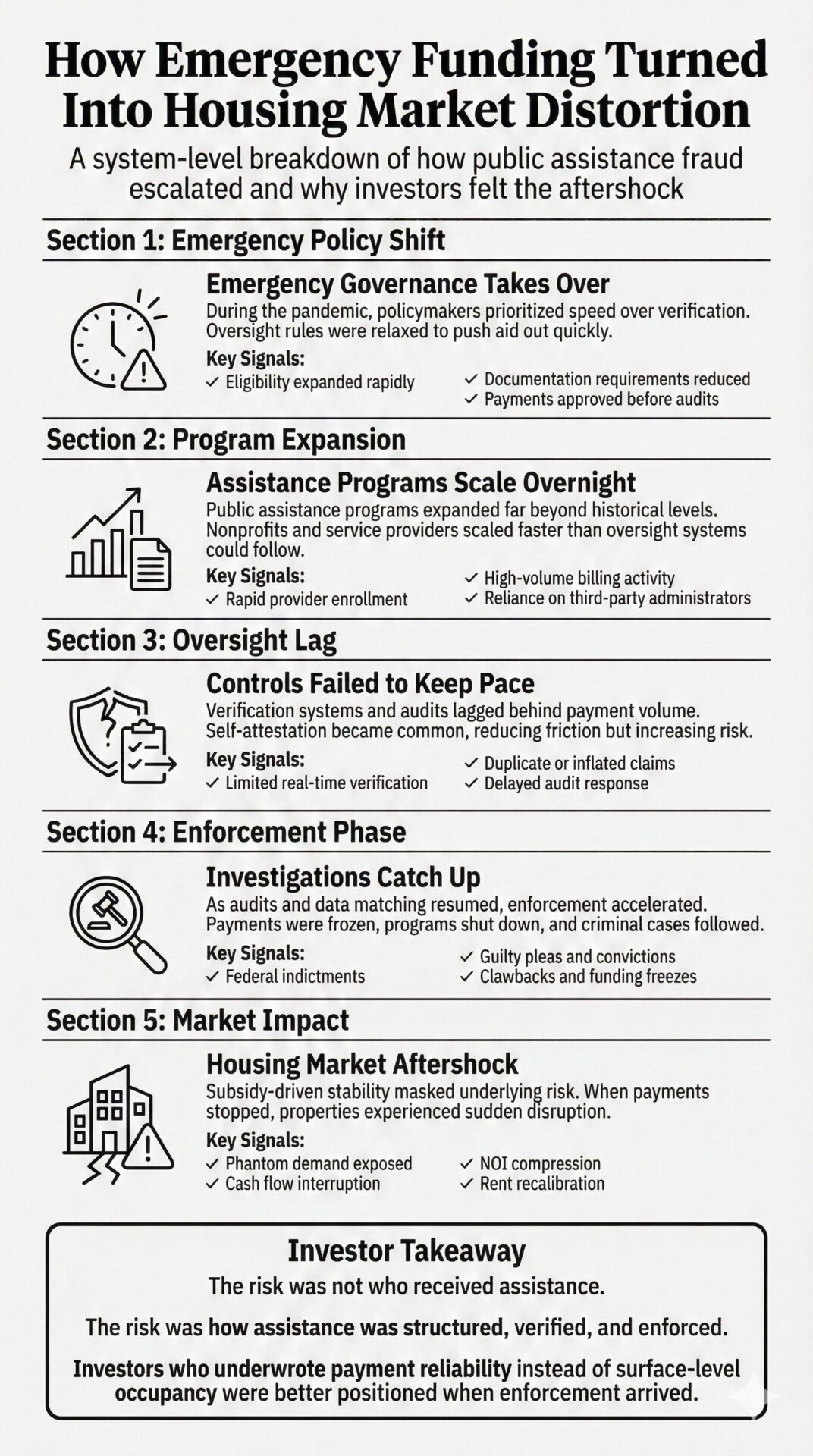
Infographic showing emergency funding expansion, oversight failures, enforcement actions, and housing market aftershock affecting investors.
Why Somali-Linked Cases Dominate Headlines
The prominence of Somali-linked cases within this national pattern is largely the result of scale, concentration, and timing.
In several jurisdictions, particularly Minnesota, emergency funding flowed into programs where Somali-led nonprofits already played a central operational role.
When oversight failed and abuse expanded, the dollar amounts involved quickly reached levels that demanded federal intervention.
The volume of organizations implicated amplified visibility.
Rather than isolated incidents, investigators uncovered networks of providers submitting large numbers of claims through the same systems, often over extended periods.
This created cases that were not only financially significant but also structurally complex, drawing national media attention.
Geographic clustering further simplified both investigation and reporting.
Concentrated activity within a limited number of metropolitan areas made patterns easier to detect and easier to explain publicly.
Media coverage gravitated toward these locations, reinforcing the association between specific communities and the broader narrative of fraud.
As a result, Somali-linked cases became emblematic of a larger national failure.
They were not unique in mechanism, but they were evident due to the intersection of demographic concentration, emergency policy decisions, nonprofit reliance, and delayed enforcement.
This visibility shaped public perception and set the stage for the intense scrutiny that followed.
Minnesota as the Epicenter and Symbol
Feeding Our Future as the Defining Case
Minnesota became the national focal point for housing and public assistance fraud largely because of the scale and visibility of the Feeding Our Future case.
What began as a nonprofit participating in a federal child nutrition program expanded at an unprecedented rate during the pandemic, submitting claims that far exceeded historical norms.
Oversight agencies flagged unusual growth early, yet payments continued while disputes played out through administrative processes and the courts.
As investigations progressed, prosecutors alleged that the program had been used to funnel massive sums of public money through a network of affiliated sites that lacked the capacity to deliver the services claimed.
The case resulted in multiple convictions and guilty pleas, establishing criminal conduct by specific individuals and organizations rather than program participants as a whole.
The significance of Feeding Our Future extends beyond the charges themselves.
It revealed how a single nonprofit could act as a central node for hundreds of claims, sponsors, and vendors, exposing the vulnerabilities of reimbursement-based systems that rely on trust, speed, and limited verification.
For investigators and policymakers nationwide, the case became a reference point for understanding how emergency funding could be exploited at scale.
Why the Case Shaped National Perception
Several factors elevated the Feeding Our Future case from a state-level scandal to a national symbol.
The ethnic concentration among many of the defendants drew intense attention, particularly because the organizations involved were publicly associated with Somali-led community initiatives.
This concentration was repeatedly emphasized in media coverage, shaping how the story was framed and understood by the public.
The dollar amounts involved also mattered.
Alleged losses reached levels rarely seen in nonprofit fraud cases, transforming what might have been viewed as administrative failure into a headline-grabbing national issue.
Court proceedings included detailed evidence, financial records, and testimony that reinforced the perception of systemic breakdown rather than isolated misconduct.
Political fallout further amplified visibility.
Legislative hearings, public statements, and interagency disputes kept the case in the spotlight well beyond the initial arrests.
Minnesota’s experience became shorthand for a broader national concern about how emergency funds were distributed, monitored, and recovered.
As a result, Minnesota came to symbolize the risks inherent in rapid funding expansion combined with weak oversight.
The Feeding Our Future case did not invent these vulnerabilities, but it exposed them in a way that forced national attention and reframed the conversation around public assistance fraud, nonprofit accountability, and the downstream consequences for housing-related programs.
Housing and Rental Assistance as the Next Front
Housing Stabilization Services and Similar Programs
As enforcement widened beyond nutrition programs, attention shifted toward housing-adjacent assistance programs, particularly those designed to prevent homelessness and stabilize vulnerable households.
In Minnesota and other states, these programs expanded rapidly during the pandemic, often with minimal upfront controls and heavy reliance on third-party providers.
Housing Stabilization Services was one such program. It was intended to fund case management, housing support, and stabilization activities for individuals at risk of losing housing.
Participation surged far beyond original projections as eligibility standards remained broad and provider enrollment required limited verification.
Somali-led service providers became prominent participants because they already operated within immigrant and refugee communities, had language capacity, and were positioned to scale quickly.
Similar structures existed in rental assistance programs nationwide. Emergency funding prioritized speed and access, while documentation standards were relaxed.
Oversight agencies approved reimbursements based largely on provider-submitted claims, with limited ability to confirm whether services were delivered as billed or whether outcomes matched reported activity.
How Alleged Abuse Intersects With Real Estate
The intersection with real estate emerges through how these programs structured payments and incentives.
Many housing assistance programs tied reimbursements to housing outcomes such as tenant placement, stabilization milestones, or continued occupancy.
Payments flowed to service providers, landlords, or intermediaries based on reported activity rather than independently verified results.
When verification failed, claims could be submitted repeatedly for the same individuals, addresses, or services. In some cases, properties were associated with multiple assistance claims without corresponding evidence of housing stability.
This created a disconnect between reported program success and actual housing conditions on the ground.
For landlords and investors, these dynamics introduced hidden risks.
Rental demand appeared stronger where assistance dollars flowed freely, occupancy looked stable, and arrears were temporarily masked by third-party payments.
When investigations began, and payments were frozen or clawed back, properties dependent on these revenue streams experienced sudden cash flow disruption.
The shift toward housing and rental assistance fraud represents an escalation rather than a departure from earlier cases.
The mechanisms are similar, but the consequences reach deeper into local real estate markets, affecting rent reliability, vacancy rates, and investor underwriting assumptions.
How Community Structure Intersects With Fraud Risk
Tight Networks Amplify Both Efficiency and Exposure
The structure of many Somali immigrant communities played a meaningful role in how certain assistance programs scaled rapidly and, in some cases, became vulnerable to abuse.
Tight social networks built around shared language, trust, and cultural familiarity reduced friction in service delivery. These same dynamics allowed information, resources, and operational practices to move quickly across organizations and individuals.
When programs rewarded volume and speed, these networks could expand participation efficiently.
Providers shared knowledge about enrollment processes, billing systems, and reimbursement timelines. In environments with weak verification, the same efficiency that enabled legitimate access also increased exposure to misuse.
Once improper practices entered a network, they could spread faster than oversight mechanisms could respond.
This dynamic does not imply wrongdoing by the community itself. It reflects how closely connected ecosystems respond to incentive structures, especially when external controls are minimal.
Informal Norms Meeting Formal Systems
Many assistance programs relied on formal bureaucratic processes that assume strict documentation, audit trails, and independent verification.
In contrast, some community-based service delivery relied heavily on trust, verbal confirmation, and relationship-based validation.
When these informal norms intersected with formal reimbursement systems that accepted self-attestation, the gap between expectation and enforcement widened.
Agencies often lacked the cultural or operational capacity to challenge claims in real time.
Oversight staff were understaffed, unfamiliar with community structures, or constrained by policy directives that emphasized payment velocity over verification.
This mismatch allowed questionable claims to pass through systems designed to prioritize access rather than scrutiny.
The result was not immediate detection, but delayed discovery, often years after payments had been issued.
The Problem Is Not Culture but Mismatch
The research consistently shows that fraud risk increased where three conditions aligned. Self-attestation replaced documentation. Oversight lagged behind payment volume. Funding scaled faster than enforcement capacity.
These conditions existed nationwide across many programs and communities.
The reason Somali-linked cases appear more frequently is that dense participation, nonprofit concentration, and rapid scaling made both opportunity and detection more visible in certain regions.
The issue is structural mismatch, not cultural behavior.
Understanding this distinction is essential for investors and policymakers alike.
Without addressing how incentive design, verification standards, and oversight capacity interact with tightly connected service networks, similar patterns will continue to surface in other communities and programs under different names.
Political and Oversight Decisions That Made This Inevitable
Emergency Governance Changed the Rules
The policy environment that allowed large-scale fraud to emerge was shaped by deliberate political decisions made during a period of crisis.
As emergency funding accelerated, lawmakers and administrators prioritized speed of disbursement over traditional safeguards. Eligibility rules were broadened, documentation standards were lowered, and agencies were directed to move money quickly to avoid humanitarian fallout.
These changes fundamentally altered the risk profile of housing and public assistance programs.
Somali-led nonprofits, already embedded in communities targeted by relief efforts, were positioned to scale operations rapidly under the new rules.
The same policies that expanded access also removed friction points that previously limited abuse. Once those controls were relaxed, oversight agencies lacked the tools and authority to slow payments even as warning signs appeared.
Emergency governance did not create fraud, but it reshaped the environment in which fraud could grow unchecked.
Fragmented Accountability
Oversight responsibility was divided across multiple layers of government, creating gaps where accountability weakened. Federal agencies authorized funding and issued guidance.
States administered programs and contracted with vendors. Local nonprofits executed services and submitted claims. No single entity owned end-to-end fraud prevention.
When problems emerged, agencies pointed to jurisdictional limits. Federal officials cited state administration.
State agencies blamed federal guidance or third-party contractors.
Vendors argued they followed state instructions. This fragmentation delayed corrective action and allowed questionable practices to persist across multiple payment cycles.
In Minnesota, this structure meant that even when concerns were raised internally, enforcement stalled. Payments continued while disputes moved through administrative channels, courts, and political offices.
The absence of clear ownership over fraud prevention turned oversight into a reactive process rather than a preventative one.
Warnings Existed but Action Lagged
Red flags surfaced well before law enforcement intervention. Oversight agencies observed unusual growth patterns, inconsistent reporting, and claims that exceeded reasonable service capacity.
Internal warnings were documented, but decisive action was often delayed due to political sensitivity, legal risk, and fear of disrupting aid delivery.
In some cases, attempts to halt payments triggered lawsuits alleging discrimination or procedural violations. Courts, focused on administrative fairness rather than criminal investigation, ordered payments to resume.
Political leaders faced pressure to maintain funding flows, particularly in programs serving vulnerable populations, further slowing enforcement.
By the time investigations reached full scale, significant funds had already been disbursed.
The lag between warning and action transformed what could have been contained administrative issues into criminal cases with national consequences.
Confirmed Convictions and Named Defendants
Individuals Already Convicted
The investigative record makes clear that criminal responsibility in these cases rests with specific individuals and organizations, not with the Somali immigrant community as a whole.
In Minnesota, the Feeding Our Future case resulted in multiple convictions and guilty pleas after extensive federal investigation and trial proceedings.
Courts established criminal liability through documentary evidence, financial records, testimony, and verdicts that confirmed intentional misuse of public funds.
These convictions demonstrated how a limited number of individuals exploited reimbursement-based systems by submitting false claims, sponsoring sites that lacked operational capacity, and diverting funds for personal enrichment.
The outcomes of these cases confirmed that the misconduct was organized, deliberate, and concentrated among identifiable actors rather than diffuse across program participants.
From an enforcement standpoint, these convictions marked a turning point.
They validated early concerns raised by oversight agencies and confirmed that emergency-era controls had failed.
They also set legal precedents that shaped subsequent investigations into housing-adjacent programs.
Individuals Charged but Not Yet Adjudicated
Beyond confirmed convictions, additional cases involving housing and rental assistance programs remain pending.
These cases involve individuals and organizations charged with fraud, theft, or related financial crimes connected to housing stabilization services and rental aid administration. Legal proceedings are ongoing, and outcomes have not yet been determined.
It is critical to distinguish between charged conduct and adjudicated guilt.
While indictments outline alleged schemes and identify suspected misconduct, criminal liability will ultimately be decided by courts.
These pending cases nonetheless illustrate the breadth of enforcement activity and signal continued scrutiny of programs that expanded rapidly under relaxed oversight.
The pattern emerging from both convictions and pending charges underscores a consistent theme.
Enforcement agencies are targeting organizational leaders, financial officers, program administrators, and intermediaries who controlled access to funds and had responsibility for compliance.
This focus reinforces the conclusion that fraud risk concentrated at points of authority and control, not within communities defined by identity.
As investigations continue, additional charges may follow. Any future accountability will be tied to documented actions, financial evidence, and legal standards, not to ethnicity or community affiliation.
Named Cases That Bridge Nutrition Fraud and Housing Assistance Abuse
Asha Farhan Hassan and the Expansion Into Housing Programs
One of the most significant recent developments in these investigations is the federal charging and guilty plea of Asha Farhan Hassan, age 28.
Hassan was charged by federal information with wire fraud for her role in a multimillion-dollar scheme involving Minnesota’s Early Intensive Developmental and Behavioral Intervention benefit program. Prosecutors further alleged that she participated in the Feeding Our Future fraud scheme and personally received approximately $465,000 in misappropriated funds.
She has pled guilty to one count of wire fraud in federal court and is awaiting sentencing.
This case is notable because it explicitly connects child nutrition fraud and housing-adjacent services, demonstrating how similar mechanisms and actors moved across multiple public assistance programs once oversight weaknesses were identified.
Hassan’s legal status is clearly established. She has been charged and has entered a guilty plea under federal law, which distinguishes her case from allegations that have not yet been adjudicated.
Her prosecution illustrates how enforcement has progressed from a single flagship case into a broader examination of overlapping benefit programs that relied on similar reimbursement models, documentation standards, and nonprofit intermediaries.
Confirmed Convictions in the Feeding Our Future Case
The Feeding Our Future prosecution remains the foundational case that brought national attention to these issues. Aimee Bock, the founder and executive director of Feeding Our Future, was convicted in federal court on charges including wire fraud, conspiracy, and bribery.
Prosecutors described her as the central organizer who oversaw the diversion of hundreds of millions of dollars in federal child nutrition funds.
Salim Said, a business owner tied to food distribution contracts, was also convicted. He was charged with wire fraud and conspiracy, with prosecutors alleging that he controlled shell companies and laundered proceeds from fraudulent claims.
These convictions established that the misconduct was organized, deliberate, and executed by individuals with authority over access to funds and program approvals.
Additional Individuals Charged or Prosecuted
Beyond the primary convictions, multiple individuals connected to Feeding Our Future have been charged or have pled guilty. Abdi Nur Salah, a Minneapolis mayoral aide, pled guilty to wire fraud conspiracy, highlighting how political access intersected with the fraud network.
Other defendants include nonprofit operators and food site affiliates such as Mohamed Nur, Abdikarim Ahmed, and Abdifatah Aden, all of whom have been charged with wire fraud or related conspiracy offenses.
Their cases remain pending and have not yet been adjudicated.
Housing Stabilization Services Fraud and Program Expansion
The Housing Stabilization Services program in Minnesota became the next focal point as investigations widened. Asha Farhan Hassan’s guilty plea places her at the center of this expansion, linking Feeding Our Future to Medicaid-funded housing services.
Prosecutors have charged additional defendants in connection with this program, though some names remain sealed or cases are still moving through the courts. Charges include Medicaid fraud, wire fraud, and theft.
The rapid growth of this program, from a modest annual cost to well over $100 million before its shutdown, mirrors patterns seen in earlier cases and reinforces concerns about how quickly reimbursement-based systems scaled under relaxed oversight.
Comparable Housing-Related Cases Nationally
While Feeding Our Future and Minnesota-based programs remain the most visible, similar cases have emerged elsewhere.
Tracy Denise Jones, a senior vice president at the Atlanta Housing Authority, was indicted on charges including theft of federal funds, wire fraud, and mortgage fraud.
In New York City, Desiree Royer, a director within the rental assistance program, was indicted for theft and fraud tied to duplicate payments issued to landlords.
These cases demonstrate that the mechanisms uncovered in Minnesota are not geographically isolated and that housing assistance fraud has surfaced in multiple jurisdictions under comparable conditions.
Why More Names Are Expected
Federal prosecutors have publicly stated that investigations remain ongoing.
Financial tracing continues, additional indictments are anticipated, and the extension of the statute of limitations for pandemic-era fraud to ten years means enforcement activity can continue well into the next decade.
This timeline allows prosecutors to pursue complex cases that require long-term forensic accounting and coordination across agencies.
Legal Clarification for Readers
It is essential to distinguish legal status clearly. Individuals who are convicted or have pled guilty have established criminal responsibility. Individuals who are charged or indicted face allegations that are pending adjudication.
Those not named in charging documents have no legal implication. This distinction remains critical as enforcement efforts continue and new cases emerge.
Why More Charges Are Likely Without Naming Names
Investigators Follow Patterns, Not Identities
Enforcement agencies do not expand cases based on ethnicity or community affiliation.
They follow patterns embedded in data, documentation, and financial behavior. Across multiple programs, investigators identified recurring indicators that typically precede criminal charges.
These include billing volumes that grow faster than program norms, repeated claims tied to the same individuals or addresses, and documentation that appears duplicated or recycled across submissions.
Another common indicator is asset accumulation that does not align with reported income or organizational purpose.
When financial records show funds moving rapidly from program accounts into personal purchases, luxury assets, or unrelated business ventures, scrutiny intensifies. These signals, not identity, determine the direction and scope of investigations.
As cases progress, investigators map relationships between entities, vendors, and individuals to determine whether improper activity was isolated or coordinated.
This process naturally expands outward from initial defendants to others who shared access to systems, approvals, or financial control.
Who Investigators Typically Examine Next
Patterns observed in the existing cases point to specific roles that receive heightened scrutiny as investigations deepen. Nonprofit executives and board members are examined for governance failures and approval authority.
Financial officers and bookkeepers are reviewed for control over accounts, documentation, and disbursements. Program administrators are evaluated for their role in authorizing claims and monitoring compliance.
Third-party vendors and contractors are also reviewed, particularly those responsible for software platforms, payment processing, or compliance verification.
In parallel, public employees with access to approval systems or payment workflows are examined to determine whether oversight failures were negligent or intentional.
This role-based focus explains why investigations often widen over time.
Once initial misconduct is established, enforcement agencies assess whether other participants enabled, ignored, or benefited from the same practices.
Community Proximity Increases Scrutiny
In tightly connected nonprofit ecosystems, proximity accelerates investigative overlap. Shared vendors, shared office space, overlapping leadership, or referral relationships can link otherwise separate entities.
When one organization becomes the subject of enforcement action, adjacent organizations naturally come under review to determine whether similar practices occurred.
This proximity does not imply guilt. It reflects how investigators methodically trace financial flows and operational relationships.
In communities where participation in assistance programs is dense, the likelihood of overlap is higher, and scrutiny becomes more visible.
As a result, additional charges are more likely not because of who is involved, but because the same structural conditions that allowed fraud to scale also create traceable networks that enforcement agencies are now systematically examining.
How This Could Distort Real Estate Markets
Phantom Demand in Somali-Dense Rental Markets
In markets where housing and rental assistance programs expanded rapidly, subsidy-driven occupancy created the appearance of stable or rising demand even when underlying affordability remained strained.
In Somali-dense rental markets, assistance payments often bridged the gap between tenant income and market rents, masking true rent-to-income pressure.
When third-party payments flowed consistently, units appeared occupied, rent rolls looked healthy, and vacancy rates remained compressed. This environment encouraged landlords and investors to underwrite continued stability.
However, because demand was partially sustained by programs operating under weakened verification standards, it was vulnerable to sudden disruption once investigations began and payments slowed or stopped.
The result is phantom demand. Market signals suggest strength, but that strength depends on temporary or unstable funding mechanisms rather than durable tenant income.
Cash Flow Shocks When Payments Are Frozen
When enforcement actions escalate, payments tied to questioned programs are often paused, frozen, or clawed back.
For landlords reliant on these payment streams, the impact can be immediate. Rent that had been paid by agencies or intermediaries disappears, delinquency rises, and eviction proceedings increase.
These disruptions compress NOI quickly. Properties that appeared stable can move into distress within a single quarter.
Lenders may reevaluate debt service coverage, insurers may reassess risk, and operators may be forced to inject capital to stabilize operations.
This effect is not limited to properties directly implicated in fraud.
Payment freezes and program shutdowns ripple outward, affecting compliant landlords operating within the same assistance frameworks.
Stigma Spillover Risk
Beyond direct financial impact, there is a secondary risk that affects tenant relations and leasing behavior.
As fraud cases gain publicity, properties associated with investigated programs or communities may face heightened scrutiny from lenders, insurers, and regulators.
Law-abiding Somali tenants and landlords may experience increased screening requirements, reduced access to housing options, or delayed approvals.
This stigma spillover can distort markets further. Properties may struggle to lease units not because of demand weakness, but because of risk aversion triggered by association rather than evidence.
Investors operating in these markets must navigate both operational risk and reputational sensitivity.
Together, phantom demand, cash flow disruption, and stigma spillover illustrate how failures in oversight and enforcement can extend well beyond criminal cases.
They reshape local market dynamics, distort pricing signals, and introduce volatility that investors may not anticipate until after exposure becomes visible.
Investor Risk and Ethical Responsibility
Financial Risk
The financial exposure created by these cases extends beyond properties directly tied to fraudulent activity.
Investors operating in markets with heavy reliance on housing and rental assistance programs face the risk of overstated rent rolls, delayed payments, and sudden revenue gaps.
When third-party payers are disrupted by audits or investigations, cash flow assumptions can unravel quickly.
Reliance on unstable payment sources increases exposure to compliance reviews, retroactive denials, and clawbacks.
Properties underwritten on the assumption of uninterrupted assistance may experience rapid NOI compression, forcing owners to absorb losses or restructure operations.
These risks highlight the importance of understanding not just rent levels, but the durability and verification standards behind each revenue stream.
Reputational and Operational Risk
Beyond balance sheets, association with investigated programs can create operational strain.
Properties connected to assistance programs under scrutiny may face increased oversight from regulators, lenders, and insurers.
Administrative burdens grow as documentation requests increase, leasing slows, and property managers are required to demonstrate compliance retroactively.
Tenant relations can also become more complex.
Law-abiding tenants may feel targeted or unsettled by increased scrutiny, while property staff must navigate heightened sensitivity around screening, verification, and communication.
Missteps can escalate into legal or reputational issues, even for compliant operators.
These pressures underscore how enforcement actions can disrupt day-to-day operations, regardless of whether an investor engaged in wrongdoing.
Ethical Lens
Investors must balance fraud prevention with lawful and ethical conduct. Strengthening screening processes and payment verification is necessary, but it must be done in a manner that complies with fair housing laws and avoids discriminatory practices.
Decisions must be based on documentation, behavior, and compliance risk, not on identity or community affiliation.
Ethical responsibility also extends to understanding the broader impact of investment decisions.
Overreaction to fraud cases can contribute to market exclusion for compliant tenants and service providers. Underreaction can expose investors to preventable losses.
The challenge is not choosing between vigilance and fairness, but implementing systems that uphold both.
Investors who approach these markets with disciplined underwriting, transparent operations, and respect for legal boundaries are better positioned to navigate the risks without amplifying harm.
What Comes Next
Enforcement Trajectory
The enforcement phase surrounding housing and public assistance fraud is still unfolding. Investigations that began with nutrition programs have expanded into housing stabilization services, rental assistance, and other housing-adjacent funding streams.
Audits are becoming more aggressive, data sharing between agencies is increasing, and law enforcement is prioritizing recovery alongside prosecution.
As investigators continue to unwind multi-year payment histories, additional cases are likely to surface. These actions will not be limited to Minnesota.
Similar program structures and oversight gaps exist across multiple states, increasing the likelihood of new audits, payment suspensions, and indictments elsewhere. The pace of enforcement suggests that scrutiny will intensify rather than fade.
Policy Response
Policy response is already shifting toward tighter controls. Documentation standards are being reinstated, self-attestation is being reduced or eliminated, and oversight agencies are being restructured to centralize accountability.
These changes are designed to prevent recurrence, but they also introduce friction into programs that previously prioritized speed.
For housing markets, this means slower approvals, delayed payments, and higher administrative costs.
Programs that once operated with minimal verification will require deeper documentation and ongoing compliance.
While these changes improve integrity, they also reduce flexibility for landlords and service providers who relied on streamlined processes.
Market Correction
As enforcement and policy reform converge, localized market corrections are likely.
In areas where assistance dollars played an outsized role in sustaining occupancy, vacancy rates may rise, and rents may recalibrate. Investors may exit subsidy-heavy assets in favor of properties with more predictable revenue profiles.
This correction will not be uniform. Some markets will absorb the shift smoothly, while others may experience sharper disruption depending on the degree of exposure to affected programs.
The transition period may be volatile, particularly where assistance funding had masked underlying affordability constraints.
Tired of the noise? As markets adjust to tighter oversight and payment reliability becomes more important than speed, this shift reflects the broader principles outlined in the 2026 Ownership Reset, which examines how investors can reposition for stability in a post-emergency funding environment. Click here to listen now.
Assessment
Why This Is Happening
The convergence of rapid funding, weak oversight, and dense nonprofit ecosystems created conditions where fraud could scale before detection.
Emergency governance prioritized velocity over verification, and fragmented accountability delayed intervention even as warning signs accumulated.
Media coverage then simplified complex systems into identity-based narratives, amplifying public reaction without fully explaining root causes.
The repeated appearance of the Somali immigrant community in these stories is the result of demographic concentration, program design, and operational visibility, not inherent behavior.
Fraud emerged where incentives, access, and oversight failed simultaneously.
The Smart Real Estate Investing Position
Fraud is individual.
Risk is systemic.
Investors must understand why certain communities appear repeatedly in these cases without turning explanation into accusation.
The lesson for real estate investors is not about who receives assistance, but about how assistance is structured, monitored, and sustained.
Markets function on trust in data, payments, and enforcement.
When those foundations weaken, distortion follows.
Recognizing that reality allows investors to protect capital, operate ethically, and avoid repeating the same structural failures that brought these cases into national focus.
Frequently Asked Questions: Somali-Linked Housing and Assistance Fraud Investigations
Based on search trends and public inquiry during the final quarter of 2025, this FAQ addresses the most common questions surrounding Feeding Our Future, the Minnesota Housing Stabilization Services collapse, and nationwide Emergency Rental Assistance fraud.
The Feeding Our Future and Nonprofit Fraud Scandal
What exactly was the Feeding Our Future scandal?
Feeding Our Future was a large-scale fraud scheme centered in Minnesota that exploited the USDA Federal Child Nutrition Program. The nonprofit, led by Aimee Bock, sponsored hundreds of food distribution sites that existed largely on paper, including parking lots and small storefronts without kitchens. These sites claimed to serve millions of meals that were never provided. Prosecutors documented that more than $250 million in taxpayer funds were diverted and laundered into luxury vehicles and real estate purchases in Minnesota, Turkey, and Kenya. By late 2025, more than 78 individuals had been indicted in connection with the scheme.
Was Representative Ilhan Omar involved in the fraud?
There is no evidence that Representative Ilhan Omar was criminally involved. She did, however, face political scrutiny for supporting legislation such as the MEALS Act, which loosened regulatory requirements during the pandemic, and for publicly defending nonprofit operators while investigations were underway. Critics argued her stance contributed to delayed regulatory action. Omar stated she had no regrets and emphasized the humanitarian intent of the legislation. Campaign finance records show she received donations from individuals later indicted, though the donations were legal at the time they were made.
Who is Aimee Bock?
Aimee Bock was the Executive Director of Feeding Our Future and the central figure in the fraud. Prosecutors alleged she coordinated a network of shell companies to launder stolen funds. When the Minnesota Department of Education attempted to stop payments, Bock sued the agency, alleging discrimination, and successfully obtained a court order forcing payments to resume. She was later convicted in federal court.
The Housing Stabilization Services Collapse
Why was Minnesota’s Housing Stabilization Services program terminated?
The program was terminated in 2025 after investigators concluded it had become a vehicle for industrial-scale fraud. Initially projected to cost $2.6 million per year, the program’s expenses exploded to more than $104 million in 2024. Prosecutors found widespread billing for services never delivered, including claims tied to individuals in addiction recovery and even deceased persons. The program was formally shut down in August 2025.
How did the Housing Stabilization Services fraud operate?
Fraudsters created consulting and service firms that billed Medicaid for housing transition and stabilization services. Because the program had extremely low barriers to entry, providers could enroll with minimal verification. Firms billed for inflated or entirely fabricated hours. In at least one documented case, a provider admitted to inflating claims to purchase a BMW and real estate in Kenya.
Emergency Rental Assistance and Market Impact
Did rental assistance fraud affect rent prices?
Yes. Investigations found that fraudulent rental applications created phantom demand in many markets. Units appeared occupied or fully applied for, even when rent was not actually being paid. This artificially reduced vacancy rates and signaled tight market conditions to investors, contributing to upward pressure on rents for legitimate tenants. In some Atlanta properties, investigators found that up to half of rental applications contained falsified information.
What was the New York cybersecurity failure people keep referencing?
This refers to the collapse of the New York State Emergency Rental Assistance portal in June 2021. Contractors Guidehouse Inc. and Nan McKay failed to complete the required cybersecurity testing before launch. Within 12 hours, the system was breached, exposing sensitive applicant data and enabling identity theft. In June 2025, the firms agreed to pay $11.3 million to settle allegations of gross negligence.
What is self-attestation, and why is it blamed?
Self-attestation was a policy that allowed applicants to declare eligibility for assistance without submitting proof of income or hardship. While intended to speed aid delivery, it eliminated critical verification safeguards. This made it easy for fraudsters to fabricate eligibility and submit duplicate or false claims at scale.
Accountability, Politics, and New Laws
Were any government officials fired or prosecuted?
Yes. Several officials were implicated across different jurisdictions:
- Abdi Nur Salah, a senior aide to Minneapolis Mayor Jacob Frey, pled guilty to wire fraud connected to Feeding Our Future
- Tracy Denise Jones, a Senior Vice President at the Atlanta Housing Authority, was indicted for stealing housing assistance funds
- Eric Grumdahl, a Minnesota Assistant Commissioner overseeing Housing Stabilization Services, was fired in September 2025
- Desiree Royer, a director at New York City’s Human Resources Administration, was indicted for a rental assistance theft scheme
What is the FACT Act?
The FACT Act, passed in 2025, converted the Pandemic Response Accountability Committee into a permanent federal fraud oversight body. This ensured that the advanced data analytics tools used to uncover pandemic fraud remain in place for future enforcement.
Was the statute of limitations for pandemic fraud changed?
Yes. Congress passed legislation in late 2025 extending the statute of limitations for pandemic-related fraud from five years to ten years. Lawmakers cited the sheer volume and complexity of cases as the reason prosecutors needed additional time to pursue charges through 2030 and beyond.