Why the St. Louis Industrial Pipeline Hit 5,500 Acres
Although the St. Louis industrial pipeline looks sudden, it reflects planned growth in acreage. More than $5 billion in aerospace- and aviation-related projects are expected to spur 900 jobs across the region.
Infrastructure shocks drive the rail land race
Freightway added four rail served sites in 2025, lifting the pipeline to almost 5,500 acres across 20 sites in 16 locations. Similar to Tampa’s strategy, targeted maritime rail improvements show how removing freight bottlenecks can rapidly reshape industrial site demand.
That expansion tracks $8.9 billion in regional freight investments, including MoDOT’s $3 billion I 70 program and main line rail adjacency at the Heart of America Mega Site.
Incentives and Market consolidation tighten supply
Policy incentives concentrated demand as enterprise zones, TIF districts, and Opportunity Zones reduced effective costs, while Missouri manufacturing inputs stayed exempt from sales and use tax.
Avina Clean Hydrogen’s $820 million East St. Louis plant, targeting up to 20,000 annual rail cars, intensified competition for well located tracts.
What “Development-Ready” Means for St. Louis Rail-Served Sites
When corporate site selectors demand speed and certainty, a St. Louis rail-served parcel labeled development-ready signals that most prework is already complete. Separately, the city is advancing projects like the Monarch redevelopment to turn a 150,000-sq-ft industrial building and 29 parcels into a transit-accessible workforce and training campus.
Certification standards often mirror national benchmarks and reduce location risk.
Certification Reduces Hidden Risk
Programs typically require title work, surveys, and due diligence that address environmental constraints, access, and development costs.
That upfront documentation helps avoid surprises later in the process. In fast-growing industrial hubs, verified interstate access can materially cut transit times and operating costs for end users.
Missouri Certified Sites are marketed as pre-qualified, investment-ready locations.
This helps industrial teams compare options using consistent information at scale.
Utility capacity and transportation connections are usually verified as part of the certification process.
That way, rail integration can move forward without major redesign.
Entitlements Tighten Permitting Timelines
Development-ready status generally indicates industrial zoning and land-use compatibility have already been reviewed for noise, vibration, and truck volumes.
This reduces the risk of late-stage land-use conflicts.
Regulatory encumbrances are addressed earlier in the timeline.
As a result, site plan approvals and building permits can move faster once an end user commits.
Where Are the 5,500 Acres: 20 Rail Sites, 16 Locations?
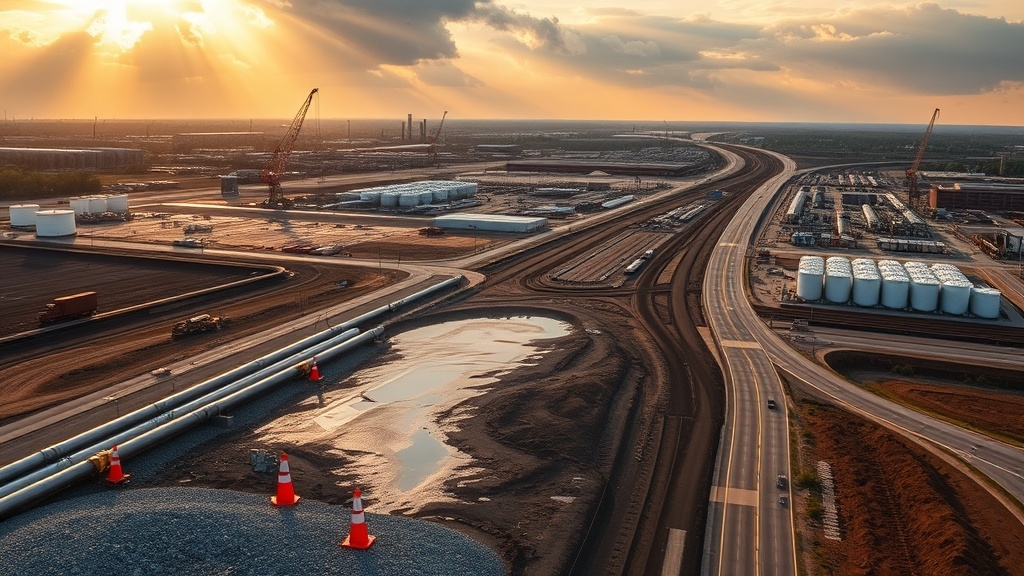
Where the region’s nearly 5,500 acres of rail-served industrial land is concentrated now shapes which projects can move first.
As of Q2 2025, the rail-served subset covers 20 sites in 16 locations and totals nearly 5,500 acres.
TRRA additions added 300+ acres.
Recent mega-site planning elsewhere underscores how multi-modal transportation and high-utility capacity are becoming table-stakes for modern industrial parks.
Disrupted geography across the river
Missouri inventory clusters near north and south city industrial corridors, St. Louis County, and interstate junctions.
Illinois acreage concentrates in Dupo, East St. Louis, Granite City, and nearby Metro East communities.
Spatial Mapping places most sites near I‑55, I‑70, and I‑270, with river barge links close by.
Community Proximity becomes a gating factor as greenfield tracts and infill parcels compete for utilities, zoning certainty, and Class I rail or TRRA access.
Biggest St. Louis Rail-Served Sites: Admiral Parkway + TRRA
Acreage is becoming the scarce commodity in the St. Louis rail pipeline.
Mega-sites amplify industrial risk
Admiral Parkway in Dupo, Illinois adds roughly 1,000 acres of heavy industrial zoning.
Its planned I-255 and Davis Street Ferry Road interchange, backed by $45 million in IDOT funding, raises both community impacts and traffic scrutiny.
TRRA access hardens competitive lines
TRRA switching and bridge control offers neutral links to all six Class I carriers, tightening interchange reliability for riverfront industries.
Environmental mitigation planning is expected as greenfield work meets floodplain and habitat constraints.
| Asset | Disruption factor |
|---|---|
| Admiral Parkway | UP service potential and intermodal adjacency |
| Incentives | Enterprise Zone and TIF cost recovery |
| Highways | Direct I-255 access under construction |
| TRRA network | Shared mainlines and Mississippi bridges |
Projects Driving Demand: Avina SAF and 2026 Prospects
Avina’s proposed $820 million sustainable aviation fuel facility is jolting the St. Louis Metro East industrial market.
Planned on roughly 90 acres in East St. Louis, it targets up to 120 million gallons annually using KBR licensed PureSAF alcohol to jet technology.
Demand Shock From Rail and Pipe
Existing rail and pipeline links are positioned for feedstock logistics and outbound ASTM SAF.
TRRA estimates as many as 20,000 railcars per year, intensifying land competition near interchanges and storage.
Like Mesa’s 11.6-acre push tied to the Elliot Tech corridor, the market premium is shifting toward sites with utility interconnections and reliable power planning baked in.
2026 Prospects Turn Disruptive
State REV incentives and 150 to 157 permanent jobs raise scrutiny of community impacts and tax base shifts.
By 2026, site control and infrastructure access will likely hinge on:
- ethanol supply corridors
- tank farm capacity
- barge and highway redundancy
- airport delivery commitments
Frequently Asked Questions
What Tax Incentives and Abatements Are Available for Rail-Served Developments?
Missouri rail-served developments may access state tax credits for track maintenance and new customer rail infrastructure. These credits can be transferable and may allow carryforward.
Local abatements may also be available through Chapter 100, Tax Increment Financing (TIF), and Payments in Lieu of Taxes (PILOTs).
Opportunity Zones can further enhance financing returns for qualifying projects.
How Long Do Rail Access Agreements and TRRA Switching Contracts Take to Finalize?
Rail access agreements typically finalize in 6–18 months. With added complexity, they can extend to 18–24 months.
TRRA switching contracts often take 6–12 months to complete.
Timelines depend heavily on engineering, legal review, and permitting requirements. Approval bottlenecks commonly come from multi-department reviews.
What Environmental Remediation Costs Are Typical for These Industrial Parcels?
Remediation costs can vary widely by contaminant type and site conditions.
A contamination assessment may cost in the thousands.
Cleanup for petroleum impacts often runs in the low- to mid-six figures.
Solvent plume cleanup commonly ranges from hundreds of thousands to several million.
If asbestos excavation is involved, costs can reach the high-six to low-seven figures.
Are There Minimum Acreage or Railcar-Volume Requirements to Secure Rail Service?
Generally, railroads impose no fixed minimum acreage.
However, you still need enough land to accommodate required track geometry and unit-train storage.
Direct rail service typically depends more on expected car volume than acreage.
In many cases, railroads look for roughly 200–250 annual carloads, with higher volumes often expected for unit-train shippers.
Which Utilities (Power, Water, Gas) Are Capacity-Constrained at Key Sites?
Electric capacity is constrained at East St. Louis and riverfront substations.
Water availability and wastewater treatment are limited at Avina and older municipal systems.
Natural gas laterals and legacy mains face pressure limits, requiring upgrades.
Assessment
St. Louis industrial land offerings have tightened as the rail-served pipeline surpasses 5,500 acres.
Development-ready parcels are being positioned to shorten entitlements, extend utilities, and secure rail access amid rising near-term site selection deadlines.
The 20 identified sites across 16 locations highlight a concentrated push along TRRA corridors.
Admiral Parkway is among the largest.
Biofuels and other heavy industrial prospects, including projects tied to sustainable aviation fuel planning, are reinforcing demand ahead of 2026.