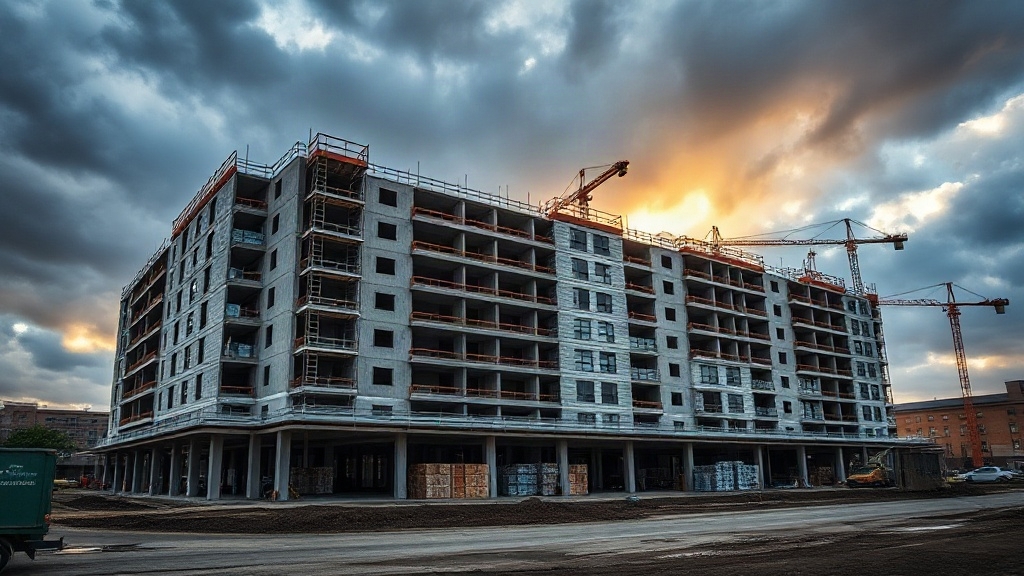



Why CRE Stress Is Rising Now
Accelerating strain across commercial real estate is being driven by a sharp convergence of higher interest rates, weaker property valuations, tighter credit, and softer demand in key segments.
Across property types, distress reached 40.4% in February 2025, reflecting broad deterioration. These figures are based on RMA benchmarking of roughly $1 trillion in commercial exposures.
Office remained the weakest segment at 59.4% distressed, while multifamily climbed to 46.1%. In Dallas, office vacancy climbed to 17.9%, above its 10-year average, underscoring how office vacancy is compounding lender risk.
Industrial also stayed under pressure, though retail and residential construction performed better.
Multifamily Pressures Deepen
Multifamily weakness has been intensified by rental oversupply, especially in high-end apartments.
Elevated vacancies, slower absorption, and inflation-hit renters reduced pricing power in heavily built markets.
At the same time, an interest squeeze and rising operating costs weakened cash flow and increased delinquency risk.
Stress has been most visible in fast-growth regions like Texas, Arizona, Colorado, and parts of the Northeast.
The CRE Refinancing Wall in 2024 and 2025
Against that backdrop, the refinancing wall became one of the market’s central threats, as roughly $950 billion in CRE debt matured in 2024 and about $957 billion was scheduled for 2025. That was nearly triple the long-term average of around $350 billion.
The pressure was not confined to a single date. It represented a rolling test across quarters, with maturities remaining elevated into 2026. Office markets were especially exposed, with vacancy rates near 20% adding pressure to refinancing outcomes.


Fewer Delays, More Forced Outcomes
Higher rates reduced loan proceeds and increased borrower equity demands at refinancing. As a result, more loans required cash-in structures, restructuring, sales, or default.
At the same time, loan extensions became less available. The market shifted from delaying problems toward resolving them, increasing the likelihood of charge-offs, reserve builds, modifications, and foreclosures across banks, CMBS trusts, and private lenders.
Why Office CRE Losses Keep Worsening
Office losses keep worsening because the sector’s core fundamentals continue to erode. Vacancy has risen above its Global Financial Crisis peak to a new record high, according to TD Economics.
Persistent remote and hybrid work are limiting demand. Slower economic growth is also expected to weigh further on leasing and renewals.
New supply is still arriving, while landlords are relying more on tenant incentives. That is pressuring rents, occupancy, and net operating income.
Refinancing Stress Deepens
Falling cash flow is reducing office values. That weakens collateral and makes refinancing harder for borrowers facing maturities in a high-rate environment.
CBRE says interest rates, economic uncertainty, and structural demand shifts are driving office valuations lower. This is widening financing gaps and raising default risk.
As more loans require extensions or modifications, lower valuations are increasing expected loss severity. That becomes more painful when distress turns into nonperformance.
Which Banks Have the Most CRE Exposure
As refinancing stress spreads, attention is shifting to where commercial real estate risk is concentrated across the banking system.
Among the largest lenders by volume, JPMorgan Chase and Wells Fargo each hold roughly $127 billion in CRE loans, while Bank of America carries about $86.6 billion.
U.S. Bank and PNC also rank high, at about $54.2 billion and $48.2 billion.
Concentration Risks Beyond Size
Even so, large banks are more diversified.
A St. Louis Fed analysis put big-bank CRE exposure near 6.8 percent of assets, far below levels seen at many smaller institutions.
The sharper concern lies in capital concentrations and regional vulnerabilities.
Community and regional banks are almost five times more exposed to CRE than big banks in one summary.
Another data set found 55 banks above 300 percent of equity, including Flagstar, Zions, Comerica, Valley National, Synovus, Umpqua, and SouthState.
How CRE Losses Could Strain U.S. Banks
While commercial real estate stress is not evenly distributed, the pressure is building most visibly in office portfolios. Weak occupancy, lower property values, and refinancing risk are converging.
Higher rates are colliding with maturing loans from low-rate years, leaving borrowers unable to refinance on prior terms. That can accelerate write-downs, weaken collateral coverage, and intensify capital erosion, especially at banks with concentrated office exposure.
Deposits can exit quickly when confidence weakens. Unrealized securities losses can limit liquidity options.
Funding contagion can raise wholesale borrowing costs. Even if systemwide capital remains above regulatory minimums in severe scenarios, shrinking buffers can restrict lending and balance-sheet flexibility.
Regional and community banks face sharper pressure because CRE concentrations are heavier, diversification is thinner, and localized office losses can hit earnings and capital faster.
Assessment
Commercial real estate losses are moving from a contained asset-class problem to a broader bank balance-sheet threat.
Higher rates, falling office values, and a heavy refinancing calendar are forcing lenders to recognize deeper stress.
Large and regional banks with concentrated CRE exposure remain most vulnerable.
Loss severity appears likely to rise as more loans mature into weaker property markets.
The result is a more fragile credit environment, with pressure spreading through valuations, reserves, earnings, and capital.