
LISTEN TO THIS ARTICLE
Key Takeaways
- Trust structures can help investors organize ownership, succession, privacy, beneficiary control, and long-term planning, but they must match the investor’s actual goal.
- A trust does not automatically replace an LLC, eliminate taxes, protect against lawsuits, avoid lender restrictions, or preserve insurance coverage.
- The best trust strategy usually depends on coordination between the investor, attorney, CPA, lender, title company, insurance professional, and property management team.



Why Trust Structures Matter More as Your Portfolio Grows
The real estate investor’s hidden ownership problem
Most real estate investors start with one simple goal: buy the property.
That makes sense.
In the beginning, the biggest questions usually feel practical.
- Can you find a deal?
- Can you qualify for financing?
- Can the rent cover the mortgage?
- Can you manage the repairs?
- Can you keep a tenant in place?
But as your portfolio grows, the question changes.
It’s no longer just, “Can I buy this property?”
It becomes, “How should this property be owned?”
That one question can affect almost everything that happens next. It can affect what shows up in public records. It can affect who has legal authority to act if you become incapacitated. It can affect what happens to the property when you die.
It can affect how easily your heirs can manage or inherit the asset. It can affect how your lender, insurance company, CPA, title company, and attorney view the ownership structure.
A rental property is not just a house, duplex, apartment building, short-term rental, or commercial asset. It is a legal asset tied to title, debt, insurance, taxes, liability, income, heirs, contracts, and state law.
When that property is owned in your personal name, every one of those issues is connected directly to you.
For a beginner with one property, that may feel simple. For an investor with multiple rentals, partners, heirs, loans, and properties in different states, that simplicity can turn into a problem.
If something happens to you, who can collect rent?
Who can sign a lease?
Who can speak with the lender?
Who can sell or refinance the property?
Who can pay taxes, handle repairs, manage insurance claims, or keep the property from falling into legal confusion?
This is where trust structures become important. A trust can help define who controls property, who benefits from property, who steps in after death or incapacity, and how real estate fits into a larger wealth plan. But a trust is not just a form you download and sign. It is part of a legal structure that must match the investor’s actual goal.
For real estate investors, that goal might be estate planning. It might be privacy. It might be succession. It might be beneficiary control. It might be long-term wealth transfer. It might be coordination with an LLC. It might be passive ownership through a Delaware Statutory Trust. It might be advanced planning for a high-value portfolio.
The hidden problem is that many investors keep buying property without building the ownership structure around it. They build the portfolio first and ask ownership questions later.
That can work for a while.
Then a lawsuit happens. A death happens. A refinance happens. A partner dispute happens. A child inherits property before they’re ready. A property in another state gets stuck in probate. A lender questions a transfer. An insurance company says the named insured does not match the legal owner.
By then, the structure is no longer theoretical. It becomes the difference between clean control and expensive confusion.
The mistake many investors make
The biggest mistake is thinking the word “trust” means one thing.
It doesn’t.
A revocable living trust is not the same as an irrevocable trust. A land trust is not the same as an asset protection trust. A spendthrift provision is not the same as an LLC. A Delaware Statutory Trust is not the same thing as putting your rental property into your family estate plan.
Yet investors often hear the word “trust” and assume it means privacy, asset protection, tax savings, probate avoidance, and lawsuit protection all at once.
That assumption is dangerous.
A trust can be powerful, but only when it is matched to the right job. Some trusts are built mainly for estate planning. Some are designed to hold title. Some are used for privacy. Some are used for tax deferral strategies. Some are used to control how heirs receive assets. Some are advanced structures that require giving up control in exchange for possible protection or estate planning benefits.
The problem is that real estate investing attracts a lot of oversimplified advice. You may hear that putting property into a trust will hide your assets, stop lawsuits, eliminate taxes, protect you from creditors, avoid lender problems, and make your estate bulletproof.
That is not how this works.
Privacy is not the same as asset protection.
Probate avoidance is not the same as liability protection.
Tax deferral is not the same as tax elimination.
A trust document is not the same as insurance.
A land trust is not the same as an LLC.
A revocable living trust may help with succession and probate planning, but it generally does not protect the property from your personal creditors while you still control the trust. A land trust may keep your personal name off certain public-facing title records, but it does not automatically stop a determined plaintiff from discovering who benefits from the property.
An irrevocable trust may offer stronger planning benefits, but it usually requires giving up control and accepting more complexity. A Delaware Statutory Trust may help certain investors complete a passive 1031 exchange, but it also comes with strict limits, fees, and a lack of direct control.
That is why the better question is not, “Should I use a trust?”
The better question is, “What problem am I trying to solve?”
If the problem is operational liability from tenants, guests, contractors, or property conditions, an LLC and proper insurance may matter more than a trust.
If the problem is what happens to the property after death, a revocable living trust may be part of the answer.
If the problem is keeping a child from mismanaging inherited rental income, a trust with carefully written distribution rules may matter.
If the problem is privacy, a land trust may help in some states, but it should not be confused with legal protection.
If the problem is exiting appreciated real estate, a Delaware Statutory Trust or charitable structure may enter the conversation, depending on the investor’s tax and planning goals.
Trust structures can help real estate investors. But they can also create tax problems, financing problems, insurance problems, title problems, and legal problems when used casually.
That is the core idea behind this guide: a trust is a tool, not a shortcut.
What this guide will cover
This guide will walk through trust structures for real estate investors in plain English, without treating them like magic paperwork.
You will learn what a trust is, how the basic parties work, and why the relationship between grantor, trustee, and beneficiary matters. You will also learn why real estate investors use trusts for estate planning, privacy, succession, controlled inheritance, tax planning, and portfolio organization.
The guide will explain the major trust structures investors hear about, including revocable living trusts, irrevocable trusts, land trusts, spendthrift trust provisions, asset protection trusts, charitable remainder trusts, qualified personal residence trusts, dynasty trusts, business trusts, and Delaware Statutory Trusts.
It will also compare trusts with LLCs, because this is where many investors get confused. Trusts and LLCs are not enemies. They often solve different problems. In many real estate structures, the LLC holds the property for liability separation, while the trust owns the LLC interest for estate planning and succession.
This guide will also cover the parts investors often overlook, including taxes, financing, due-on-sale risk, lender consent, insurance coverage, title transfers, compliance, public records, and professional review.
Most importantly, this guide will separate real benefits from dangerous misconceptions.
Trusts can help with real estate planning.
Trusts can create order.
Trusts can help transfer wealth.
Trusts can protect certain beneficiaries in certain situations.
Trusts can help organize a growing portfolio.
But trusts do not automatically erase taxes, stop lawsuits, bypass lenders, replace insurance, or make ownership invisible.
For real estate investors, the goal is not to chase the most impressive-sounding structure. The goal is to build the right structure for the right property, the right risk, the right family plan, and the right long-term strategy.

What Is a Trust?
The plain-English definition
A trust is a legal arrangement for holding and managing property.
That property can be cash, investments, business interests, personal property, or real estate. For a real estate investor, the property could be a single-family rental, duplex, apartment building, short-term rental, commercial building, land, or membership interest in an LLC that owns real estate.
The basic idea is simple.
One person creates the trust. Another person or institution manages the trust property. One or more people or entities benefit from the trust.
That sounds simple, but the details matter.
When real estate is placed into a trust, the trust structure helps define who has authority over the property, who benefits from the property, and what happens to the property if the original owner dies, becomes incapacitated, or wants the property handled under specific rules.
A trust can also separate legal title from beneficial ownership.
Legal title is about who has authority to hold and manage the property.
Beneficial ownership is about who receives the benefit of the property, such as rental income, eventual sale proceeds, or long-term inheritance value.
For example, an investor might place a rental property into a revocable living trust. The trustee holds legal authority over the property under the terms of the trust. The investor may still receive the rental income and maintain control during life, depending on how the trust is written. After the investor dies, a successor trustee may step in and manage or distribute the property without forcing the family through a long court process.
That is one of the main reasons real estate investors pay attention to trusts. A properly designed trust can create a smoother plan for ownership, control, and succession.
But a trust is not automatically an asset-protection shield.
It is not automatically a tax-saving machine.
It is not automatically private in every situation.
It is not automatically better than an LLC.
A trust is a legal tool. Whether it helps or hurts depends on the type of trust, the property involved, the investor’s goals, the state law that applies, the financing attached to the property, and the way the trust is actually used.
The main parties in a trust
Most trusts involve three main roles: the grantor, the trustee, and the beneficiary.
The grantor is the person who creates the trust. This person may also be called the settlor, trustor, or trust maker, depending on the state, document, or attorney drafting it.
For a real estate investor, the grantor is often the property owner who wants to place real estate or LLC membership interests into the trust. The grantor decides what the trust is supposed to accomplish, such as avoiding probate, planning for heirs, protecting a beneficiary from poor financial decisions, or organizing a larger real estate portfolio.
The trustee is the person or institution responsible for managing the trust property.
That role matters a lot.
The trustee may have authority to sign documents, collect rent, manage repairs, communicate with professionals, sell property, distribute income, or follow specific instructions written into the trust. In a simple revocable living trust, the investor may serve as the original trustee and keep control while alive and competent. The trust may then name a successor trustee who steps in after death or incapacity.
The beneficiary is the person or entity that benefits from the trust.
A beneficiary may receive income, use of property, future ownership, or some other benefit created by the trust agreement. In a revocable living trust, the grantor may also be the main beneficiary during life. After death, children, a spouse, charities, or other heirs may become the beneficiaries.
For real estate investors, the beneficiary structure can be extremely important.
A trust can say who receives rental income.
It can say who inherits the property.
It can say whether a property should be sold or held.
It can say whether a child receives income outright or only through controlled distributions.
It can say what happens if one beneficiary wants to sell and another wants to keep the property.
It can also name a successor trustee, which is the person or institution that takes over if the original trustee can no longer serve.
That successor trustee role is one of the most practical reasons investors use trusts. If the investor becomes incapacitated or dies, someone needs clear authority to keep the real estate operating. Tenants still need answers. Mortgages still need to be paid. Insurance still needs to stay active. Repairs still need to happen. Property taxes still come due.
Without a clear structure, the family may need court involvement before anyone can act.
With a properly funded and properly written trust, the successor trustee may be able to step in more efficiently and keep the portfolio from getting stuck.
Why fiduciary duty matters
A trustee is not just a name on a document.
A trustee has legal responsibilities.
That responsibility is called fiduciary duty. In plain English, it means the trustee must act for the benefit of the trust and its beneficiaries, not just for personal convenience.
This matters because real estate can create constant decisions.
Should the property be repaired or sold?
Should rent be raised?
Should a tenant be removed?
Should a mortgage be refinanced?
Should insurance coverage be changed?
Should rental income be distributed or kept for reserves?
Should heirs receive property outright or continue receiving income under the trust?
The trustee has to follow the trust document and applicable law when making those decisions. That is why choosing a trustee is not something to take lightly.
A trustee who manages real estate may need to understand leases, repairs, insurance, taxes, property managers, contractors, lenders, title issues, and recordkeeping. Even if the trustee hires professionals, the trustee still needs enough judgment to supervise the process and act responsibly.
For investors, this is one of the biggest differences between owning a property casually and creating a real ownership plan.
A trust can create order, but only if the people involved understand their roles.
The grantor must know why the trust exists.
The trustee must know what authority and duties come with the role.
The beneficiaries must understand that the trust document controls how benefits are received.
This is also why real estate investors should not treat trusts as generic paperwork. A trust that holds real estate should be written with real estate issues in mind. It should address management authority, sale authority, refinance authority, rental income, expenses, distributions, incapacity, death, successor control, and coordination with any LLCs that may own the actual properties.
The more complex the portfolio, the more important these details become.
A trust can help organize ownership, succession, and beneficiary control. But the trust only works if it is properly drafted, properly funded, and properly maintained.





Why Real Estate Investors Use Trust Structures
Estate planning and continuity
Real estate is different from most assets because it does not pause when the owner dies, becomes disabled, or loses the ability to make decisions.
Tenants still need someone to call. Rent still needs to be collected. Mortgages still need to be paid. Property taxes still come due. Insurance policies still need to stay active. Repairs still need to be handled. Leases may need to be renewed. Contractors may need to be paid. A property manager may need instructions. A buyer may be waiting. A lender may need signatures.
That is why estate planning is one of the main reasons real estate investors look at trust structures.
For an investor with one rental property, estate planning may feel like something to handle later. But even one property can create a legal and financial mess if there is no clear plan for who takes over. If the property is titled only in the investor’s personal name, the family may need to go through probate before anyone has clear authority to sell, refinance, transfer, or manage the property.
Probate can be slow, public, expensive, and frustrating. For a real estate portfolio, it can be even worse because every property has ongoing obligations. A rental house cannot sit in legal confusion for months while heirs try to figure out who has authority.
A properly funded revocable living trust can help solve that continuity problem. It can name a successor trustee who steps in if the investor dies or becomes incapacitated. That successor trustee may be able to manage the property, collect rent, pay bills, communicate with professionals, and follow the instructions in the trust without waiting for a court to appoint someone.
This is not just about death. Incapacity can be just as important.
If an investor is hospitalized, disabled, or mentally unable to manage their affairs, someone still needs legal authority to keep the portfolio operating. A trust can create a smoother transition by naming who has that authority and what they are allowed to do.
For real estate investors, continuity matters because real estate is an active asset. Even a passive rental still needs decisions. A trust can help make sure those decisions do not stop when the original owner can no longer make them.
This becomes even more important when the investor owns property in more than one state. Without planning, heirs may need to deal with probate in multiple jurisdictions. A trust can help centralize the ownership plan so the family is not forced to manage a separate court process in every state where property is located.
That does not mean every investor needs a complex trust structure. It means every investor should think beyond the purchase and ask what happens if they are no longer available to sign, approve, manage, transfer, or decide.
The larger the portfolio gets, the more dangerous it becomes to leave that question unanswered.
Privacy and title presentation
Many investors also use trusts because they want more privacy.
In many counties, property ownership is easy to search. A person’s name may appear in public records, property appraiser databases, recorder records, deed records, tax records, or other local systems. For investors who own multiple properties, that can make the portfolio more visible than they would like.
A trust may help with how ownership appears in public-facing title records, depending on the structure and the state. A land trust, for example, is often used to hold title to real estate while keeping the beneficiary’s name out of the public deed record. In that kind of setup, the trustee’s name may appear publicly, while the beneficial owner is listed privately in the trust documents.
That can be useful.
It may reduce casual public visibility. It may make it harder for someone to quickly connect every property to one investor through a simple public-record search. It may also make ownership look more organized and professional.
But privacy should not be confused with secrecy.
A trust does not make ownership invisible. It does not hide property from courts. It does not prevent tax authorities, lenders, title companies, insurers, regulators, or litigants from requesting information. If there is a lawsuit, subpoena, title issue, financing review, insurance claim, or government inquiry, the people behind the structure may still need to be disclosed.
That is one of the most important points for investors to understand.
Privacy is a practical benefit.
Privacy is not the same as asset protection.
A land trust may keep an investor’s personal name off certain public records, but it does not automatically protect the investor from liability if someone is injured at the property. It does not automatically stop a plaintiff’s attorney from finding the beneficial owner during legal discovery. It does not replace an LLC, insurance, proper leases, clean books, or safe property operations.
This is where bad advice can create problems. Some investors hear that a trust provides privacy and assume that privacy means they cannot be sued. That is not accurate. You can make ownership less obvious to the general public and still remain legally responsible if the structure does not include proper liability protection.
For many investors, privacy works best as one layer inside a larger plan. A land trust may help with public-record privacy. An LLC may help with operational liability separation. Insurance may help respond to claims. A revocable living trust may help with estate planning and succession. Each tool has a different job.
When investors understand that difference, privacy becomes useful. When they misunderstand it, privacy can become a false sense of security.
Asset management and family planning
Trusts can also help investors create rules for how real estate should be managed and passed down.
This matters because real estate often becomes a family asset, even when it starts as an individual investment. A rental property may be intended to support a spouse. It may be used to create income for children. It may be held for grandchildren. It may be part of a long-term plan to build generational wealth.
But leaving real estate to family members is not always simple.
One child may want to sell. Another may want to keep the property. One heir may understand real estate. Another may not. One family member may be financially responsible. Another may be dealing with debt, divorce, addiction, lawsuits, poor judgment, or outside pressure from a spouse or creditor.
A trust can help create rules before those problems happen.
For example, a trust can say who receives income from a rental property. It can say whether a property should be held or sold. It can say when beneficiaries receive distributions. It can name a trustee to manage the property instead of handing direct control to a beneficiary who is not ready. It can create different treatment for different heirs, depending on the family situation and the investor’s goals.
This can be especially useful when an investor wants the benefit of real estate to pass to heirs without giving those heirs immediate control over the asset.
A parent may want a child to receive income from rental property, but not have the right to sell the property immediately. A grandparent may want property income to help pay for education, housing, or medical needs. An investor may want a surviving spouse to receive income during life, then have the property pass to children later. A family may want a trustee to manage a portfolio professionally instead of dividing properties among heirs who may not agree.
Trusts can also help investors think through incapacity. If the investor cannot manage the portfolio, a successor trustee can be named to step in. That trustee can be given authority to hire property managers, pay expenses, handle leases, communicate with tenants, and preserve the property for beneficiaries.
This kind of planning is not only for wealthy investors. It becomes relevant as soon as the investor owns property that other people depend on or may inherit.
Real estate can create income, appreciation, tax benefits, and long-term wealth. But it can also create arguments, confusion, and pressure when there is no plan.
A trust can help turn the investor’s intentions into written instructions.
Tax planning and transaction planning
Real estate investors also look at trusts because ownership structure can affect tax planning and transaction planning.
Trusts can play a role in tax strategy, but a trust should not be treated as an automatic tax shelter. A trust does not magically eliminate rental income. It does not automatically erase capital gains. It does not turn personal expenses into business deductions. It does not let an investor keep full control while pretending income belongs somewhere else.
In many cases, a revocable living trust is treated as a grantor trust for income tax purposes. That means the income, deductions, depreciation, expenses, and gains may still flow to the investor’s personal tax return. From an income tax standpoint, the trust may not change much during the investor’s lifetime.
That does not make the trust useless. It simply means the main benefit may be estate planning and continuity, not income tax reduction.
Other trust structures can be more tax-sensitive. Irrevocable trusts, charitable remainder trusts, Delaware Statutory Trusts, qualified personal residence trusts, dynasty trusts, and non-grantor trusts can involve more complex tax planning. These structures may affect income tax, estate tax, gift tax, capital gains timing, 1031 exchange planning, charitable deductions, basis, and beneficiary taxation.
That is why real estate investors should never move property into a trust without CPA review.
Transaction planning is another major issue. If a property has a mortgage, transferring title into a trust may raise lender questions. If the investor plans to refinance, the lender may require documents, trustee certifications, or even a title change before closing. If the investor plans to sell, the title company may need to review the trust agreement or trustee authority. If the investor plans to complete a 1031 exchange, the ownership structure must be reviewed carefully so the taxpayer selling the relinquished property matches the taxpayer acquiring the replacement property.
Delaware Statutory Trusts are a good example of how trusts can intersect with transaction planning. Some investors use DSTs as passive replacement-property options in 1031 exchanges. That can appeal to investors who want to exit active management while still pursuing tax deferral under the rules of the exchange. But DSTs also come with strict limitations, fees, sponsor risk, illiquidity, and loss of direct control.
Charitable structures can also enter the conversation when an investor owns highly appreciated property and wants to exit without immediately triggering the same tax result as a direct sale. But those strategies require detailed planning, and they are not for every investor.
The key point is simple: trusts can be part of tax and transaction planning, but they should be handled with precision.
The more aggressive the tax claim sounds, the more careful the investor should be.
If someone says a trust can eliminate taxes while the investor keeps full control, that is a warning sign. If someone says a trust can convert personal expenses into deductions, that is a warning sign. If someone says the IRS cannot challenge the structure, that is a warning sign.
Good trust planning is specific, documented, conservative, and professionally reviewed.
Bad trust planning is usually sold as a secret shortcut.
Investor psychology and control
Trust planning also forces investors to face a deeper issue: control.
Most real estate investors like control. That is part of the attraction of real estate. You can choose the property, negotiate the deal, improve the asset, select tenants, refinance, sell, hold, raise rents, adjust strategy, and build wealth through direct decisions.
Trusts can change that control dynamic.
With a revocable living trust, the investor may keep significant control during life. The investor may serve as trustee, remain the beneficiary, amend the trust, remove assets, sell property, refinance, or revoke the trust entirely. That flexibility is one reason revocable trusts are common estate planning tools.
But that same flexibility is also why revocable trusts usually do not provide strong asset protection against the investor’s own creditors. If the investor can take the property back, a court may treat the property as reachable by the investor’s creditors.
That is the tradeoff.
The more control you keep, the less protection some structures may provide.
With an irrevocable trust, the investor may give up control to pursue stronger estate planning or asset-protection goals. But giving up control is not a small decision. It may affect who can sell the property, who can refinance it, who receives income, how distributions are made, and what happens if the investor changes their mind later.
That is why trust structures are not just legal documents. They are control documents.
They define who decides.
They define who benefits.
They define who steps in.
They define who can change the plan.
They define what happens when the investor is no longer the one making every decision.
For some investors, that feels uncomfortable. They want asset protection but do not want to give up authority. They want privacy but do not want paperwork. They want tax benefits but do not want restrictions. They want probate avoidance but do not want to retitle property. They want heirs protected but do not want to pay for proper drafting.
That tension is normal, but it has to be handled honestly.
A trust can only do what the law and the trust document allow it to do. It cannot give an investor every benefit with no tradeoff.
Real estate investors should think of trust planning as a decision about control, risk, timing, and legacy. The right structure depends on what the investor owns, what the investor wants to protect, who should benefit, how much control the investor is willing to give up, and what professionals say about the tax, legal, lending, title, and insurance consequences.
A trust can create order.
It can create continuity.
It can support privacy.
It can guide inheritance.
It can help coordinate a larger portfolio.
But it must match the investor’s real goals. Otherwise, it is just paperwork with a powerful name.

The Big Three Questions Before Using Any Trust
Question 1: What are you trying to protect?
Before a real estate investor chooses any trust structure, they need to answer one question clearly: what are you actually trying to protect?
That sounds simple, but it’s where many investors go wrong.
Some investors say they want asset protection, but what they really want is privacy. Some say they want tax savings, but what they really need is estate planning. Some say they want to protect their children, but they haven’t decided whether that means protecting the children from creditors, bad decisions, divorce, probate, estate taxes, or family conflict.
A trust can’t solve a vague problem.
It has to be matched to a specific goal.
If you’re trying to protect the property from problems that happen at the property, such as tenant injuries, guest claims, contractor disputes, or short-term rental liability, a trust may not be the first tool to consider. That kind of risk often points toward insurance, strong lease documents, safe property operations, and possibly an LLC.
If you’re trying to protect your heirs from a slow probate process, a revocable living trust may be more relevant. The issue isn’t necessarily a lawsuit. The issue is who can step in, manage the asset, and transfer ownership after death without forcing the family through unnecessary court delays.
If you’re trying to protect family wealth from being mismanaged by heirs, the question changes again. You may need trust language that controls distributions, names a responsible trustee, and prevents a beneficiary from immediately selling or pledging away the property.
If you’re trying to protect privacy, you may be looking at a land trust or another title-holding structure. But privacy does not mean lawsuit protection. Keeping your personal name off a public-facing deed may make ownership less obvious, but it does not make the asset invisible to courts, tax authorities, lenders, title companies, insurers, or litigants.
If you’re trying to protect against estate taxes, creditor claims, or long-term wealth transfer problems, you may be in more advanced territory. Irrevocable trusts, asset protection trusts, charitable trusts, dynasty trusts, and other complex structures may come into the conversation, but they usually require deeper legal and tax planning.
This is why the first question matters so much.
Are you protecting against probate?
Are you protecting against public-record exposure?
Are you protecting against operational liability?
Are you protecting against heirs making poor decisions?
Are you protecting against estate tax exposure?
Are you protecting against future creditors?
Are you protecting against family conflict?
Are you protecting against management disruption if you become incapacitated?
Each answer points to a different structure.
A trust should never be chosen because it sounds impressive. It should be chosen because it solves a defined problem.
For real estate investors, the cleanest planning usually starts by writing down the exact risk first. Not the tool. Not the trust type. Not the structure someone mentioned online.
The risk.
Once the risk is clear, the structure can be built around it.
Question 2: What are you willing to give up?
Every trust structure involves a tradeoff.
The biggest tradeoff is usually control.
Real estate investors often want protection without giving anything up. They want to keep full control, keep all income, sell whenever they want, refinance whenever they want, change beneficiaries whenever they want, move assets whenever they want, and still claim strong protection from creditors, lawsuits, taxes, and estate problems.
That is not how trust planning usually works.
If you keep full control, the law may treat the property as still reachable by you, and in some situations, reachable by your creditors. That is why a revocable living trust can be useful for estate planning, probate avoidance, and succession, but it generally should not be described as a strong asset-protection structure while the grantor remains in control.
You can usually amend it.
You can usually revoke it.
You can usually take the property back.
That flexibility is valuable, but it comes with limits.
An irrevocable trust may offer stronger planning benefits in certain situations, but it requires giving up control. Once property is transferred into a properly structured irrevocable trust, the investor may no longer have the same freedom to take the property back, sell it personally, change the rules, or treat it like a personal asset.
That can feel uncomfortable, especially for investors who built their portfolio by being hands-on.
The same issue appears in different ways across trust planning.
If you want privacy through a land trust, you may have to accept more paperwork, more trustee coordination, and more complexity with lenders or insurance.
If you want passive ownership through a Delaware Statutory Trust, you may have to give up direct control over property decisions.
If you want beneficiary protection through spendthrift-style planning, you may have to accept that a trustee, not the beneficiary, controls distributions.
If you want advanced asset protection, you may need to move before any legal problem exists, use the right jurisdiction, follow strict rules, and accept that some structures are expensive, rigid, and heavily dependent on state law.
Even basic trust planning has tradeoffs.
You may need to transfer title.
You may need to update insurance.
You may need to review mortgage documents.
You may need to pay attorneys and CPAs.
You may need to coordinate your trust with LLC operating agreements.
You may need to explain the structure to a lender, title company, or property manager.
You may need to keep better records.
That is not a reason to avoid trusts. It is a reason to use them carefully.
The investor has to ask: what am I willing to give up to get the benefit I want?
Am I willing to give up simplicity?
Am I willing to give up direct control?
Am I willing to give up speed when refinancing or selling?
Am I willing to pay for proper professional drafting?
Am I willing to keep records and maintain the structure?
Am I willing to involve a trustee?
Am I willing to accept that some strategies may not work in every state?
The wrong answer is pretending there is no tradeoff.
The right answer is choosing the tradeoff intentionally.
A trust is not just a document that adds benefits to a property. It can change how the property is owned, controlled, transferred, taxed, insured, financed, and managed. The investor needs to understand what changes before moving the asset.
Question 3: Who needs to approve or understand the structure?
A trust structure does not exist in isolation.
That is especially true with real estate.
A property may involve a deed, mortgage, title insurance policy, hazard insurance policy, landlord policy, leases, property management agreement, LLC operating agreement, tax return, estate plan, partnership agreement, and local recording rules.
Changing ownership can affect all of those pieces.
That means the investor should not create a trust in a vacuum.
The estate planning attorney may understand the trust, but may not fully analyze the rental property loan.
The real estate attorney may understand title, but may not be designing the estate plan.
The CPA may understand tax reporting, but may not know whether the lender will object to the transfer.
The insurance agent may know how to update the policy, but may not know whether the trust structure matches the LLC ownership plan.
The title company may know what it needs for closing, but may not be giving legal or tax advice.
Each professional sees a different part of the structure.
Before transferring property into any trust, the investor should know who needs to review it.
An attorney should review whether the trust is properly drafted for the investor’s goals and state law.
A CPA should review how the trust may affect income taxes, deductions, depreciation, basis, capital gains, estate taxes, gift taxes, and tax filings.
A lender should be considered before transferring mortgaged property, especially if the property is a non-owner-occupied rental. Many loans include due-on-sale language, and transfers can create risk if they are handled casually.
A title company may need to review the trust or trustee authority before a sale, refinance, or transfer.
An insurance agent should review the policy before and after the transfer. If the deed changes but the insurance policy still names only the individual investor, the structure may create a coverage gap.
A property manager may need updated instructions on who owns the property, who signs management agreements, who receives funds, and who has authority to approve repairs.
A business partner may need to understand the structure if the property is held in an LLC, partnership, or joint venture.
A successor trustee should understand the role before an emergency happens. Naming someone as trustee is not enough if that person has no idea what properties exist, where documents are stored, how rent is collected, or who to call.
Beneficiaries may also need some level of understanding, depending on the family plan. They may not need every legal detail, but they should know there is a structure and that the trustee, not informal family pressure, controls what happens after death or incapacity.
This is where many real estate investors get into trouble.
They create a trust, but never fund it.
They fund it, but never update insurance.
They update the deed, but never ask the lender.
They create an LLC, but never transfer the membership interest into the trust.
They name a successor trustee, but never tell that person what they are supposed to manage.
They create a structure that looks good on paper but breaks down in real life.
A good trust structure should be understandable to every professional who has to interact with it.
The attorney should understand the goal.
The CPA should understand the tax treatment.
The lender should understand the ownership change.
The title company should understand who can sign.
The insurance company should understand who needs coverage.
The trustee should understand their authority.
The investor should understand the tradeoff.
That is how trust planning becomes useful instead of decorative.
Before using any trust, the investor should slow down and answer the three questions clearly: what am I protecting, what am I giving up, and who needs to understand this before I move the property?
Those answers will prevent most of the expensive mistakes investors make when they treat trust structures like shortcuts instead of planning tools.

Revocable Living Trusts for Real Estate Investors
What a revocable living trust is
A revocable living trust is one of the most common estate planning tools real estate investors hear about.
It is created during the investor’s lifetime. The person who creates it is usually called the grantor, settlor, trustor, or trust maker. In many basic estate plans, that same person also serves as the initial trustee and beneficiary while alive.
That means the investor can usually keep control.
The investor may be able to amend the trust, change beneficiaries, sell property, refinance property, move assets in or out of the trust, or revoke the trust entirely. That flexibility is one of the main reasons revocable living trusts are so popular.
For real estate investors, the main purpose of a revocable living trust is usually not lawsuit protection. It is usually continuity.
A revocable living trust can help define what happens to real estate if the investor dies or becomes incapacitated. It can name a successor trustee who steps in and manages the trust property according to the trust document. That successor trustee may be able to collect rent, communicate with property managers, pay expenses, sign documents, sell property, or distribute assets without forcing the family to wait for a court to appoint someone.
That can matter a lot.
Real estate does not stop needing management just because the owner is gone or unable to act. A tenant still needs repairs. A lender still expects payment. Insurance still needs to stay active. A property tax bill still arrives. A lease may still need to be renewed.
A revocable living trust can help keep those responsibilities from falling into confusion.
But it is important to understand the word “revocable.”
If the investor can revoke the trust and take the assets back, the trust generally does not create a strong barrier against the investor’s own creditors. In plain English, if you still control the property, a court may treat it like property you still effectively own.
That is why investors should view a revocable living trust primarily as an estate planning and continuity tool, not as a standalone asset-protection strategy.
How rental property can fit into a revocable trust
Rental property can fit into a revocable living trust in more than one way.
The simplest method is direct ownership. The investor transfers legal title from their personal name into the name of the trust. Once the deed is properly prepared and recorded, the trust becomes the title holder, and the trustee manages the property under the terms of the trust agreement.
For example, instead of a rental property being titled to “Jane Smith,” it may be titled to “Jane Smith, Trustee of the Jane Smith Revocable Living Trust,” or similar wording approved by the attorney and title company.
That direct approach may be common for personal residences and some simple rental property situations, but it is not always the best structure for investment real estate.
Many investors use a layered structure instead.
In that structure, an LLC owns the rental property, and the revocable living trust owns the membership interest in the LLC.
This can make more sense because the LLC is often used for liability separation, while the trust is used for estate planning and succession. The LLC may help contain property-level risk, while the trust helps ensure the investor’s ownership interest in the LLC transfers according to the estate plan.
That structure may look like this in plain English:
The LLC owns the rental property.
The trust owns the LLC interest.
The investor controls the trust during life, depending on the trust terms.
The successor trustee steps in if the investor dies or becomes incapacitated.
This can be especially useful for investors who own multiple properties. Instead of placing every property directly into one trust, the investor may hold different properties in separate LLCs, then have the trust own the LLC interests.
That kind of structure may help separate liability among properties while still keeping the estate plan organized.
However, rental property should not be moved into a trust casually.
If the property has a mortgage, the transfer needs to be reviewed. Some transfers can create due-on-sale concerns. If the property is insured in the investor’s personal name, the insurance policy needs to be updated. If the property has tenants, leases and management agreements may need to reflect the correct ownership and signing authority. If the property is held in an LLC, the operating agreement may need to be updated so the trust properly owns the membership interest.
A revocable living trust can be useful only if it is properly funded and coordinated.
A trust document sitting in a folder does not control a property that was never transferred into it.
Benefits for investors
The biggest benefit of a revocable living trust is continuity.
If a real estate investor dies with property titled only in their personal name, that property may need to go through probate before heirs can fully control, transfer, sell, or refinance it. Probate can be public, slow, and expensive. It can also be especially frustrating when the asset is a rental property that still needs active management.
A properly funded revocable living trust can help reduce that problem.
Instead of waiting for a court process to determine who can act, the successor trustee named in the trust may be able to step in and manage the property under the trust’s instructions. That can help protect rental income, keep bills paid, preserve insurance coverage, and reduce confusion for tenants, family members, and professionals.
Another major benefit is incapacity planning.
Death is not the only risk. If an investor becomes seriously ill, injured, or mentally unable to make decisions, someone still needs authority to manage the portfolio. A revocable living trust can name who takes over and what they can do. That can prevent the family from needing to seek court-appointed conservatorship or guardianship just to keep the real estate operating.
Revocable living trusts can also help investors with multi-state property ownership.
If an investor personally owns rental properties in several states, heirs may need to deal with probate issues in more than one jurisdiction. That is called ancillary probate. A properly structured and funded trust may help reduce the need for separate probate proceedings tied to each state where property is located.
A revocable living trust can also create a clearer inheritance plan.
The trust can say who receives the property, who receives income, whether the property should be sold, whether beneficiaries should receive assets outright, and who manages the property before distribution. That can be helpful when the investor has multiple heirs, a blended family, minor children, adult children with different financial habits, or a long-term desire to keep property in the family.
It can also support privacy in one limited way.
Probate is generally a public court process. A trust may allow assets to pass outside of probate, which can keep some family and asset-transfer details more private than a court-administered estate. That does not mean real estate ownership becomes invisible, but it can reduce the amount of estate administration that appears in public probate records.
For many real estate investors, the best reason to use a revocable living trust is not sophistication. It is order.
The trust creates a written plan for who acts, who benefits, and what happens next.
Limitations and risks
A revocable living trust has limits.
The first and most important limit is asset protection.
A revocable living trust generally does not protect the investor’s assets from the investor’s own creditors while the investor is alive and retains control. Because the investor can usually revoke the trust and take the property back, the law may treat the trust assets as available to satisfy the investor’s personal obligations.
That means a revocable living trust should not be sold or described as a lawsuit shield.
If a tenant sues over an injury at a rental property held directly in a revocable trust, the trust alone may not contain that liability. If the investor is sued personally, the trust may not prevent creditors from reaching assets the investor still controls. This is why investors often need insurance and, in some cases, LLCs or other entity structures alongside a trust.
The second limitation is tax treatment.
A revocable living trust usually does not create major income tax changes during the investor’s lifetime. Rental income, deductions, depreciation, expenses, and gains often continue to be reported by the investor directly. That can be simple, but it also means the trust should not be viewed as a tax elimination strategy.
If someone claims a revocable living trust can erase rental income taxes while allowing the investor to keep full control, that is a serious warning sign.
The third limitation involves financing.
If the rental property has a mortgage, transferring title into a trust may raise questions. Some lender protections apply in specific owner-occupied residential trust transfers, but investors should not assume those protections apply to non-owner-occupied rental properties. Rental property transfers should be reviewed carefully before the deed changes.
The fourth limitation involves insurance.
If the deed is changed but the insurance policy is not updated, the investor may create a dangerous coverage problem. The named insured, additional insured, or trust endorsement needs to match the ownership structure. Before and after any transfer, the investor should review the property insurance policy with an insurance professional.
The fifth limitation is funding.
A revocable living trust only works for property that is actually placed into the trust or otherwise coordinated with the trust. Many people sign trust documents but never retitle real estate or transfer LLC membership interests. In that case, the trust may not accomplish the goal.
The sixth limitation is false confidence.
A trust can make an investor feel organized, but the structure still needs maintenance. Property acquisitions, refinances, LLC formations, new insurance policies, beneficiary changes, and family changes may require updates. If the trust is never reviewed again, it may fall out of sync with the investor’s real portfolio.
A revocable living trust is useful, but it is not complete planning by itself.
It must be coordinated with title, financing, insurance, taxes, LLC ownership, property management, and the investor’s broader estate plan.
Best-fit investor profile
A revocable living trust is often a strong fit for real estate investors who care about probate avoidance, succession planning, incapacity planning, and family continuity.
It may be especially useful for an investor who owns one or more rental properties and wants a clear plan for what happens after death. It can also be useful for an investor who owns property in multiple states and wants to reduce the risk of multiple probate proceedings.
It may fit an investor with children, a spouse, blended family concerns, or heirs who may not be ready to manage property directly. The trust can give the investor a way to name a successor trustee and create instructions for how the real estate should be handled.
It may also fit an investor who already uses LLCs but has not created an estate plan for the LLC membership interests. In that situation, the trust may own the LLC interests, while the LLCs own the properties.
A revocable living trust is not the best fit for an investor whose main goal is strong asset protection from personal creditors. It is also not the right tool for someone looking for aggressive tax avoidance. It should not be used as a substitute for insurance, an LLC, professional tax planning, or proper lending review.
The ideal user is the investor who wants control during life, a smoother transition after death or incapacity, and a cleaner plan for how rental property fits into the family’s long-term wealth structure.
For many real estate investors, that makes the revocable living trust a foundational planning tool.
Not because it solves every problem.
Because it solves one of the most important ones: what happens when the investor can no longer personally hold everything together.



Irrevocable Trusts for Real Estate Investors
What an irrevocable trust is
An irrevocable trust is a trust that usually cannot be changed, revoked, or undone by the grantor after it is created and funded.
That is the biggest difference between a revocable living trust and an irrevocable trust.
With a revocable living trust, the investor usually keeps control. The investor can often amend the trust, remove property, change beneficiaries, or revoke the trust entirely.
With an irrevocable trust, the investor gives up certain rights.
That loss of control is not a mistake. It is the point.
The reason an irrevocable trust may provide stronger planning benefits is because the investor is no longer treating the property as fully personal property. Depending on the structure, state law, timing, trustee powers, beneficiary rights, and tax design, an irrevocable trust may help remove assets from the investor’s taxable estate, create stronger separation from future creditors, protect beneficiaries, or support long-term family wealth planning.
But investors need to understand the tradeoff clearly.
You do not place real estate into an irrevocable trust and still act like nothing changed.
The trustee now matters.
The trust document now matters.
The beneficiaries now matter.
The distribution rules now matter.
The tax treatment now matters.
The location of the property now matters.
The timing of the transfer now matters.
An irrevocable trust is not casual paperwork. It is a serious legal structure. Once real estate is transferred into it, the investor may not be able to simply take the property back, change the terms, sell the asset personally, or use the property exactly as before.
That can be powerful when the trust is designed correctly.
It can be disastrous when the investor does not understand what they’re giving up.
For real estate investors, an irrevocable trust should be treated as an advanced planning tool, not a beginner shortcut.
Why investors consider irrevocable trusts
Real estate investors usually consider irrevocable trusts because they want stronger planning results than a revocable living trust can provide.
One of the most common reasons is estate tax planning.
If an investor owns a large real estate portfolio, the future value of that portfolio may become a major estate planning issue. Rental properties, commercial assets, land, and development sites can appreciate significantly over time. If those assets remain inside the investor’s taxable estate, the estate may eventually face tax exposure, liquidity pressure, or forced-sale problems.
An irrevocable trust may help move certain assets out of the investor’s taxable estate, depending on how the trust is structured. That can be useful for high-net-worth investors who want future appreciation to occur outside their personal estate.
Another reason is long-term wealth transfer.
An investor may want rental property to benefit children, grandchildren, or future generations without giving those beneficiaries direct control too early. An irrevocable trust can create rules for who receives income, when distributions are made, who manages the property, and how long the assets remain protected under the trust structure.
This can matter when the investor wants the family to benefit from real estate without allowing one heir to sell everything immediately.
Irrevocable trusts may also be considered for beneficiary protection.
A beneficiary may be financially irresponsible. A beneficiary may be in a high-risk marriage. A beneficiary may have creditors. A beneficiary may be too young to manage property. A beneficiary may receive government benefits that could be disrupted by direct inheritance. A trust can help control how and when the beneficiary receives value.
Some investors also consider irrevocable trusts for asset-protection planning.
This area requires caution.
An irrevocable trust may provide creditor protection in certain situations, but only when it is properly structured, funded before trouble appears, and supported by applicable law. It should not be used to hide property from known creditors, avoid existing lawsuits, dodge judgments, or move assets after a liability event has already happened.
Asset-protection planning must happen before the problem, not after it.
That is why irrevocable trusts require attorney involvement. The investor needs to know whether the trust is being used for estate tax planning, beneficiary protection, creditor planning, charitable planning, family control, or some combination of those goals.
The structure should follow the goal.
It should not be chosen because it sounds stronger than a revocable trust.
Real estate use cases
Irrevocable trusts can be used in several real estate planning scenarios, especially when the investor is thinking beyond simple ownership.
One use case is passing down a family rental portfolio.
An investor may own several rental properties that produce steady income. Instead of leaving those properties outright to heirs, the investor may transfer them into an irrevocable trust designed to hold and manage them for family benefit. The trust can name a trustee, define distribution rules, and prevent beneficiaries from immediately forcing a sale.
This can be useful when the investor wants the portfolio to remain intact.
Another use case is planning for high-value appreciation.
If an investor owns land, development property, or rental assets expected to rise significantly in value, an irrevocable trust may be considered as part of an estate tax strategy. The idea is to shift future appreciation according to a plan, rather than waiting until the asset has grown much larger inside the investor’s estate.
This kind of planning requires careful valuation, timing, tax analysis, and legal drafting.
A third use case is protecting heirs from themselves or others.
Suppose an investor wants a child to benefit from rental income but does not want that child to sell the property, pledge it as collateral, lose it in a divorce, or mismanage the cash flow. An irrevocable trust can create a structure where the trustee controls the property and the beneficiary receives income or support under the trust’s rules.
A fourth use case is charitable or legacy planning.
Some real estate investors use irrevocable trust structures when they want to combine family goals, tax planning, and charitable intent. That may involve more specialized trust planning, but the basic idea is the same: the investor is using the trust to control how the real estate value is transferred over time.
A fifth use case is reducing management confusion after death.
If property is left outright to several heirs, they may disagree about what to do with it. One may want to sell. One may want to keep it. One may need cash. One may want to manage it personally. One may not understand real estate at all.
An irrevocable trust can reduce that conflict by giving authority to a trustee and defining the plan in advance.
That does not mean an irrevocable trust is always the right choice.
For many investors, a revocable living trust plus LLC structure may be enough. But for investors with larger estates, complex family situations, high-value assets, creditor concerns, or long-term wealth transfer goals, irrevocable trusts may become part of the conversation.
Major risks
The first major risk of an irrevocable trust is loss of control.
Real estate investors are used to making decisions. They decide when to buy, sell, refinance, renovate, raise rent, replace management, or change strategy. Once property is placed into an irrevocable trust, those decisions may belong to the trustee or may be limited by the trust agreement.
That can create problems if the investor later changes their mind.
The second major risk is tax complexity.
Irrevocable trusts can be taxed in different ways depending on how they are drafted. Some may be grantor trusts, where income is still reported by the grantor. Others may be non-grantor trusts, where the trust is treated as a separate taxpayer. Non-grantor trusts can face compressed tax brackets and separate filing requirements.
Real estate adds more complexity because rental income, depreciation, repairs, improvements, debt, capital gains, basis, and distributions all need to be handled correctly.
The third major risk is financing difficulty.
Lenders may not like complicated ownership structures. If a property has a mortgage, the transfer must be reviewed before it happens. If the investor wants to refinance later, the lender may require trustee documentation, trust review, or even a restructuring before closing.
The fourth risk is title and sale authority.
The trustee must have clear authority to sell, lease, mortgage, or manage real estate. If the trust document is poorly drafted, a title company may hesitate to close a transaction. That can delay a sale or refinance.
The fifth risk is insurance mismatch.
If the property owner changes but the insurance policy does not, coverage problems may follow. The trust, trustee, LLC, or other relevant parties may need to be listed correctly. A trust structure that is not properly insured can create a dangerous gap.
The sixth risk is fraudulent transfer exposure.
An investor cannot wait until a lawsuit, tenant injury, loan default, judgment, divorce, creditor claim, or other liability event appears and then move property into an irrevocable trust to keep it away from creditors. Courts can unwind transfers that are made to hinder, delay, or defraud creditors.
Asset-protection planning must be legitimate, properly timed, and legally supported.
The seventh risk is state-law variation.
Real estate is governed heavily by the law of the state where the property is located. A trust created in one state may not deliver the expected result for property located in another state. This is especially important with asset-protection claims. Physical real estate is not just governed by the investor’s preferred trust jurisdiction. The location of the property matters.
The eighth risk is family conflict.
An irrevocable trust can reduce conflict when drafted well. But it can also create conflict if beneficiaries do not understand the plan, if the trustee is not trustworthy, or if the trust gives unclear instructions.
This is why trustee selection is so important.
The trustee should be capable, responsible, organized, and willing to follow the trust terms. For complex real estate portfolios, the trustee may also need access to attorneys, CPAs, property managers, lenders, bookkeepers, and insurance professionals.
An irrevocable trust can be a powerful structure, but it is not forgiving. Mistakes can be expensive, difficult to reverse, and hard for families to manage later.
Best-fit investor profile
An irrevocable trust is usually best suited for investors who have moved beyond basic property ownership and need advanced planning.
That may include a high-net-worth investor with a growing real estate portfolio. It may include an investor worried about estate taxes. It may include an investor who wants to move future appreciation outside of the taxable estate. It may include an investor who wants property to benefit children or grandchildren under controlled rules.
It may also fit an investor with a complicated family situation.
For example, an investor may have children from multiple relationships, a spouse who needs income, heirs who should not receive property outright, or beneficiaries who need protection from creditors, divorce, addiction, poor financial decisions, or outside influence.
It may fit an investor who wants to preserve rental property as a long-term family asset rather than allow heirs to sell it immediately.
It may fit an investor doing sophisticated wealth planning with attorneys, CPAs, and financial advisors who understand real estate.
But it is usually not the best fit for a beginner who simply wants to buy a first rental property.
It is not the best fit for an investor who wants complete control and maximum flexibility.
It is not the best fit for someone who wants quick tax savings without understanding the consequences.
It is not the best fit for someone trying to move property away from existing creditors or active legal problems.
The right investor for an irrevocable trust is someone who understands that protection and control often move in opposite directions. They are willing to give up some flexibility to pursue a defined estate, tax, asset-protection, or family-planning goal.
For the right investor, an irrevocable trust can be a serious wealth-preservation tool.
For the wrong investor, it can become a costly trap.
That is why no real estate investor should transfer property into an irrevocable trust without professional legal and tax guidance.
Related Questions
What Is the Difference Between a Revocable and Irrevocable Trust?
A revocable trust can be altered or canceled by the grantor at any time during their life, offering control but less tax benefit. An irrevocable trust generally cannot be changed once established, but it provides significant tax advantages and asset protection.
How Much Money Do You Need to Set Up a Trust?
There is no legal minimum to establish a trust. While they are often associated with high-net-worth individuals, middle-class families frequently use them for properties, life insurance policies, or simple probate avoidance.
Does a Living Trust Avoid Probate?
Yes. Assets placed inside a living trust bypass the lengthy and public probate process, allowing for immediate and private transfer to beneficiaries upon the grantor’s death.
Can I Be the Trustee of My Own Trust?
Yes. With a revocable living trust, you are typically the initial trustee, maintaining full control over your assets. You will name a successor trustee to take over upon your passing or incapacitation.
Can an Irrevocable Trust Be Broken or Changed?
While traditionally rigid, some states allow irrevocable trusts to be modified through a legal process called decanting, or with the unanimous consent of all beneficiaries and the trustee.
How Much Does It Cost to Set Up a Trust?
Costs vary widely based on complexity and location. A simple revocable trust might cost between $1,000 and $3,000 in legal fees, while complex irrevocable trust structures for wealth preservation can cost significantly more.
How Does a Trust Protect Your Wealth?
Trusts protect wealth by shielding assets from future creditors, removing them from your taxable estate, and imposing rules on how and when beneficiaries can spend the money.
Does a Trust Avoid Estate Taxes?
Irrevocable trusts can reduce or eliminate estate taxes by removing assets from your taxable estate. Revocable trusts, however, do not provide estate tax benefits because the grantor retains ownership.
What Are the Tax Implications of an Irrevocable Trust?
Irrevocable trusts have their own tax identification numbers and file separate tax returns. Trust income retained by the trust is taxed at compressed trust tax brackets, which reach the highest tax rates much faster than individual tax brackets.
Do Trusts Protect Assets from Lawsuits and Creditors?
Irrevocable trusts generally protect assets from creditors and lawsuits because the grantor no longer legally owns the assets. Revocable trusts offer no such protection.
What Are the Disadvantages of Putting Your House in a Trust?
Disadvantages include the upfront legal cost to establish the trust and the administrative hurdle of transferring the deed. Refinancing a home held in a trust can also require additional paperwork.
How Does a Generation-Skipping Trust Work?
A generation-skipping trust transfers wealth to grandchildren or later descendants, bypassing the children. This strategy avoids the estate taxes that would normally be levied when the assets pass from the children to the grandchildren.
What Is a Spousal Lifetime Access Trust?
A Spousal Lifetime Access Trust is an irrevocable trust where one spouse gifts assets for the benefit of the other spouse. It removes the assets from their combined taxable estate while allowing the beneficiary spouse access to the funds during their lifetime.
How Does a Grantor Retained Annuity Trust Work?
A Grantor Retained Annuity Trust allows a grantor to transfer wealth to heirs while receiving an annual annuity payment for a set term. If the trust assets appreciate faster than the IRS hurdle rate, the excess growth passes to beneficiaries free of gift and estate taxes.
What Is a Charitable Remainder Trust?
A charitable remainder trust provides an income stream to the grantor or other beneficiaries for a specified term, after which the remaining assets are donated to a designated charity. It offers an upfront charitable tax deduction.
What Is a Domestic Asset Protection Trust?
Available in certain states, a domestic asset protection trust is an irrevocable self-settled trust that allows the grantor to be a discretionary beneficiary while still protecting the trust assets from their own creditors.
What Happens to a Trust When the Grantor Dies?
A revocable trust becomes irrevocable upon the grantor’s death. The designated successor trustee steps in to manage the assets, pay remaining debts, and distribute funds to beneficiaries according to the trust documents.
Do Beneficiaries Pay Taxes on Trust Distributions?
Beneficiaries typically pay income tax on distributions drawn from the trust’s income. Distributions made from the trust’s principal are generally tax-free to the beneficiary.
What Is a Special Needs Trust and Who Needs One?
A special needs trust provides financial support for a disabled person without disqualifying them from government assistance programs like Medicaid or Supplemental Security Income.
Should I Put My Business in a Trust?
Placing business interests into a trust can ensure a smooth succession, prevent the business from being tied up in probate, and offer significant estate tax advantages, especially when using specialized irrevocable trusts.

Land Trusts for Real Estate Investors
What a land trust is
A land trust is a trust structure used to hold title to real estate.
In a basic land trust arrangement, the trustee holds legal title to the property, while the beneficiary holds the beneficial interest. The trustee’s name may appear in public records, while the beneficiary’s identity is kept out of the public-facing deed record.
That is the main reason real estate investors pay attention to land trusts.
A land trust can change how ownership appears in public records.
Instead of the investor’s personal name appearing directly on the deed, the deed may show the name of the trustee or the name of the trust, depending on the state, drafting, and local recording practices. The investor may still control or benefit from the property through the beneficial interest, but the public-facing title record may not display the investor’s personal name.
This can be useful for investors who want a cleaner separation between personal identity and property ownership.
But the legal treatment of land trusts varies by state. Some states have more established land trust practices. Others may not recognize or use them in the same way. That means an investor should not assume that a land trust created in one state will work the same way for property in another state.
Real estate is strongly tied to local law.
The state where the property is located matters. The county recording rules matter. The title company’s requirements matter. The lender’s requirements matter. The insurance company’s requirements matter.
A land trust is not just a private document. It has to work inside the real-world system of deeds, title records, mortgages, insurance, leases, taxes, and property management.
For real estate investors, the best way to understand a land trust is this:
A land trust can hold title.
A land trust can support privacy.
A land trust can help organize beneficial ownership.
A land trust does not automatically protect the investor from lawsuits.
That last point matters most.
Why investors like land trusts
Investors usually like land trusts because they can provide a layer of privacy.
Real estate ownership can be very public. In many counties, anyone can search property records and find an owner’s name, mailing address, assessed value, purchase history, and sometimes related ownership information. For investors who own multiple properties, that public trail can make the portfolio easy to identify.
A land trust may reduce that visibility.
If the trustee or trust name appears in public records instead of the investor’s personal name, the investor’s ownership may be less obvious to casual searchers. That can be attractive for investors who do not want tenants, sellers, competitors, marketers, judgment hunters, or curious members of the public easily connecting every property to one individual.
Privacy can also help investors who own property in sensitive situations.
An investor may be buying distressed property. They may be negotiating multiple acquisitions in the same market. They may be holding property near family members, business partners, or competitors. They may simply prefer not to have every property tied directly to their personal name online.
A land trust can also help with beneficial interest planning.
In some structures, the beneficial interest in a land trust may be transferred separately from the deed itself, depending on state law and how the trust is written. That can create flexibility in certain transactions, though investors should not rely on this without legal and title guidance.
Some investors also like land trusts because they can create a cleaner public-facing ownership structure across multiple properties. Instead of having every deed show the same personal owner name, the investor may use separate land trusts or trustee arrangements for different properties.
But the attraction should stay grounded.
A land trust may reduce public visibility.
It may create a layer between the investor’s personal name and the deed.
It may make casual searching harder.
It may support a broader privacy strategy.
It does not make the investor invisible.
It does not erase legal responsibility.
It does not replace insurance.
It does not replace an LLC.
It does not stop a valid lawsuit.
The value of a land trust is real, but it is limited. It should be used for the right purpose.
Common land trust uses
One common use of a land trust is holding rental houses.
An investor may place a single-family rental into a land trust so the public deed does not show the investor’s personal name. This may be especially appealing when the investor owns several properties in the same market and wants to reduce public-record visibility.
Another common use is holding property during acquisition or repositioning.
An investor may use a land trust when buying property that will later be sold, refinanced, transferred, or placed into a broader structure. In that situation, the land trust may help keep the investor’s name off the public record while the strategy is being executed.
Land trusts are also sometimes discussed in connection with subject-to transactions.
In a subject-to deal, an investor acquires control of property while existing financing remains in place. These deals are legally and financially sensitive. A land trust may be part of how some investors structure title or beneficial interests, but this area requires serious legal review. The existence of a land trust does not eliminate lender risk, due-on-sale risk, disclosure concerns, or state-law issues.
Some investors also use land trusts as part of a privacy-plus-LLC structure.
In that model, the land trust holds title to the property, and the beneficial interest in the land trust is owned by an LLC. The purpose is to combine public-record privacy with liability separation. The land trust keeps the investor’s personal name off the deed, while the LLC is used to create a liability shield around the beneficial ownership interest.
That kind of structure may be more sophisticated than a land trust alone, but it must be set up correctly.
The trustee must be appropriate.
The beneficial owner must be documented.
The LLC operating agreement must match the plan.
The insurance must reflect the structure.
The lender must be considered.
The title company must understand who has authority to sign.
The tax reporting must remain clean.
A land trust may also be used when multiple investors want privacy around ownership interests. The trust can hold title while the beneficial interests are assigned according to private agreements. But again, that structure should be reviewed by an attorney because beneficial ownership, securities concerns, partnership tax issues, and financing issues can arise quickly.
For many real estate investors, the cleanest use case is simple privacy.
The investor wants the public deed to show a trustee or trust instead of the investor’s personal name. That can be useful, but the investor should not confuse that privacy with protection.
Land trust limitations
The most important limitation is that a land trust does not automatically provide asset protection.
This is where many investors misunderstand the tool.
If someone is injured at a property held in a land trust, the land trust by itself may not stop that person from suing the parties connected to the property. If the investor is the beneficiary, that beneficial interest may be discovered during litigation. If the investor personally controls the property, collects income, directs repairs, communicates with tenants, or manages decisions, that control may become relevant.
A land trust can make ownership less obvious in public records.
It does not make ownership impossible to find.
During a lawsuit, attorneys can use discovery tools to ask who benefits from the trust, who controls the property, who receives income, who signed documents, who paid expenses, who directed repairs, and who had responsibility for the condition that led to the claim.
That means land trust privacy may deter casual searches, but it should not be treated as a legal wall.
The second limitation is state law.
Land trusts are not equally common or equally effective everywhere. Some states have long-standing land trust practices. Other states may be less familiar with them. Title companies, lenders, and closing agents may also have different comfort levels with land trust documents.
This can create delays or confusion during sales, refinances, or transfers.
The third limitation is financing.
Lenders may hesitate when property is held in a land trust, especially if they do not understand the structure or if the property is an investment property with existing financing. A lender may ask for trust documents, trustee certification, beneficiary information, or a transfer out of the trust before refinancing. In some cases, the transfer itself may raise due-on-sale questions.
The fourth limitation is insurance.
The insurance policy must match the ownership structure. If the property is deeded to a land trust, but the insurance policy only names the investor personally, there may be a coverage issue. The trust, trustee, beneficiary, LLC, or other related parties may need to be listed correctly, depending on the carrier’s requirements and the structure.
The fifth limitation is false anonymity.
Some investors think that if their personal name is not on the deed, no one can connect them to the property. That is not reliable. Mailing addresses, tax records, financing documents, leases, property management agreements, court records, business filings, utility accounts, online listings, and payment trails may still connect the investor to the property.
The sixth limitation is tax confusion.
A land trust does not automatically change tax treatment. Income still has to be reported by the correct taxpayer. Expenses, depreciation, gains, losses, and interest must be tracked properly. If an LLC owns the beneficial interest, tax reporting must reflect that. If an individual owns the beneficial interest, the tax reporting may look different.
The seventh limitation is trustee risk.
The trustee holds legal title. That role should not be handed to the wrong person casually. The trustee must understand their limited role, sign documents properly, act according to the trust agreement, and avoid creating confusion around who has authority.
A poorly structured land trust can create more problems than it solves.
The land trust should have a clear purpose, proper documentation, coordinated insurance, clean tax reporting, lender awareness, and attorney review.
A land trust can be useful.
But it is not a shield.
Best-fit investor profile
A land trust may be a good fit for a real estate investor whose main goal is privacy in public records.
It may fit an investor who owns rental houses and does not want every property tied directly to their personal name in a simple county search. It may fit an investor who is buying multiple properties in the same market and wants to reduce public visibility. It may fit an investor who wants the title record to show a trustee or trust name instead of the individual investor.
It may also fit an investor who is building a broader privacy and liability structure.
For example, an investor might use a land trust for title privacy and an LLC for liability separation. In that case, the land trust and LLC are not competing tools. They are doing different jobs inside the same plan.
The land trust supports privacy.
The LLC supports liability containment.
The insurance policy supports claim protection.
The estate plan supports succession.
That kind of structure may be more useful than relying on a land trust by itself.
A land trust is not the best fit for an investor whose main goal is strong asset protection. It is also not the best fit for someone who wants to avoid taxes, hide assets from creditors, bypass lenders, or make ownership impossible to discover.
It may also be a poor fit for investors who need simple conventional financing or frequent refinancing, unless the lender, attorney, and title company are comfortable with the structure.
The best land trust user is an investor who understands the difference between privacy and protection.
They want less public exposure, but they are not pretending the trust makes them untouchable.
They are willing to coordinate the trust with LLCs, insurance, title, financing, tax reporting, and professional legal guidance.
For that investor, a land trust can be a useful privacy layer.
For an investor looking for a magic shield, it is the wrong tool.


Spendthrift Trusts and Real Estate Investors
What a spendthrift provision is
A spendthrift trust is often talked about like it is a special kind of trust.
Technically, that can be misleading.
In many cases, “spendthrift” refers to a provision inside a trust, not always a completely separate trust category. A spendthrift provision is language that limits a beneficiary’s ability to sell, assign, pledge, borrow against, or give away their future interest in the trust.
That matters because if the beneficiary cannot freely transfer their interest, creditors may also have a harder time reaching that interest before it is distributed.
In plain English, a spendthrift provision is designed to protect trust assets from the beneficiary’s own bad decisions, creditors, financial pressure, lawsuits, divorce issues, or outside influence.
For real estate investors, this can matter when rental property is intended to support heirs over time.
An investor may not want to leave a rental property outright to a child. If the child receives the property directly, they may sell it quickly, borrow against it, lose it in a lawsuit, mismanage the income, or be pressured by someone else to cash it out.
A trust with spendthrift language can create more control.
Instead of giving the property directly to the beneficiary, the trust can hold the property or the LLC interest that owns the property. The trustee can manage the asset and distribute income according to the trust document. The beneficiary may receive support, income, or scheduled distributions, but not full control over the property itself.
That is the central idea.
The trust protects the structure of the inheritance by limiting what the beneficiary can do with it.
This can be especially important with real estate because property is not just a cash account. A rental property requires management, insurance, repairs, tenants, taxes, debt decisions, and long-term strategy. If the wrong person receives control too early, the asset can lose value quickly.
A spendthrift provision can help slow that down.
But it must be written correctly, used in the right trust structure, and supported by applicable state law.
Why investors are interested in spendthrift trusts
Real estate investors are often interested in spendthrift planning because they are not just building assets for themselves.
They’re building assets that may eventually support other people.
That changes the planning question.
It is no longer only, “How do I buy and protect this property while I’m alive?”
It becomes, “How do I make sure this property benefits the right people after I’m gone?”
That is where spendthrift provisions can become useful.
An investor may want rental income to support a child, but they may not trust that child to manage property. Another investor may have a beneficiary who is financially irresponsible, going through divorce, dealing with addiction, vulnerable to manipulation, or carrying significant debt. Another investor may have minor children or young adults who are not ready to inherit real estate outright.
A spendthrift structure can give the investor a way to separate benefit from control.
The beneficiary can benefit from income or distributions.
The trustee controls the asset according to the trust.
That separation can be valuable.
For example, instead of leaving a duplex directly to a 22-year-old beneficiary, the trust can hold the duplex or hold the LLC membership interest that owns the duplex. The trustee can collect rent, pay expenses, maintain insurance, build reserves, and distribute income for approved purposes. The beneficiary receives support without having the ability to sell the property on impulse.
Spendthrift planning can also help when multiple heirs are involved.
If one beneficiary is responsible and another is not, the trust can create different distribution rules. If an investor wants one property to support a surviving spouse and later pass to children, spendthrift-style language may help keep the structure intact. If an investor wants real estate income to support grandchildren, the trust can define how that income is used.
This is why spendthrift planning is often tied to generational wealth.
Real estate investors do not just want to transfer property. They want the property to keep working after they are gone.
A spendthrift provision can help protect that intent.
It can also reduce pressure on heirs.
Without a trust, a beneficiary may be pressured to sell property, pledge their interest, borrow against the asset, or divide it in a way that harms the long-term plan. With proper trust language, the beneficiary may not have that level of direct control.
That can be frustrating for a beneficiary who wants full access.
But from the investor’s perspective, that may be the whole point.
The goal is not just to give.
The goal is to preserve, manage, and protect the benefit over time.
Proper real estate framing
For real estate investors, the proper way to frame spendthrift planning is beneficiary protection.
That is where the concept is easiest to understand and most useful to explain.
An investor builds or owns a real estate portfolio.
The investor wants that portfolio to create long-term benefits.
The investor does not want heirs to lose, sell, divide, pledge, mismanage, or waste the assets.
A trust with spendthrift language can help create rules around those future benefits.
The trust may own property directly, although that may not always be ideal. In many cases, it may be cleaner for an LLC to own the property, while the trust owns the LLC membership interest. That can separate operational liability from estate and beneficiary planning.
For example, the LLC owns the rental house.
The trust owns the LLC interest.
The trustee manages the trust’s interest.
The beneficiary receives income or support under the trust terms.
That kind of structure may help align real estate ownership with long-term family planning.
The spendthrift provision is not protecting the property from every risk. It is protecting the beneficiary’s access and transfer rights. It is helping prevent the beneficiary from turning a long-term asset into fast cash or exposing the inheritance to avoidable outside claims.
Spendthrift provisions are not about beating the system.
They are about controlling how wealth is distributed.
They can be especially useful when the investor wants property income to support heirs without giving those heirs direct control over the underlying asset.
That may apply when beneficiaries are young, financially inexperienced, vulnerable to creditors, in unstable relationships, or simply not interested in managing real estate.
It may also apply when the investor wants a family portfolio to remain intact for a longer period of time.
If rental properties are inherited outright, beneficiaries may fight over them. One person may want cash. One may want control. One may want to sell. One may want to keep the property. A trust can reduce some of that friction by giving the trustee authority and giving beneficiaries rights according to the document.
That does not remove every conflict.
But it gives the investor a plan.
Real estate investors should think of spendthrift provisions as guardrails.
They do not make the road risk-free.
They help keep the inheritance from veering off course.
Best-fit investor profile
Spendthrift planning is usually best suited for investors who are thinking seriously about heirs, beneficiaries, and long-term wealth transfer.
It may fit an investor with children or grandchildren who are not ready to manage property.
It may fit an investor with heirs who struggle with money.
It may fit an investor who wants to protect beneficiaries from creditors, divorce exposure, manipulation, or poor financial decisions.
It may fit an investor who wants rental income to support family members without giving them direct control over the property.
It may fit an investor who wants a real estate portfolio to remain intact after death.
It may also fit an investor with a blended family, multiple beneficiaries, or a desire to create different distribution rules for different people.
Spendthrift planning is probably not the right starting point for an investor who owns one rental property and simply needs basic estate planning. That investor may need a revocable living trust, LLC planning, insurance review, and a simple succession plan before considering more advanced beneficiary restrictions.
It is also not the right fit for someone trying to protect themselves from existing creditors while keeping full control over the assets.
That is a different and much more complicated conversation.
The best-fit investor understands the real purpose of spendthrift language.
They are not trying to create a magic shield.
They are trying to protect the people who will eventually benefit from the real estate.
They want structure, rules, and long-term stewardship.
For that investor, a spendthrift provision can be a powerful part of the estate plan.
Not because it makes real estate untouchable.
Because it helps keep inherited real estate from being lost, wasted, pledged, or controlled by the wrong hands.

Asset Protection Trusts
What asset protection trusts attempt to do
Asset protection trusts are designed to create legal separation between assets and certain future creditor claims.
That is the basic idea.
A person transfers assets into a trust. The trust is written with protective language. A trustee manages the assets under the trust terms. Depending on the law, the timing, the structure, and the facts, the assets may become harder for future creditors to reach.
For real estate investors, the appeal is obvious.
Real estate creates risk.
A tenant can get hurt. A guest can sue. A contractor can claim nonpayment. A lender can pursue a deficiency. A business partner can file a dispute. A personal creditor can try to reach valuable assets. A professional with outside liability exposure may worry that a claim unrelated to the property could threaten the portfolio.
Asset protection trusts are often marketed as a way to put wealth behind a legal barrier before those problems happen.
But that phrase matters: before those problems happen.
Asset protection planning is preventive planning. It is not emergency cleanup after a lawsuit, injury, default, judgment, divorce, or creditor claim has already appeared.
That is where many investors misunderstand the concept.
An asset protection trust is not a magic escape hatch. It cannot be used to defraud creditors. It cannot make a known problem disappear. It cannot guarantee that real estate becomes untouchable. It cannot override every court, every lender, every tax rule, every state law, or every exception creditor.
It is a legal structure with limits.
For real estate investors, those limits are especially important because real estate is physical. A rental property is not just an account on paper. It sits in a state, in a county, under local property law. That means the state where the real estate is located can matter as much as the state where the trust is created.
This is one reason asset protection trusts are not beginner structures.
They require careful legal design. They require proper timing. They require clean motives. They require state-specific analysis. They require tax review. They require insurance coordination. They require understanding the difference between liabilities that come from the property and liabilities that come from the owner personally.
An LLC may help contain liabilities that arise from a specific property.
Insurance may help pay for covered claims.
A trust may help with certain ownership, estate, beneficiary, and future creditor planning issues.
Those tools can work together, but they are not the same tool.
A real estate investor should not hear “asset protection trust” and assume it replaces LLCs, insurance, safe operations, proper leases, bookkeeping, lender compliance, or professional advice.
At best, an asset protection trust is one layer inside a larger structure.
At worst, it is expensive paperwork that creates false confidence.
Domestic asset protection trusts
A domestic asset protection trust, often called a DAPT, is an irrevocable trust created under the laws of a U.S. state that allows certain self-settled asset protection planning.
“Self-settled” means the person creating the trust may also be a beneficiary of the trust.
That is what makes DAPTs different from traditional third-party spendthrift planning.
Historically, the law was skeptical of someone creating a trust for their own benefit while also trying to keep their own creditors away from the assets. The general idea was simple: you should not be able to put assets into a trust, still benefit from them, and then tell creditors those assets are off-limits.
Some states changed that approach by passing domestic asset protection trust laws.
States often discussed in this area include Nevada, Alaska, Delaware, South Dakota, and others with specific statutes. These states may allow an investor to create an irrevocable trust, retain some limited beneficial interest, and gain some protection from future creditors if the structure is properly created and the claim arises outside the applicable challenge period.
But the word “may” is important.
A DAPT is not automatically effective just because it is created in a favorable state.
The trust must follow the statute.
The trustee requirements must be satisfied.
The transfer must be made before creditor problems exist.
The investor must not retain too much control.
The trust must be properly administered.
The assets must be appropriate for the structure.
The state law must actually apply to the claim.
Real estate adds another layer of difficulty.
If an investor lives in one state, creates a DAPT in a second state, and owns rental property in a third state, the investor cannot assume the DAPT state’s law controls everything. Real estate is usually governed by the law of the state where the property is physically located.
That is a major issue.
For example, an investor may create a trust in a state known for strong asset protection laws, but the property itself may be located in a state that does not recognize the same level of protection. If a lawsuit involves that property, a court in the property state may apply its own law to the real estate.
That can weaken or defeat the protection the investor expected.
This is why DAPTs are often better suited for liquid assets, investment accounts, business interests, or other assets that can be structured under the selected trust jurisdiction more cleanly. Real estate can still be part of advanced planning, but it requires more caution.
Domestic asset protection trusts can also be expensive.
They may require specialized attorneys, professional trustees, state-specific administration, tax review, and ongoing compliance. They may also create tension with financing, title, insurance, and management if real estate is involved.
A DAPT can be a serious tool for the right person.
But it is not a simple way for everyday investors to make rental properties untouchable.
Offshore asset protection trusts
Offshore asset protection trusts are trusts created under the laws of a foreign jurisdiction.
They are often marketed as stronger, more private, and harder for U.S. creditors to attack. The idea is that a creditor may have to pursue claims in a foreign legal system, under laws that may be more favorable to the trust, with shorter limitation periods, higher litigation costs, or more difficult enforcement procedures.
That may sound attractive to investors with major liability exposure.
But offshore trusts are not simple.
They are expensive. They are complex. They come with serious tax, legal, reporting, and reputational issues. They require specialized counsel. They may require foreign trustees, foreign administration, and detailed compliance with U.S. tax reporting rules.
They are also not invisible to U.S. authorities.
A U.S. person may still have reporting obligations. The trust may still create tax filings. Transfers may still be scrutinized. Courts may still issue orders affecting the investor personally. If the investor retains too much control or uses the structure improperly, the trust may fail to deliver the protection being promoted.
For real estate investors, offshore planning is especially complicated because U.S. real estate is physically located in the United States.
A foreign trust does not move the land offshore.
The property is still in a state. It is still subject to local property law. It is still subject to title rules, insurance requirements, lender rights, tax obligations, leases, code enforcement, and court jurisdiction tied to the property.
This is why offshore trusts are usually not the first solution for direct ownership of U.S. rental property.
They may be discussed in broader high-net-worth planning, especially for liquid assets, international families, or investors with complex global exposure. But for the average real estate investor, offshore asset protection trusts are usually too complex, too expensive, and too risky to consider without a very specific reason.
They should never be used because of fear-based marketing.
They should never be used because someone online said they are bulletproof.
They should never be used to avoid taxes, hide assets, or move property away from known creditors.
An offshore trust is not a casual investor tool. It is advanced legal planning that belongs in the hands of highly qualified attorneys and tax professionals.
Fraudulent transfer warning
The most important warning about asset protection trusts is this: timing matters.
If an investor transfers property into an asset protection trust after a problem already exists, the transfer may be attacked.
That problem could be a lawsuit.
It could be a tenant injury.
It could be a lender default.
It could be a pending judgment.
It could be a business dispute.
It could be a divorce.
It could be a known creditor claim.
It could be a reasonably foreseeable liability.
The law generally does not allow someone to move assets out of reach after a creditor has already appeared. These transfers may be challenged under fraudulent transfer, fraudulent conveyance, or voidable transaction laws.
In plain English, if a court decides the transfer was made to hinder, delay, or defraud creditors, the court may unwind it.
That can destroy the planning.
It can also make the investor look worse.
This is why legitimate asset protection planning happens early. It is done when there is no current claim, no known lawsuit, no hidden creditor, and no immediate liability event. It is done as part of a broader financial and estate plan, not as a reaction to panic.
Real estate investors should take this seriously.
Rental property creates obvious liability risks. If a tenant falls through a broken stairway and files a claim, it is too late to transfer the property into a trust and pretend the asset is protected. If an investor personally guarantees a loan and then defaults, it is too late to move properties into a trust to frustrate collection. If a lawsuit has already been threatened, a sudden transfer may create more legal exposure, not less.
Asset protection trusts are not tools for hiding assets from existing problems.
They are tools for planning before problems arise.
Even then, they must be paired with basic risk management.
Keep the property safe.
Use proper leases.
Maintain insurance.
Consider LLC structures where appropriate.
Keep business and personal finances separate.
Document repairs.
Respond to hazards.
Use qualified professionals.
Avoid personal guarantees when possible.
Do not rely on one structure to solve every risk.
The best asset protection plan is boring, early, documented, conservative, and legally reviewed.
The worst one is rushed, secretive, aggressive, and created after the investor is already in trouble.
Best-fit investor profile
Asset protection trusts are best suited for investors with meaningful wealth, elevated creditor exposure, and the willingness to accept complexity.
That may include high-net-worth investors with large real estate portfolios. It may include developers, physicians, business owners, professionals, or investors exposed to liability outside the rental properties themselves. It may include families with significant assets who want to coordinate estate planning, creditor planning, and long-term wealth preservation.
It may also include investors who have already built a strong foundation.
They have proper insurance.
They use LLCs or entities where appropriate.
They have clean books.
They respect lender and title requirements.
They work with attorneys and CPAs.
They are planning before problems appear.
They understand that asset protection is not secrecy.
They understand that giving up control may be required.
They understand that state law matters.
They understand that real estate is tied to the law of the state where the property is located.
This is not usually the best starting point for a new investor with one rental property.
That investor may need a basic estate plan, insurance review, LLC discussion, title review, and succession plan before considering any advanced asset protection trust.
It is also not a good fit for someone who wants to keep complete control while claiming complete protection.
It is not a good fit for someone trying to avoid taxes.
It is not a good fit for someone trying to move assets after a legal problem has already started.
The right investor for an asset protection trust is not looking for a shortcut.
They are looking for a carefully designed legal layer inside a broader risk management strategy.
For that investor, an asset protection trust may be worth exploring.
But only with serious professional guidance, clean timing, and a realistic understanding of what the structure can and cannot do.

Delaware Statutory Trusts for Real Estate Investors
What a Delaware Statutory Trust is
A Delaware Statutory Trust, often called a DST, is a specialized trust structure used to hold real estate.
For real estate investors, DSTs are most often discussed in connection with 1031 exchanges. They allow multiple investors to own fractional interests in larger, professionally managed real estate assets without directly managing the property themselves.
That is the key attraction.
Instead of buying another rental house, apartment building, retail center, industrial building, or commercial property directly, an investor may use a DST to own a fractional interest in a larger institutional-grade asset or portfolio.
The investor does not become the landlord in the traditional sense.
The investor does not personally handle tenants.
The investor does not personally negotiate leases.
The investor does not personally manage repairs, capital improvements, refinancing, or day-to-day operations.
The DST sponsor and trustee structure handle the property according to the offering documents and legal rules that govern the DST.
That can be appealing for investors who have owned real estate for years and are tired of active management.
For example, an investor may sell an apartment building that has appreciated significantly. They may want to defer capital gains through a 1031 exchange, but they may not want to buy another property that requires tenants, repairs, debt management, and daily decisions. A DST may give that investor a way to stay in real estate, pursue tax deferral, and receive passive income without becoming an active operator again.
But a DST is not the same as owning a rental property directly.
It is not the same as buying a property through your own LLC.
It is not the same as controlling a local duplex, self-storage facility, or small apartment building.
A DST interest is passive. The investor gives up direct control in exchange for access, convenience, and professional management.
That tradeoff is central to understanding whether a DST makes sense.
How DSTs fit into 1031 exchanges
A 1031 exchange allows a real estate investor to defer recognition of capital gain when they sell investment or business-use real estate and acquire qualifying like-kind replacement real estate under strict rules.
The challenge is that those rules can be difficult to satisfy.
The investor has limited time to identify replacement property. The investor has limited time to close. The replacement property must qualify. The ownership structure must be handled carefully. Debt, equity, timing, title, taxpayer identity, and exchange documentation all matter.
That pressure can create a major problem.
An investor may sell a property and then struggle to find a suitable replacement property before the deadline. They may not want to overpay just to complete the exchange. They may not want another management-heavy asset. They may not want to take on a bad deal simply to avoid a tax bill.
This is where DSTs often enter the conversation.
A properly structured DST may qualify as replacement property for a 1031 exchange. That means an investor may be able to sell appreciated real estate and exchange into a fractional interest in a DST rather than buying a whole property directly.
This can make DSTs especially attractive near the end of a 1031 identification period when an investor has not found the right direct replacement property. Some investors use DSTs as a backup option. Others use them intentionally from the beginning because they want passive real estate ownership.
DSTs may also help investors diversify.
Instead of selling one property and buying one replacement property, an investor may exchange into multiple DSTs across different property types, markets, sponsors, or asset classes. That can spread risk, though it does not remove risk.
For example, an investor who sells a small apartment building may exchange into DST interests tied to multifamily, industrial, medical office, net lease, or self-storage assets, depending on available offerings and suitability.
But DSTs are not simple just because they are passive.
The investor still needs a qualified intermediary for the 1031 exchange. They still need tax guidance. They still need to understand the offering documents. They still need to evaluate the sponsor, fees, debt, property type, market, tenant risk, projected income, exit strategy, and liquidity limits.
A DST can help solve the replacement-property problem.
It can also create a new set of risks if the investor treats it like a guaranteed income product.
It is still real estate.
It is still subject to market risk.
It is still subject to sponsor execution.
It is still subject to tenant risk, interest-rate risk, property risk, debt risk, and exit risk.
The 1031 feature may be useful, but it should not distract the investor from analyzing the actual investment.
Benefits of DSTs
The first major benefit of a DST is passive ownership.
Many real estate investors reach a point where they no longer want to manage property directly. They may be tired of tenants, repairs, contractors, insurance claims, local regulation, debt calls, vacancy, and property management problems.
A DST can allow the investor to remain invested in real estate without handling those day-to-day responsibilities.
The second benefit is access.
DSTs may give individual investors access to larger assets that would be difficult or impossible to buy alone. These may include large apartment communities, industrial properties, medical office buildings, retail assets, net lease properties, or diversified real estate portfolios.
The third benefit is potential 1031 exchange compatibility.
For investors selling appreciated real estate, DSTs may provide a replacement-property option that supports tax deferral when the structure and transaction are handled correctly. This can be especially useful when the investor does not want to identify and close on another directly owned property.
The fourth benefit is diversification.
An investor may use DSTs to spread exchange proceeds across multiple properties, markets, tenants, or asset classes. Instead of moving from one concentrated property into another concentrated property, the investor may pursue a more diversified real estate position.
The fifth benefit is speed and convenience.
Because DST offerings are already structured, an investor may be able to move more quickly than they could when negotiating a direct property acquisition. That can be valuable during a 1031 exchange timeline, where delays can create serious tax consequences.
The sixth benefit is professional management.
The investor does not need to personally run the property. The DST sponsor and management structure handle leasing, operations, reporting, and asset management. For an investor who wants less involvement, that can be attractive.
The seventh benefit is estate planning simplicity in some cases.
DST interests may be easier for heirs to inherit than an actively managed rental property, depending on the investor’s broader estate plan. Instead of inheriting a property that requires direct management, heirs may inherit a passive real estate interest.
That does not mean DSTs are superior to direct ownership.
It means they solve a different problem.
A direct owner has control.
A DST investor has convenience.
A direct owner can make decisions.
A DST investor relies on the sponsor.
A direct owner may create value through active management.
A DST investor accepts the structure and strategy already in place.
For the right investor, that tradeoff may be worth it.
Risks of DSTs
The biggest risk of a DST is lack of control.
When an investor buys a rental property directly, they can usually decide when to refinance, sell, renovate, change management, adjust rents, negotiate leases, or reposition the asset.
With a DST, the investor does not have that kind of direct control.
The sponsor and trustee structure control the property within the limits of the DST rules and offering documents. The investor is passive. That means the investor must be comfortable relying on the sponsor’s decisions.
The second major risk is illiquidity.
DST interests are not publicly traded like stocks. An investor should not assume they can sell quickly if they need cash. The investment may last for years, and the exit depends on the sponsor’s strategy, market conditions, and property performance.
The third risk is sponsor risk.
A DST is only as strong as the quality of the sponsor, underwriting, management, property selection, financing, and execution. A weak sponsor can create major problems even if the property looks attractive.
Investors should review the sponsor’s track record, fees, debt strategy, assumptions, property type, market, tenant mix, reserves, and exit plan.
The fourth risk is fees.
DSTs may involve acquisition fees, asset management fees, disposition fees, financing costs, selling commissions, and other expenses. These fees can affect investor returns. A passive structure may feel simple, but the cost structure must be understood.
The fifth risk is debt.
Many DSTs use financing. Debt can increase potential returns, but it can also increase risk. If interest rates, property income, occupancy, or refinancing conditions move against the investment, debt can become a problem.
The sixth risk is property-level performance.
A DST is still tied to real estate. If tenants leave, rents fall, expenses rise, capital needs increase, insurance costs spike, financing becomes difficult, or the local market weakens, investor distributions and exit value may be affected.
The seventh risk is limited flexibility.
DSTs are subject to restrictions. The trustee may have limited ability to renegotiate leases, raise new capital, refinance, or make major changes after the offering is closed. These limits help maintain the tax treatment, but they can also reduce flexibility when market conditions change.
The eighth risk is suitability.
DSTs are not right for every investor. They are usually offered through private placement structures and may be limited to accredited investors. They require careful review of offering documents, risk factors, projected returns, debt, fees, and tax consequences.
The ninth risk is assuming tax deferral equals investment quality.
A bad replacement property is not made good just because it helps complete a 1031 exchange. Investors should not let tax pressure force them into a DST they do not understand.
The tax strategy matters.
The investment still has to make sense.
Best-fit investor profile
A DST may be a good fit for an investor who is selling appreciated investment real estate and wants a passive 1031 exchange replacement option.
It may fit an investor who has owned and managed rental property for years and wants to stop being an active landlord.
It may fit an investor who wants exposure to larger real estate assets without buying an entire property directly.
It may fit an investor who wants to diversify exchange proceeds across multiple properties or markets.
It may fit an investor who is nearing retirement and wants less operational responsibility.
It may fit an investor whose heirs do not want to manage property but may benefit from passive real estate ownership.
It may also fit an investor who is under 1031 exchange timing pressure and needs a qualified replacement-property option, though that should not be the only reason to invest.
A DST is probably not the best fit for an investor who wants control.
It is not the best fit for someone who wants to force appreciation through renovations, repositioning, rent increases, creative financing, or hands-on management.
It is not the best fit for someone who may need quick liquidity.
It is not the best fit for someone who does not understand private placement risks.
It is not the best fit for someone who is only chasing tax deferral and ignoring the underlying real estate.
The ideal DST investor understands the tradeoff clearly.
They are giving up control to gain passive ownership, professional management, potential diversification, and possible 1031 exchange utility.
For that investor, a DST can be a useful tool.
Not because it is risk-free.
Because it can help solve a very specific problem: how to stay invested in real estate after selling appreciated property, without having to buy and manage another property directly.

Trusts vs. LLCs for Real Estate Investors
The core difference
Real estate investors often ask whether they should use a trust or an LLC.
That question sounds practical, but it usually starts from the wrong place.
A trust and an LLC are not the same kind of tool. They are built for different jobs.
An LLC is a business entity. In real estate investing, its main job is usually liability separation. If a tenant, guest, contractor, or other person brings a claim connected to a property, the LLC may help contain that claim inside the entity that owns the property, assuming the LLC is properly formed, properly maintained, properly insured, and not abused.
A trust is different.
A trust is a fiduciary ownership arrangement. Its main job is usually to define who controls property, who benefits from property, what happens if the owner dies or becomes incapacitated, how assets pass to beneficiaries, and how the investor’s estate plan is carried out.
That means the LLC is often about operational risk.
The trust is often about ownership, succession, and control.
For example, if a tenant slips on a broken stair at a rental property, the investor may want an LLC and insurance to help manage that property-level risk. A revocable living trust by itself is usually not the right tool for that problem.
But if the investor dies and the family needs someone to collect rent, sign documents, pay bills, and manage the property without waiting for probate, a trust may be the more relevant tool.
This is why the trust-versus-LLC debate can mislead investors.
The better question is not, “Which one is better?”
The better question is, “What problem am I trying to solve?”
If the problem is liability from rental operations, an LLC may be part of the answer.
If the problem is probate, incapacity, inheritance, or long-term family planning, a trust may be part of the answer.
If the investor owns multiple rentals, has heirs, uses debt, wants continuity, and wants liability separation, the answer may involve both.
That is where many investors eventually end up.
The LLC holds the property.
The trust owns the LLC interest.
The insurance policy covers the correct parties.
The estate plan controls what happens next.
That layered structure is not about complexity for the sake of complexity. It is about giving each tool the right job.
When an LLC may be better
An LLC may be better when the investor’s main concern is active rental property risk.
Rental real estate creates operational liability. Tenants can be injured. Guests can file claims. Contractors can dispute payment. Security deposits can be mishandled. Short-term rental guests can create damage or lawsuits. Commercial tenants can create lease disputes. A property can have code, habitability, environmental, or maintenance issues.
Those risks come from the property and the business activity around the property.
A trust is usually not designed to contain those risks.
An LLC may help separate the investor’s personal assets from liabilities connected to the property, depending on state law, proper operation, insurance coverage, and whether the investor respects the entity as a real business structure.
This is why LLCs are common for rental portfolios.
An investor may place each property into a separate LLC or group properties based on risk, value, financing, geography, or strategy. The goal is to prevent one property’s problem from spreading across the entire portfolio.
For example, if an investor owns five rental houses in one personal name, a major claim at one property could create exposure across the investor’s broader personal assets. If each property is held in a properly maintained LLC with appropriate insurance, the investor may have stronger separation between each asset.
That does not mean an LLC is perfect.
An LLC does not replace insurance.
An LLC does not protect the investor if the investor personally guarantees a loan.
An LLC does not protect against every kind of personal misconduct.
An LLC does not work well if the investor mixes personal and business funds, ignores formalities, undercapitalizes the entity, or treats the LLC like a fake shell.
An LLC also may create financing complications. Some residential lenders do not want rental property transferred into an LLC after closing. A transfer may raise due-on-sale questions. Refinancing may require moving property out of the LLC or using commercial financing. Insurance also needs to match the ownership structure.
Even with those limits, an LLC may still be the better first tool when the investor is focused on active rental operations and property-level liability.
That is especially true for higher-risk assets, such as short-term rentals, multifamily properties, student rentals, properties with employees or contractors, and commercial properties with public access.
If people regularly enter the property, the investor should be thinking about liability containment.
That conversation usually starts with insurance and may include an LLC.
A trust may still be useful, but it may not be the frontline protection tool for operational risk.
When a trust may be better
A trust may be better when the investor’s main concern is estate planning, continuity, probate avoidance, beneficiary control, or long-term family planning.
Real estate does not transfer as smoothly as a checking account or personal item. If property is titled only in an individual’s name, the family may need probate before anyone can sell, transfer, refinance, or fully manage the asset after death.
That can create major problems for rental property.
The tenant still expects repairs.
The mortgage still needs to be paid.
The insurance policy still needs attention.
The property manager still needs instructions.
The tax bill still arrives.
The property may need to be sold quickly.
If no one has clear authority, the family may be forced into a court process while the property continues to require decisions.
A revocable living trust can help solve that problem.
If the trust is properly drafted and funded, it can name a successor trustee who steps in after the investor’s death or incapacity. That trustee can follow the trust document, manage the property, collect rent, pay expenses, and eventually distribute or sell the property according to the plan.
A trust may also be better when the investor wants to control what heirs receive.
Leaving property outright to beneficiaries can create problems. One heir may want to sell. Another may want to keep the property. One may be financially responsible. Another may not. One may be going through divorce. Another may have creditors. One may understand real estate. Another may have no interest in managing tenants or repairs.
A trust can create rules.
It can say who receives income.
It can say when distributions are made.
It can say whether a property should be held or sold.
It can name a trustee to manage the property instead of handing control directly to a beneficiary.
It can help protect young, inexperienced, or vulnerable beneficiaries from receiving too much control too quickly.
A trust may also be better when the investor owns property in multiple states.
Without planning, heirs may have to deal with probate in more than one state. A trust may help centralize the succession plan and reduce the need for separate court processes tied to out-of-state property.
A trust can also help with incapacity.
If the investor becomes unable to act, the successor trustee may be able to step in without the family needing court intervention to manage the portfolio.
This is where a trust shines.
It tells the world who has authority when the investor no longer does.
But a trust is not automatically better for liability.
A revocable living trust generally does not protect the investor’s personal assets from the investor’s own creditors while the investor keeps control. A land trust may support privacy, but it does not automatically stop lawsuits. An irrevocable trust may create stronger planning results, but it usually requires loss of control and careful legal design.
So a trust may be better when the issue is ownership control, inheritance, continuity, or beneficiary planning.
It may not be better when the issue is active rental property liability.
The trust-plus-LLC structure
For many serious real estate investors, the most practical answer is not trust or LLC.
It is trust plus LLC.
In a trust-plus-LLC structure, the LLC owns the rental property. The trust owns the membership interest in the LLC.
This gives each structure a defined role.
The LLC is the operating container for the property. It may sign leases, collect rent, open a bank account, pay expenses, hold insurance, and help separate property-level liability from the investor personally.
The trust is the estate planning container for ownership. It controls who owns the LLC interest, who steps in after death or incapacity, and how the investor’s beneficial interest passes to heirs or other beneficiaries.
This can be especially useful for investors with multiple rental properties.
Instead of one person owning every property directly, each property may be owned by a separate LLC or by a carefully designed grouping of LLCs. Then the investor’s revocable living trust owns the LLC membership interests.
If the investor becomes incapacitated, the successor trustee may be able to manage the LLC interests according to the trust document.
If the investor dies, the trust can control what happens to the LLC interests without forcing each property through probate.
If the investor has children or other beneficiaries, the trust can define how those LLC interests are distributed, held, managed, or sold.
This structure can also help avoid a common estate planning gap.
Many investors form LLCs and place properties inside them, but never update the ownership of the LLC membership interests. They assume the LLC solves everything. It does not.
An LLC may own the property, but someone still owns the LLC.
If the investor owns the LLC membership interest personally, that membership interest may still need to pass through the investor’s estate. If the investor dies, the family may still face delays, court involvement, or operating agreement problems before someone can manage or inherit the ownership interest cleanly.
A trust can help solve that by owning the LLC interest during the investor’s life.
That way, the legal member is the trust, not just the individual investor. When the investor dies, the trust continues. The successor trustee can follow the trust document and manage or transfer the LLC interest according to the plan.
This structure can be especially important when the investor owns out-of-state property through single-member LLCs.
The goal is to prevent the investor’s death from freezing the LLC interest or creating probate problems that the investor thought they had already avoided.
But the trust-plus-LLC structure must be done correctly.
The deed must be right.
The LLC operating agreement must be right.
The trust assignment must be right.
The insurance must be right.
The tax reporting must be right.
The lender issues must be reviewed.
The property manager must know who has authority.
The successor trustee must know what exists and how to act.
If the investor simply creates documents but never coordinates them, the structure may fail when it matters.
The power of the trust-plus-LLC structure comes from coordination.
The LLC handles the property.
The trust handles ownership succession.
Together, they can create a cleaner structure than either one alone.
Common mistake
The most common mistake is treating the trust-versus-LLC question like a one-step decision.
An investor hears that LLCs protect assets, so they place a rental property into an LLC and assume the estate plan is finished.
Another investor hears that trusts avoid probate, so they place a rental property into a revocable living trust and assume the liability plan is finished.
Both investors may still have serious gaps.
The LLC investor may have no succession plan.
The trust investor may have no liability separation.
The LLC investor may leave heirs with a frozen or poorly documented membership interest.
The trust investor may expose the entire trust-owned portfolio to a property-level lawsuit.
The LLC investor may forget to transfer membership interests into the trust.
The trust investor may forget to update insurance or review the mortgage.
The biggest structural mistake is failing to understand who owns what.
Does the individual own the property?
Does the trust own the property?
Does the LLC own the property?
Does the trust own the LLC?
Does the investor personally own the LLC membership interest?
Does the operating agreement recognize the trust as a member?
Does the trustee have authority to manage the LLC interest?
Does the title company understand the structure?
Does the lender?
Does the insurance company?
Does the CPA?
Does the property manager?
These questions matter more than the label.
A structure that sounds impressive can still fail if the documents do not match.
For example, an investor may create a revocable living trust, but leave the LLC membership interests in their personal name. In that case, the trust may not control the LLC interest after death the way the investor expected.
Another investor may transfer a rental property directly into a trust, but forget that the property has active tenants, liability exposure, and a landlord policy that no longer matches the owner on the deed.
Another investor may transfer property into an LLC without lender review and accidentally create due-on-sale risk.
Another may create a land trust for privacy but fail to pair it with insurance and liability planning.
The mistake is not using the wrong tool.
The mistake is using one tool and pretending it solves every problem.
A trust can be excellent for estate planning.
An LLC can be excellent for liability separation.
Insurance can be essential for covered claims.
A CPA can keep the tax reporting clean.
A lender can clarify financing limits.
A title company can confirm signing authority.
A real estate attorney can help make sure the structure works under state law.
The investor’s job is to make sure these pieces are coordinated.
Trusts and LLCs are not rivals.
For many real estate investors, they are partners in the same structure.

How Trusts Affect Taxes
Grantor trust vs. non-grantor trust
Trust taxation starts with one basic question: who is treated as the taxpayer?
That question matters because a trust can own or control real estate in a legal sense, but the tax treatment may still flow back to the person who created the trust.
That is usually the case with a grantor trust.
A grantor trust is generally treated as connected to the grantor for income tax purposes. In plain English, the IRS may treat the person who created the trust as still owning the income and deductions for tax reporting purposes.
For many real estate investors, a revocable living trust is treated this way during the grantor’s lifetime. The trust may hold title to property or own LLC membership interests, but the investor may still report rental income, expenses, depreciation, interest, repairs, and gains on their personal tax return just as they did before the trust existed.
That surprises some investors.
They assume that if property is placed into a trust, the tax result automatically changes. In many basic revocable trust situations, it may not. The trust may be useful for probate avoidance, incapacity planning, and succession, while income tax reporting remains connected to the investor personally.
That does not make the trust pointless.
It simply means the tax benefit is not the main benefit.
A non-grantor trust is different.
A non-grantor trust is generally treated as its own taxpayer. It may need its own tax identification number. It may file its own income tax return. It may pay tax directly on income that is retained inside the trust. It may also issue tax reporting forms to beneficiaries when income is distributed.
This can create complexity quickly.
Real estate income is already detailed. Rental property may involve rent, mortgage interest, property taxes, repairs, depreciation, capital improvements, insurance, management fees, legal fees, travel, utilities, reserves, losses, suspended losses, refinances, sales, and capital gains.
When a non-grantor trust owns or receives income from real estate, those issues do not disappear. They must be tracked and reported under the correct tax rules.
The trust document matters.
The ownership structure matters.
The property use matters.
The distribution rules matter.
The state tax rules matter.
The investor’s estate plan matters.
The CPA’s interpretation matters.
This is why real estate investors should not create or fund a trust without tax review. A trust can be simple in one situation and very complex in another. The name of the trust alone does not tell the full tax story.
The real question is how the trust is classified and how income, deductions, gains, losses, and distributions are treated.
That question belongs with a qualified CPA or tax attorney before the deed changes.
Form 1041 basics
Form 1041 is the federal income tax return used by estates and certain trusts.
Real estate investors do not need to become tax preparers to understand this form, but they should know why it matters.
If a trust is treated as a separate taxpayer, it may have to file Form 1041. That return can report income, deductions, gains, losses, distributions, and other tax items connected to the trust.
For a real estate trust, that can include rental income, deductible expenses, depreciation, capital gains from property sales, interest income from reserves, and distributions to beneficiaries.
In some cases, a trust may retain income and pay tax at the trust level.
In other cases, the trust may distribute income to beneficiaries, and the beneficiaries may report that income on their own tax returns.
That is where trust accounting becomes important.
A trustee needs clean records. The trustee needs to know what income came in, what expenses were paid, what was distributed, what was retained, and what belongs to principal versus income under the trust terms and tax rules.
This is not something to figure out casually at the end of the year.
If a trust owns real estate, the trustee may need to coordinate with a CPA from the beginning. The trustee may need accounting records, bank statements, rent rolls, closing statements, loan statements, depreciation schedules, repair invoices, insurance payments, property tax bills, management reports, and beneficiary distribution records.
A revocable living trust may not need separate Form 1041 reporting during the grantor’s lifetime if it is treated as a grantor trust and the grantor reports the income personally. But after the grantor dies, the tax situation can change. The trust may become irrevocable. It may need its own taxpayer identification number. It may need to file Form 1041. It may need to report rental income while the property is being held, sold, or distributed.
That transition matters for investors.
A real estate portfolio does not automatically become tax-simple after death. In many cases, it becomes more complicated. Someone has to manage records, report income, handle expenses, track depreciation, review basis issues, and coordinate distributions.
The successor trustee should know this before taking over.
A trust can help avoid probate, but it does not avoid tax administration.
That is one of the most important distinctions in real estate estate planning.
A trust may keep the family out of probate court.
It does not keep the family out of tax reporting.
Rental income and deductions
Putting rental property into a trust does not make rental income disappear.
Rent still has to be reported by the correct taxpayer.
Expenses still have to be documented.
Depreciation still has to be tracked.
Repairs and improvements still need to be classified correctly.
Mortgage interest, property taxes, insurance, utilities, management fees, legal fees, accounting fees, and maintenance costs still need to be recorded.
A trust changes the ownership structure. It does not eliminate the basic tax responsibilities of owning income-producing real estate.
This is where investors must be careful.
Some trust promoters claim that trusts can turn personal expenses into business deductions or eliminate income taxes while the investor still controls everything. That is a serious warning sign. Trusts should not be used as tax-avoidance schemes, and investors should be highly skeptical of any structure that promises secret deductions, artificial losses, or income that somehow stops being taxable without a real legal and economic reason.
For normal rental property, income and deductions must be handled under ordinary tax rules.
If the property is in a grantor trust, rental activity may continue to be reported on the grantor’s personal return. If the property is in a non-grantor trust, the trust may report the activity. If an LLC owns the rental property and the trust owns the LLC interest, the tax treatment depends on the LLC classification, the trust classification, and the ownership structure.
That is why the structure must be reviewed before tax season.
Investors should also remember that bookkeeping needs to match the structure.
If the trust owns the property, rent should not be casually deposited into the investor’s personal account without guidance. If an LLC owns the property, the LLC should usually have its own bank account. If the trust owns the LLC membership interest, the ownership records should reflect that. If distributions are made to beneficiaries, those distributions need to be tracked.
Sloppy records can create problems.
They can weaken the structure.
They can confuse tax reporting.
They can create disputes with beneficiaries.
They can make refinancing or selling harder.
They can cause issues during an audit.
Real estate investors should treat trust-owned property with the same seriousness they would give any other business or investment structure.
The lease should identify the correct landlord or authorized party.
The bank account should match the ownership plan.
The insurance should match the deed and operating structure.
The tax records should match the legal structure.
The CPA should understand the trust.
That is how a trust stays useful instead of becoming a paperwork problem.
Capital gains and property sales
Trusts can also affect what happens when real estate is sold.
This matters because many investors hold property for years. During that time, the property may appreciate, depreciation may accumulate, debt may change, improvements may be made, and the eventual sale may create a major tax event.
If a trust owns the property or owns the LLC that owns the property, the tax result depends on the type of trust and the details of the transaction.
In a grantor trust, the sale may be treated as if the grantor sold the property personally for income tax purposes. The gain, depreciation recapture, deductions, and other tax items may flow to the grantor.
In a non-grantor trust, the trust may report the sale. If gains are retained, the trust may pay tax. If gains or income are distributed, beneficiaries may have tax consequences. The rules can be technical, and the trust document may influence how proceeds are handled.
This is why investors should talk to a CPA before selling trust-owned real estate.
The sale may involve capital gain.
It may involve depreciation recapture.
It may involve state taxes.
It may involve passive activity rules.
It may involve installment sale treatment.
It may involve a 1031 exchange.
It may involve beneficiary distributions.
It may involve estate basis issues if the original owner has died.
That last point can be very important.
Real estate held until death may receive different basis treatment than real estate gifted during life, depending on the facts, the ownership structure, and tax law. Moving property into certain trusts can affect estate inclusion and basis outcomes. That is one reason estate tax planning and income tax planning must be coordinated.
A structure that helps with one tax goal may hurt another.
For example, moving property out of the estate may help with estate tax planning in some cases, but it may also affect basis planning. Keeping property in a revocable living trust may not remove it from the taxable estate, but it may preserve certain estate tax and basis outcomes depending on the law at the time.
This is not a place for guesswork.
Investors also need to be careful with 1031 exchanges.
A 1031 exchange has strict rules around taxpayer identity, timing, qualified intermediaries, property use, and replacement property. If a trust owns the relinquished property, the exchange must be structured correctly. If an LLC is involved, the ownership and tax classification must be reviewed. If a Delaware Statutory Trust is used as replacement property, the investor still needs proper exchange handling and tax advice.
A trust can be part of a successful real estate sale strategy.
It can also create delays or tax surprises if no one checks the structure before closing.
The best time to review trust tax issues is before listing, before signing a purchase agreement, before starting a 1031 exchange, and before distributing sale proceeds.
Not after the closing statement is already final.
Estate and gift tax issues
Trusts are often used in estate and gift tax planning, but the details depend heavily on the investor’s net worth, asset values, family goals, state law, federal law, timing, and the exact trust structure.
A revocable living trust usually does not remove assets from the grantor’s taxable estate because the grantor keeps control. The trust may help avoid probate and create continuity, but the property may still be counted for estate tax purposes.
An irrevocable trust may be different.
If an investor transfers real estate into a properly structured irrevocable trust and gives up enough control, the property may be removed from the investor’s taxable estate. That can be useful for high-net-worth investors who are concerned about future estate tax exposure.
But that kind of planning is technical.
The transfer may have gift tax consequences.
The property may need to be valued.
The investor may use part of their lifetime gift and estate tax exemption.
Future appreciation may move outside the estate.
Control may be limited.
Basis treatment may change.
State estate taxes may still matter.
The trust may create separate income tax reporting.
The investor may need to file gift tax returns.
The family may need liquidity to pay taxes or expenses.
None of this should be handled casually.
Real estate investors also need to think about state-level issues. Some states have estate taxes, inheritance taxes, transfer taxes, documentary taxes, or local rules that may affect trust planning. An investor with properties in multiple states may need more than one layer of legal and tax review.
Gift planning can also create unexpected problems.
If an investor gifts real estate or LLC interests into a trust, the gift may need documentation. If the property has debt, the transfer can become more complicated. If the property is hard to value, a qualified appraisal may be needed. If the investor keeps too much control, the intended tax result may fail.
Estate and gift tax planning can be powerful, but only when it is designed carefully.
A trust can help transfer wealth.
A trust can help control who receives property.
A trust can help move appreciation.
A trust can help protect beneficiaries.
A trust can help organize a family real estate portfolio.
But a trust can also create tax filings, valuation issues, basis questions, lender issues, and loss-of-control problems.
The investor’s goal should not be to avoid professional advice.
The goal should be to use professional advice before the structure is created.
For real estate investors, tax planning and trust planning should work together. The attorney should not draft in isolation. The CPA should not be brought in only after the transfer. The lender, title company, and insurance agent may also need to be part of the review.
That is how investors avoid building a structure that looks strong legally but creates tax problems later.
Trusts can affect taxes in serious ways.
The right structure can support the plan.
The wrong structure can create expensive surprises.

How Trusts Affect Financing, Refinancing, and Due-on-Sale Risk
Why lenders care
Lenders care about trust structures because lenders care about control, collateral, repayment, and enforceability.
When a lender makes a loan secured by real estate, the lender wants to know who owns the property, who is responsible for the debt, who has authority to sign documents, who controls the property, and whether anything has changed that affects the lender’s security interest.
A trust transfer can raise those questions.
If a property was originally financed in the investor’s personal name, but the deed is later transferred into a trust, the lender may want to know whether the original borrower still controls the property. If the property is transferred into an LLC, the lender may view that as an even bigger ownership change. If the trust is irrevocable, the lender may have questions about who can sell, refinance, pledge, or manage the property.
This is not just paperwork.
The lender underwrote the loan based on specific facts. Those facts may have included the borrower’s credit, income, assets, personal liability, property use, occupancy status, title, insurance, and ownership structure. If the investor changes the title after closing, the lender may view that change as a risk.
For real estate investors, this matters because many properties are financed with mortgages that include due-on-sale language. A due-on-sale clause allows the lender to demand full repayment of the loan if the property is transferred without the lender’s consent.
That does not mean every transfer automatically causes a lender to call the loan.
In practice, some lenders may ignore certain transfers if the loan is current, insurance is active, and payments keep coming. But an investor should not build a plan on the hope that a lender will not notice or will not care.
The legal right may still exist.
Trusts can also create documentation issues.
A lender may ask for a certificate of trust, trust agreement excerpts, trustee identification, beneficiary information, or proof that the trustee has authority to borrow, refinance, sell, or pledge the property. If the trust document does not clearly give the trustee those powers, refinancing or selling can become difficult.
This is especially important when the original investor is no longer acting.
If a successor trustee takes over after death or incapacity, the lender may require proof that the trustee has legal authority. If the trust is poorly drafted, unfunded, outdated, or inconsistent with the title record, the financing process can slow down or stall.
Lenders also care about property use.
A personal residence, long-term rental, short-term rental, small multifamily property, and commercial property may be treated differently. Owner-occupied property may receive different lender treatment than non-owner-occupied rental property. Conventional lenders, commercial lenders, portfolio lenders, private lenders, and hard money lenders may also respond differently to trust ownership.
That is why investors should not assume one lender’s answer applies to every property.
Before moving mortgaged real estate into a trust, the investor should review the loan documents and speak with qualified professionals. In some situations, the lender should be contacted before the transfer. In others, the attorney may help evaluate the risk and determine the safest path.
The main point is simple: a trust changes the ownership picture.
Lenders care when the ownership picture changes.
Due-on-sale concerns
The due-on-sale clause is one of the biggest financing issues real estate investors need to understand before transferring property into a trust.
A due-on-sale clause gives the lender the right to accelerate the loan if the property is sold or transferred without permission. In plain English, the lender can demand that the full loan balance be paid immediately.
For investors with low-interest mortgages, long-term fixed-rate loans, or highly leveraged rental properties, that risk can be serious.
Some investors hear that federal law protects transfers into trusts and assume they can freely move any property into any trust without lender concern. That is too broad.
The Garn-St. Germain Depository Institutions Act created important protections for certain transfers, including some transfers into inter vivos trusts. However, the research highlights an important limitation that is often skipped in casual investor advice: the protection generally applies when residential real property with fewer than five dwelling units is transferred into an inter vivos trust and the borrower remains both a beneficiary and an occupant.
That occupancy point matters.
A primary residence is not the same as a non-owner-occupied rental property.
If an investor transfers a personal residence into a revocable living trust while continuing to live there and remain a beneficiary, the lender may be restricted from enforcing the due-on-sale clause under the applicable federal protection.
But if the investor transfers a rental property into a trust, especially a non-owner-occupied rental, the analysis may be different. The occupancy requirement may not be satisfied. That means the investor should not assume the same protection applies.
The same caution applies to LLC transfers.
Transferring property into an LLC is not the same as transferring property into a revocable living trust. A transfer into an LLC may trigger due-on-sale concerns even if the investor still owns the LLC. Many investors make this transfer after closing because they want liability protection, but the loan documents may not permit it without lender approval.
This creates a practical tension.
Investors may want the LLC for liability planning.
They may want the trust for estate planning.
The lender may have restrictions on ownership transfers.
The investor has to coordinate these goals before making changes.
Due-on-sale risk does not mean every investor should avoid trusts or LLCs. It means the transfer must be reviewed carefully.
The investor should ask:
Does the property have a mortgage?
What does the loan document say?
Is the property owner-occupied or non-owner-occupied?
Is the transfer to a revocable trust, irrevocable trust, land trust, LLC, or another entity?
Will the borrower remain a beneficiary?
Will the borrower remain an occupant?
Is lender consent required?
Will the transfer affect insurance?
Will the transfer affect title insurance?
Will the investor refinance soon?
Will the investor sell soon?
These questions should be answered before the deed is recorded.
A due-on-sale problem can turn a planning decision into a liquidity crisis. If the lender accelerates the loan and the investor cannot refinance or pay it off, the property may be at risk.
The safest approach is to treat lender review as part of trust planning, not an afterthought.
Refinancing complications
Trust-owned real estate can also create refinancing complications.
A refinance is a new underwriting event. The lender is not only looking at property value and borrower income. The lender is also reviewing title, ownership, signing authority, insurance, and legal documentation.
If the property is held in a trust, the lender may need to verify that the trustee has authority to borrow against the property. If the property is held in an LLC owned by a trust, the lender may need to review the LLC operating agreement, trust documents, certificate of trust, resolutions, and signatures from the proper authorized party.
This can slow down the refinance process.
Some lenders are comfortable with revocable living trusts. Others are not. Some may require the property to be temporarily transferred out of the trust and back into the individual borrower’s name before closing. Others may allow the trust to remain on title if the documentation meets their requirements.
Commercial lenders may be more familiar with entity ownership, but they may still require detailed review.
Private lenders may be flexible, but they may charge more.
Conventional lenders may be more restrictive.
Portfolio lenders may vary widely.
That means a trust structure that works well for estate planning may still create friction when the investor wants to refinance.
This matters most when the refinance is time-sensitive.
An investor may need to refinance before a balloon payment. They may need to pull cash out for repairs or another acquisition. They may need to refinance an adjustable-rate loan. They may need to replace a hard money loan. They may need to save a deal from maturity default.
If the ownership structure is confusing, the refinance can be delayed at the worst possible time.
Investors should also think about seasoning and title history.
A lender may ask how long the borrower has owned the property, whether title has changed, whether the trust is revocable or irrevocable, and whether the borrower personally guarantees the loan. If title recently moved into a trust or LLC, the lender may require additional explanation.
Another complication is debt ownership.
Who is the borrower?
Who owns the property?
Who owns the entity?
Who signs the note?
Who signs the deed of trust or mortgage?
Who guarantees the loan?
Who receives rental income?
Who reports the income for tax purposes?
If those answers do not match cleanly, underwriting can become more difficult.
Refinancing also intersects with insurance. The lender will require insurance coverage that matches the ownership and loan structure. If the property is in a trust, the insurance must be written correctly. If an LLC owns the property and the trust owns the LLC, the carrier and lender may need to see both interests reflected properly.
This is why real estate investors should not wait until the refinance application to clean up ownership documents.
Before creating or funding a trust, the investor should think about future financing. If the investor plans to refinance within the next year, the attorney and lender should discuss whether the trust transfer should happen now, later, or in a specific way.
Trust planning should support the investment strategy.
It should not accidentally block the next financing move.
Practical investor checklist
Before transferring any mortgaged real estate into a trust, investors should slow down and review the structure from every angle.
The first step is to review the loan documents.
The investor needs to know whether the mortgage contains a due-on-sale clause, what transfers are restricted, and whether any trust transfers are addressed. If the property is a rental, the investor should be especially careful before assuming federal protections apply.
The second step is to identify the property use.
A primary residence, house hack, small multifamily, long-term rental, short-term rental, commercial property, and vacant land may all raise different financing questions. The investor should be clear about how the property is actually used.
The third step is to define the transfer type.
Is the investor transferring the property into a revocable living trust?
An irrevocable trust?
A land trust?
An LLC?
An LLC owned by a trust?
A Delaware Statutory Trust investment?
Each structure may create different lender, tax, title, and insurance issues.
The fourth step is to speak with the right professionals.
The estate planning attorney should understand the real estate strategy.
The real estate attorney should understand the title and loan issues.
The CPA should understand the tax reporting.
The insurance agent should update coverage.
The title company should confirm signing and recording requirements.
The lender may need to be consulted before the transfer, depending on the loan and the investor’s risk tolerance.
The fifth step is to confirm trustee authority.
The trust document should clearly give the trustee the authority needed for real estate ownership. That may include the power to buy, sell, lease, mortgage, refinance, repair, insure, manage, and transfer property.
If the trust owns LLC interests, the trustee should also have authority to manage, vote, transfer, or act with respect to those interests.
The sixth step is to update insurance.
The policy should match the ownership structure. If the deed changes to a trust, the policy should not remain casually written only in the investor’s personal name without review. If an LLC owns the property, the LLC should be properly insured. If a trust owns the LLC, additional insured or related coverage questions may need to be addressed.
The seventh step is to update property management and lease documents if needed.
The correct landlord, owner, manager, trustee, or LLC should be reflected in the documents. Rent collection, repair authority, security deposit handling, and notices should match the structure.
The eighth step is to keep clean records.
The investor should maintain copies of the trust, certificate of trust, deed, loan documents, insurance policies, LLC operating agreements, assignments of membership interest, lease documents, and tax records.
The ninth step is to think ahead.
Will the investor refinance soon?
Will the investor sell soon?
Will the investor complete a 1031 exchange?
Will the investor bring in partners?
Will the investor transfer property to heirs?
Will the investor need new financing?
The structure should be built for the investor’s next move, not just the current property record.
Trusts can be useful for real estate investors, but financing can expose weak planning quickly.
The best trust structure is not just legally valid.
It is financeable, insurable, understandable, and ready for the way the investor actually uses the property.

How Trusts Affect Insurance and Liability
Why insurance must match ownership
Real estate investors should never transfer property into a trust without reviewing the insurance.
A deed change can affect who legally owns the property. An insurance policy is written around who has an insurable interest, who is named on the policy, who is covered for liability, and who is entitled to protection if a claim happens.
If the deed says one thing and the insurance policy says another, the investor may have a problem.
For example, suppose an investor owns a rental property personally. The landlord insurance policy is written in the investor’s personal name. Later, the investor transfers the property into a revocable living trust but never updates the policy.
On paper, the legal owner may now be the trust.
But the policy may still name only the individual investor.
That mismatch can create confusion if there is a fire, tenant injury, water damage claim, liability claim, or lawsuit. The insurance company may question whether the named insured matches the legal owner. The lender may also require corrected insurance documents. A title company may ask questions later during a sale or refinance.
The same issue applies when property is transferred to an LLC.
If the LLC owns the property, but the policy still names only the individual investor, the LLC may not have the coverage it needs. If the trust owns the LLC membership interest, the structure may require even more careful review.
Insurance needs to follow the structure.
If the trust owns the property, the trust may need to be named properly.
If the LLC owns the property, the LLC may need to be named properly.
If the investor personally guarantees debt or remains involved in management, personal liability coverage may still matter.
If the trust owns the LLC, the insurance agent may need to understand the full chain of ownership.
This is not something investors should guess about.
The insurance agent or broker should review the deed, ownership structure, policy language, lender requirements, and liability exposure. Depending on the situation, the trust may need to be listed as a named insured, additional insured, or otherwise recognized under the policy. The LLC may also need to be listed correctly.
The exact wording matters.
A trust structure can look clean legally, but if the insurance is wrong, the investor may be exposed at the exact moment coverage is needed most.
That is why insurance review should happen before and after a transfer.
Before the transfer, the investor should ask whether the current policy can cover the new ownership structure.
After the transfer, the investor should confirm that the updated policy documents reflect the correct owner, address, property use, liability coverage, lender information, and related parties.
This is especially important for rental property because the risk is not theoretical.
Tenants can be injured.
Guests can be injured.
Contractors can be injured.
Fires happen.
Water damage happens.
Mold claims happen.
Security deposit disputes happen.
Short-term rental guests create additional exposure.
Vacant properties create different risks.
Commercial tenants create different risks.
A trust does not replace insurance. It does not pay legal defense costs. It does not rebuild a damaged structure. It does not cover a tenant’s injury. It does not satisfy lender insurance requirements.
The trust may organize ownership.
The insurance policy responds to covered risk.
Those two pieces need to match.
Landlord insurance and umbrella coverage
Landlord insurance is one of the first risk-management tools a real estate investor should review before using any trust structure.
A standard homeowner’s policy may not be enough for rental property. Rental property usually needs coverage designed for landlords, tenants, rental income, premises liability, and property damage tied to an investment use.
If the property is in a trust, the landlord policy should reflect that.
If the property is in an LLC, the landlord policy should reflect that.
If the property is a short-term rental, the investor may need specialized short-term rental coverage.
If the property is vacant, under renovation, or used commercially, the investor may need different coverage.
The ownership structure does not change the basic risk of the property.
A tenant can still slip.
A guest can still sue.
A pipe can still burst.
A fire can still spread.
A contractor can still claim injury.
An insurance policy is the investor’s first practical defense against many of these events.
A trust may help with estate planning, continuity, privacy, beneficiary control, or ownership organization. But if someone gets hurt at the property, the investor needs insurance that can respond.
That usually means reviewing property coverage and liability coverage.
Property coverage helps protect the building from covered damage. Liability coverage helps protect against covered claims when someone alleges injury or harm connected to the property.
Investors should also consider umbrella coverage.
An umbrella policy may provide additional liability limits above the underlying policies. This can matter as a portfolio grows. One rental property creates risk. Five rental properties create more risk. Short-term rentals, multifamily properties, student rentals, older buildings, pools, stairs, dogs, and commercial uses can increase exposure.
An umbrella policy is not a substitute for proper ownership structure.
An LLC is not a substitute for umbrella insurance.
A trust is not a substitute for either one.
These tools should work together.
For example, an investor may hold a rental property in an LLC, have the revocable trust own the LLC membership interest, maintain a landlord policy naming the correct insured party, and carry umbrella coverage for additional liability limits.
That is a layered plan.
The LLC may help contain liability.
The trust may help with succession.
The landlord policy may respond to covered property and liability claims.
The umbrella policy may provide additional limits.
The property manager may help reduce operational mistakes.
The lease may define tenant responsibilities.
The attorney may review the structure.
The CPA may keep tax reporting consistent.
No single piece does everything.
Insurance also needs to be reviewed whenever the investor changes the structure.
If property moves from personal ownership to trust ownership, update the policy.
If property moves from trust ownership to LLC ownership, update the policy.
If a trust becomes irrevocable after death, review the policy.
If a successor trustee takes over, review the policy.
If the property changes from long-term rental to short-term rental, review the policy.
If the property becomes vacant during renovation, review the policy.
If a new lender is added, review the policy.
If a property manager is hired, review the policy.
Real estate investing is not static. Insurance should not be static either.
The more formal the ownership structure becomes, the more important it is to make sure the insurance structure keeps up.
Property management and leases
Trust structures can also affect property management and lease documents.
This is an area many investors overlook.
When property ownership changes, the people managing the property need to know who has authority to act. That may include the trustee, LLC manager, property manager, successor trustee, or another authorized representative.
Tenants should not be confused about who the landlord is.
Property managers should not be confused about who can approve repairs.
Contractors should not be confused about who signs agreements.
Banks should not be confused about where rent is deposited.
Insurance companies should not be confused about who owns and operates the property.
If the trust owns the property directly, the lease may need to identify the correct landlord or authorized signing party. Depending on the state and attorney guidance, the lease may be signed by the trustee on behalf of the trust.
If an LLC owns the property and the trust owns the LLC membership interest, the lease may be signed by the LLC’s authorized manager or member, depending on the operating agreement. The trust may not appear in the lease at all, even though it owns the LLC interest.
This is why the structure must be clear.
Who owns the deed?
Who owns the LLC?
Who manages the LLC?
Who signs the lease?
Who collects rent?
Who holds the security deposit?
Who approves repairs?
Who receives legal notices?
Who communicates with tenants?
Who signs property management agreements?
Who signs vendor contracts?
Who has authority after death or incapacity?
These questions should be answered before a problem happens.
If the investor becomes incapacitated and the successor trustee steps in, the property manager should know who that person is and what authority they have. If the investor dies, the family should know where the trust documents, leases, insurance policies, operating agreements, and management contracts are stored.
The trust document may give the successor trustee authority, but that authority needs to be usable in real life.
A property manager may request a certificate of trust or trustee documentation.
A bank may need updated signing authority.
A tenant may need a new payment instruction.
A title company may need proof that the trustee can sell.
An insurance company may need updated contact information.
A lender may need to know who is authorized to communicate.
A trust can prevent chaos only if the people involved know how to follow it.
Lease language can also matter.
If the legal owner is an LLC, the lease should not casually name the individual investor as the landlord unless an attorney has reviewed that choice. If the trust owns the property, the trustee should sign in the correct representative capacity. If the property manager signs leases, the property management agreement should clearly authorize that role.
Security deposits also need attention.
The account holding tenant deposits should comply with state law and match the ownership or management structure. If the trust or LLC owns the property, deposit handling should not be sloppy or mixed with personal funds.
A trust structure can be undermined by casual operations.
If rent goes into the wrong account, leases name the wrong party, repairs are approved informally, insurance is outdated, and documents are scattered, the structure may not perform as intended.
Real estate investors should treat property management as part of the trust plan.
The trust is not only about what happens after death.
It affects who has authority during life, during incapacity, during transition, and during disputes.
Good trust planning should make operations clearer, not more confusing.
That means the investor should update leases, management agreements, bank authority, insurance records, tenant instructions, and professional contacts whenever the ownership structure changes.
If the paperwork says the property is owned one way, but the operations act like it is owned another way, the investor has not built a clean structure.
They have built a future problem.

How to Put Real Estate Into a Trust
Step 1: Define the purpose
Before transferring real estate into a trust, the investor needs to define the purpose of the structure.
This is the step that prevents most mistakes.
A trust should not be created just because someone said every investor needs one. It should not be created because the word “trust” sounds protective. It should not be created because an online promoter made it sound like a shortcut around taxes, lawsuits, lenders, or estate planning.
The investor has to know what problem the trust is supposed to solve.
If the goal is probate avoidance, a revocable living trust may be part of the answer.
If the goal is incapacity planning, the trust should clearly name a successor trustee and give that trustee authority to manage real estate.
If the goal is beneficiary control, the trust should define who receives income, who receives property, when distributions are made, and whether beneficiaries receive assets outright or under continuing trust terms.
If the goal is privacy, the investor may be considering a land trust, but the investor must understand that privacy is not the same as asset protection.
If the goal is liability protection, the investor may need to think about LLCs and insurance before assuming a trust solves the problem.
If the goal is estate tax planning, an irrevocable trust or other advanced structure may be considered, but only with legal and tax guidance.
If the goal is passive 1031 exchange planning, a Delaware Statutory Trust may enter the conversation, but that is a specific investment and tax strategy, not a general family trust.
The purpose drives the structure.
Without a clear purpose, the investor may choose the wrong trust, transfer property incorrectly, create tax confusion, trigger financing issues, weaken insurance coverage, or build a structure that does not solve the original problem.
The investor should be able to state the purpose in one sentence.
For example:
The trust is being used to avoid probate and name a successor trustee for rental property.
The trust is being used to control how heirs receive income from the portfolio.
The trust is being used to hold LLC membership interests for estate planning purposes.
The trust is being used as part of a larger privacy structure.
The trust is being used in a passive 1031 exchange strategy.
If the investor cannot clearly explain the purpose, the property should not be transferred yet.
The first step is not signing paperwork.
The first step is knowing why the paperwork exists.
Step 2: Choose the right professional team
Real estate trust planning is not a one-professional job.
It usually requires a team because real estate touches law, taxes, financing, title, insurance, leases, management, and family planning.
An estate planning attorney can help draft the trust and make sure it fits the investor’s family, heirs, incapacity plan, and succession goals.
A real estate attorney can help review title transfers, deeds, recording rules, mortgage restrictions, state-specific real estate issues, and property-level legal risks.
A CPA or tax advisor can review how the trust may affect income tax reporting, depreciation, capital gains, estate taxes, gift taxes, basis, passive losses, and future sales.
A lender or mortgage professional may need to review whether the transfer creates due-on-sale risk, refinancing complications, or loan-document issues.
A title company may need to confirm how the deed should be prepared, who has signing authority, what title insurance issues may arise, and whether the trust document or certificate of trust will be required.
An insurance agent should review whether the current landlord, homeowner, umbrella, or commercial policy properly covers the new ownership structure.
A property manager may need to update management agreements, rent collection instructions, owner records, lease templates, repair authority, and emergency contacts.
This may sound like a lot, but real estate is not a simple asset.
A rental property is not just something you own. It is something that produces income, carries liability, uses insurance, may have debt, requires management, and may eventually transfer to someone else.
Each professional sees a different risk.
The attorney may see a probate problem.
The CPA may see a tax issue.
The lender may see a transfer restriction.
The title company may see a signing authority problem.
The insurance agent may see a coverage gap.
The property manager may see an operational problem.
The investor needs these pieces to work together.
This is especially important when a trust owns an LLC interest instead of owning real estate directly. In that structure, the real estate may be titled to the LLC, while the trust owns the LLC membership interest. That can be a strong structure, but only if the operating agreement, trust assignment, tax reporting, insurance, and management records match.
The right team helps the investor avoid creating a structure that looks good in one document but fails everywhere else.
Step 3: Create or review the trust document
The trust document controls how the trust works.
That means it must be written for the investor’s real goals, not copied from a generic template without understanding the consequences.
For real estate investors, the trust document should clearly address real estate authority.
The trustee may need power to buy property, sell property, lease property, manage property, repair property, insure property, refinance property, mortgage property, hire professionals, open accounts, receive income, pay expenses, sign closing documents, and transfer ownership interests.
If the trust owns LLC membership interests, the trustee may also need authority to vote those interests, manage the LLC interest, assign interests, receive distributions, amend operating agreements, appoint managers, or approve sales and refinances.
The trust should also define what happens during incapacity.
If the original investor can no longer act, who becomes successor trustee? How is incapacity determined? What authority does the successor trustee have? Can the successor trustee manage rental property immediately? Can they work with property managers, lenders, banks, insurance companies, and title companies?
The trust should define what happens after death.
Who receives the property or income? Does the trustee sell the property or keep it? Are beneficiaries allowed to receive property outright? Does the trust continue for children, a spouse, grandchildren, or other heirs? Are distributions controlled or immediate? What happens if beneficiaries disagree?
The trust should also coordinate with any existing estate planning documents.
A will, power of attorney, health care directive, beneficiary designations, LLC operating agreements, partnership agreements, and prior trusts should not conflict with the new structure.
Real estate investors also need to make sure the trust document matches the ownership strategy.
If the property will be owned directly by the trust, the trustee’s real estate powers are critical.
If the property will be owned by an LLC, the trust document should be prepared to own and control LLC interests.
If the investor is using a land trust for privacy, the trust document should identify the trustee and beneficiary structure clearly.
If the investor is using an irrevocable trust, the loss of control, tax treatment, trustee powers, beneficiary rights, and transfer rules need serious review.
If the investor is using a Delaware Statutory Trust, they are usually buying into an existing DST offering, not drafting their own family trust. That requires investment, tax, and 1031 exchange review.
A trust document is not just a formality.
It is the rulebook.
If the rulebook is unclear, the structure may fail when someone needs it most.
Step 4: Review lending and title issues
Before any deed is changed, the investor should review lending and title issues.
This is where many real estate investors create accidental problems.
If the property has a mortgage, the investor needs to know whether the loan documents include a due-on-sale clause. Most mortgages do. A transfer into a trust, LLC, or other structure may trigger lender review or give the lender certain rights.
Some transfers into revocable living trusts may receive federal protection in specific owner-occupied residential situations, but investors should not assume that protection applies to non-owner-occupied rental properties. Rental properties, LLC transfers, commercial loans, and investor financing can be treated differently.
That means the loan must be reviewed before the deed changes.
The investor should also think about future refinancing.
Some lenders are comfortable with revocable living trusts. Others may require additional documentation. Some may require property to be transferred out of a trust before closing. If an LLC is involved, the lender may use commercial underwriting or require different loan terms.
A trust structure that creates financing friction can become a problem if the investor needs to refinance quickly.
Title issues also matter.
The deed must be prepared correctly. The legal description must be accurate. The trustee’s name and trust name must be stated properly. Recording requirements must be followed. Transfer taxes, documentary taxes, or local exemptions may need review. Homestead issues may arise in some states. Existing title insurance may need to be reviewed.
The title company may ask for a trust certification, trustee affidavit, or selected trust pages to confirm authority. If the trustee cannot prove authority to act, a sale or refinance can be delayed.
The investor should also review whether the transfer affects existing title insurance.
Some title policies may continue coverage after certain estate planning transfers. Others may require endorsement or review. The investor should not assume coverage automatically follows the new structure.
If the property is owned by an LLC, the title review may focus on the LLC documents instead of the trust deed. The trust may not appear on the deed if the LLC owns the property. But the assignment of LLC membership interest to the trust must still be documented correctly.
The main point is simple.
A trust transfer is not only an estate planning decision.
It is also a title and financing decision.
The investor should know how the lender, title company, and attorney view the transfer before recording anything.
Step 5: Transfer the property correctly
After the purpose is clear, the team is in place, the trust document is ready, and lending and title issues have been reviewed, the investor can move to the actual transfer.
This step is often called funding the trust.
A trust is funded when assets are legally moved into it or otherwise connected to it. For real estate, that usually means preparing and recording a deed, unless the trust is only receiving the ownership interest in an LLC that already owns the property.
If the property is being transferred directly into the trust, the deed must be prepared correctly. The current owner must sign properly. The trustee or trust name must be listed correctly. The legal description must match. The deed must follow state and county requirements. The document must be recorded where required.
If the property is held in an LLC and the trust is becoming the owner of the LLC membership interest, the process is different. The deed may not change at all. Instead, the investor may assign the LLC membership interest to the trust. The LLC operating agreement may need to be updated. The company records should show the trust as the member or owner. The tax and accounting records should match.
This distinction matters.
The trust can own real estate directly.
The trust can also own the LLC that owns the real estate.
Those are not the same structure.
The investor needs to know which one is being used.
After the transfer, insurance must be updated. The policy should reflect the correct ownership and insured parties. If the trust owns the property, the trust may need to be named. If the LLC owns the property, the LLC should generally be named. If both a trust and LLC are involved, the agent should review how to list each party.
Leases and property management agreements may also need updates.
The correct landlord, owner, trustee, LLC, or property manager should be identified. Rent collection should match the structure. Security deposits should be handled correctly. Notices should go to the right party. Signing authority should be clear.
Banking should also be reviewed.
If an LLC owns the property, rent should usually flow through the LLC account. If the trust owns property directly, the trustee may need authority over the relevant account. Personal and business funds should not be casually mixed.
Tax records should be updated.
The CPA should know what changed, when it changed, who owns the property, who reports the income, and whether any new filings are required.
The investor should keep copies of everything.
That includes the trust document, certificate of trust, deed, recording confirmation, title documents, insurance endorsements, lender correspondence, LLC operating agreement, membership assignment, lease updates, management agreements, and tax records.
A trust is only as strong as the paperwork that proves it was actually funded and maintained.
Signing the trust is not enough.
The property has to be connected to it correctly.
Step 6: Maintain the structure
Putting real estate into a trust is not the final step.
The structure has to be maintained.
Real estate portfolios change. Investors buy new properties, sell old ones, refinance loans, change insurance carriers, form LLCs, update estate plans, add beneficiaries, remove beneficiaries, hire property managers, change states, get married, get divorced, have children, lose family members, and shift strategies.
The trust structure should keep up.
At least once a year, the investor should review whether each property is titled correctly. If the trust owns the property directly, the deed should confirm that. If the LLC owns the property and the trust owns the LLC interest, the LLC records should confirm that.
The investor should review insurance annually.
Does the policy match the owner?
Does it list the correct insured parties?
Does it match the property use?
Does it cover long-term rental, short-term rental, vacancy, renovation, or commercial activity correctly?
Does the umbrella policy still provide enough coverage?
The investor should review loan documents before any new transfer or refinance.
If a new property is purchased, the investor should decide upfront whether it will be titled personally, in a trust, in an LLC, or in an LLC owned by a trust. The structure should be built into the acquisition plan instead of fixed later.
The investor should review trust beneficiaries and successor trustees.
A successor trustee who made sense ten years ago may not be the right person today. A beneficiary may have changed circumstances. A child may now be an adult. A family relationship may have changed. A trustee may have moved, died, become unable to serve, or no longer be trusted.
The investor should also make sure the successor trustee can find the documents.
A perfect trust is not helpful if nobody knows where it is.
The successor trustee should know the location of trust documents, deeds, insurance policies, LLC records, property lists, lender contacts, CPA contacts, attorney contacts, property manager contacts, bank accounts, rent rolls, leases, and tax records.
The investor should maintain clean accounting.
Trust-owned property, LLC-owned property, and personally owned property should not be mixed casually. Rent, expenses, repairs, reserves, distributions, and debt payments should be tracked according to the ownership structure.
The investor should also review the structure when laws change.
Tax laws change.
State trust laws change.
Financing standards change.
Corporate transparency rules change.
Insurance underwriting changes.
Local rental regulations change.
A structure that worked five years ago may need updates today.
Trust planning is not a one-time event.
It is part of portfolio maintenance.
The investor already maintains roofs, HVAC systems, leases, bank accounts, insurance policies, and tax records. The ownership structure deserves the same attention.
A trust can create continuity, privacy, succession, and family planning benefits.
But only if it is kept current.
A neglected trust can become another problem for heirs to untangle.
A maintained trust can become the structure that keeps the portfolio organized when the investor is no longer able to do it personally.

Common Trust Structure Mistakes Real Estate Investors Make
Mistake 1: Thinking a trust replaces an LLC
One of the most common mistakes real estate investors make is assuming a trust can replace an LLC.
That mistake usually comes from misunderstanding what each tool is designed to do.
A trust is usually an ownership, estate planning, succession, privacy, or beneficiary-planning tool. It can help define who controls property, who benefits from property, what happens after death, and how assets are transferred or managed under the trust document.
An LLC is usually a business and liability-separation tool. In real estate investing, it is often used to hold rental property, separate business activity, contain property-level liability, open bank accounts, sign leases, and operate the rental business.
Those are different jobs.
A revocable living trust may help avoid probate, but it generally does not protect the investor from personal creditors while the investor still controls the trust. A land trust may help keep the investor’s personal name off certain public-facing deed records, but it does not automatically protect against a tenant lawsuit. An irrevocable trust may provide stronger planning benefits in certain situations, but it is not usually the right operating vehicle for day-to-day rental property activity.
This matters because rental real estate creates operational risk.
A tenant can sue.
A guest can get injured.
A contractor can file a claim.
A short-term rental guest can create damage.
A property condition can lead to liability.
A trust by itself may not contain those risks. If multiple properties are held directly in one trust, a lawsuit tied to one property may create exposure across other trust assets, depending on the facts and structure.
That is why many investors use LLCs and trusts together.
The LLC owns the rental property.
The trust owns the LLC membership interest.
The LLC handles the property-level business structure.
The trust handles ownership succession and estate planning.
This does not mean every investor needs multiple LLCs and a trust from day one. It means investors should not assume one document solves every problem. A trust may help with probate and succession. An LLC may help with liability containment. Insurance may help respond to covered claims. A CPA may help keep tax reporting clean.
A trust does not replace an LLC.
A trust and an LLC may work together when the investor needs both estate planning and liability separation.
Mistake 2: Thinking privacy equals protection
Privacy and protection are not the same thing.
This is especially important with land trusts.
A land trust may help keep the investor’s personal name off certain public-facing title records. The trustee or trust name may appear on the deed instead of the beneficial owner. That can make casual public-record searches harder and may reduce visibility.
But that is privacy.
It is not lawsuit protection.
If someone is injured at the property, the land trust does not automatically stop a lawsuit. If the investor is sued, the beneficial interest may be discovered through legal discovery. Attorneys can ask questions, request documents, subpoena records, trace payments, review leases, examine management agreements, and determine who benefits from or controls the property.
A land trust can make ownership less obvious.
It does not make ownership impossible to find.
This distinction matters because investors sometimes use land trusts as if they were asset protection structures. They place property into a land trust, see that their personal name does not appear on the deed, and assume the property is now safe from claims.
That is a dangerous assumption.
Privacy may reduce unwanted attention.
Privacy may make it harder for a casual searcher to map the portfolio.
Privacy may be useful for negotiation, personal safety, or public-record control.
But privacy does not pay legal defense costs.
Privacy does not satisfy a judgment.
Privacy does not replace landlord insurance.
Privacy does not replace an LLC.
Privacy does not fix unsafe property conditions.
If the investor wants privacy, a land trust may be worth discussing with an attorney.
If the investor wants liability protection, the conversation should also include LLCs, insurance, lease quality, property maintenance, safe operations, and risk management.
The mistake is not using privacy.
The mistake is confusing privacy with legal protection.
Mistake 3: Moving property after trouble starts
Asset protection planning must happen before a problem appears.
This is one of the most important rules in trust planning.
An investor cannot wait until a tenant injury, lawsuit, creditor claim, loan default, judgment, divorce, business dispute, or financial crisis appears and then move property into a trust to keep it away from creditors.
That kind of transfer may be challenged.
Courts can unwind transfers that are made to hinder, delay, or defraud creditors. These are often discussed under fraudulent transfer, fraudulent conveyance, or voidable transaction rules. The exact terminology and rules vary by state, but the core idea is straightforward: you cannot move assets after the fact just to frustrate legitimate claims.
For real estate investors, this warning is practical.
If a tenant falls through a bad staircase and files a claim, it is too late to transfer the property into an asset protection trust and pretend the claim cannot reach it.
If a lender has already declared a default, it is too late to move the asset out of reach and assume the lender cannot challenge the transfer.
If a lawsuit has already been threatened, a sudden trust transfer may look suspicious.
If a business partner is already making claims, a last-minute deed change may create more legal trouble.
Legitimate asset protection planning is preventive. It is done when there is no known claim, no active lawsuit, no hidden creditor problem, and no foreseeable liability event. It is part of a broader plan that includes insurance, LLCs, safe property operations, clean records, and professional review.
The same warning applies to irrevocable trusts and Domestic Asset Protection Trusts.
These tools may provide planning benefits in the right circumstances, but they are not emergency shelters. They are technical structures with timing rules, state-law limits, exception creditors, and strict requirements.
Real estate investors should build structure early.
Not after the demand letter arrives.
Mistake 4: Forgetting to fund the trust
A trust document alone does not control real estate that was never placed into it.
This mistake is extremely common.
An investor pays an attorney to create a revocable living trust. The trust is signed. The binder is placed on a shelf. The investor assumes the estate plan is complete.
But the rental property is still titled in the investor’s personal name.
Or the LLC membership interests were never assigned to the trust.
Or new properties were purchased later and never added to the plan.
When that happens, the trust may not accomplish what the investor expected.
Funding the trust means legally connecting assets to the trust. For real estate, that may involve recording a deed transferring property into the trust. For LLC-owned property, it may involve assigning the LLC membership interest to the trust and updating company records.
The method depends on the structure.
If the trust will own the property directly, title must be transferred properly.
If the LLC owns the property and the trust owns the LLC interest, the deed may stay with the LLC, but the LLC ownership records must be updated.
If the investor acquires new property after creating the trust, the new property must be titled or assigned consistently with the plan.
If none of this happens, the trust may be empty or incomplete.
That can create the exact probate problem the investor was trying to avoid. The family may discover after death that the trust exists, but the property was never transferred. The result may still be probate, court involvement, delay, and confusion.
Funding is not glamorous, but it is essential.
A trust that is not funded is not a structure.
It is an intention.
Real estate investors should review the trust funding after every acquisition, sale, refinance, LLC formation, estate plan update, and major family change.
Mistake 5: Ignoring lenders
Ignoring the lender can turn a trust transfer into a financing problem.
Many real estate loans contain due-on-sale clauses. These clauses may allow the lender to demand immediate repayment if the property is transferred without consent. Some transfers into certain revocable trusts may receive legal protection in specific owner-occupied residential situations, but investors should not assume those protections apply to every rental property or every trust.
This is especially important for non-owner-occupied rental properties.
An investor may think, “I still control the trust, so the lender should not care.”
The lender may see something different.
The lender may see that legal title changed.
The lender may see an ownership transfer that was not approved.
The lender may see a trust, LLC, or other structure that was not part of the original underwriting.
The lender may not act immediately, especially if payments remain current. But that does not mean the risk disappeared. The lender may raise the issue during refinancing, sale, default, insurance review, or loan servicing.
LLC transfers can also create problems.
Investors often transfer rental property into an LLC after closing because they want liability protection. But if the loan documents prohibit transfer without consent, the lender may have the right to call the loan due.
That does not mean investors should never use trusts or LLCs.
It means they should review the loan documents before changing title.
The investor should ask:
Does the mortgage contain a due-on-sale clause?
Is the property owner-occupied or a rental?
Is the transfer going into a revocable trust, irrevocable trust, land trust, or LLC?
Does federal protection apply?
Does the borrower remain a beneficiary and occupant?
Will the lender require notice or approval?
Will the investor refinance soon?
Can the investor pay off or refinance the loan if the lender objects?
Trust planning and financing planning must work together.
A structure that protects the estate plan but creates loan acceleration risk may not be a good structure.
Mistake 6: Ignoring insurance
Insurance must match ownership.
This is one of the easiest mistakes to make and one of the most dangerous.
An investor transfers property into a trust but leaves the insurance policy in the investor’s personal name.
Or the investor transfers property into an LLC but never updates the landlord policy.
Or the investor creates a trust-plus-LLC structure, but the policy does not reflect the LLC, trust, trustee, or other relevant parties correctly.
That mismatch can create problems when a claim happens.
If the deed says the trust owns the property but the insurance policy names only the individual investor, the insurance company may ask whether the named insured has the correct insurable interest. If the LLC owns the property but the policy names only the investor, the LLC may not have the protection it needs. If a property manager, trustee, or entity is involved, the policy may need specific endorsements or named-insured language.
This matters because rental property creates real claims.
Fires happen.
Water damage happens.
Tenants get injured.
Guests sue.
Dogs bite.
Stairs fail.
Mold appears.
Contractors get hurt.
Short-term rental guests create damage.
Insurance is not a technical afterthought. It is a core part of the risk plan.
A trust does not replace insurance.
An LLC does not replace insurance.
A land trust does not replace insurance.
An asset protection trust does not replace insurance.
Every time ownership changes, the investor should contact the insurance agent before and after the transfer. The agent should review the deed, trust, LLC, property use, lender requirements, umbrella coverage, and liability exposure.
The goal is simple: the party that owns and operates the property should be covered correctly.
A trust structure with bad insurance can fail at the worst possible time.
Mistake 7: Buying an online trust template without strategy
Trusts are legal structures, not generic forms.
That does not mean every trust needs to be overly complicated. But real estate investors should be very careful with online templates, low-cost trust packages, and one-size-fits-all documents.
Real estate creates issues that a generic form may not handle well.
- Who has authority to lease property?
- Who can refinance?
- Who can sell?
- Who can manage repairs?
- Who can hire a property manager?
- Who can sign closing documents?
- Who can deal with lenders?
- Who can handle insurance claims?
- Who can manage LLC membership interests?
- What happens if the investor owns property in more than one state?
- What happens if a beneficiary wants to sell and another wants to hold?
- What happens if the property has debt?
- What happens if the trust owns an LLC interest instead of the property directly?
A generic trust may not answer these questions clearly.
It may also fail to coordinate with the investor’s LLC operating agreements, tax plan, insurance structure, lender requirements, state law, family situation, and succession goals.
This can create expensive problems later.
A title company may reject unclear trustee authority.
A lender may delay a refinance.
A successor trustee may not know what powers they have.
Beneficiaries may fight over vague language.
A CPA may be confused about tax reporting.
An LLC interest may never be assigned properly.
A property may still end up in probate.
The issue is not whether a trust was cheap.
The issue is whether it works.
For real estate investors, the trust should be drafted or reviewed with the portfolio in mind. The attorney should know what properties exist, how they are titled, whether they have loans, whether they are owned by LLCs, who the beneficiaries are, and what the investor wants to happen after death or incapacity.
An online template may be better than doing nothing in some situations, but it should not be mistaken for a complete real estate ownership strategy.
The more property an investor owns, the more dangerous generic planning becomes.
Mistake 8: Believing abusive tax claims
The most dangerous trust mistake is believing that a trust can magically eliminate taxes.
Trusts can affect tax planning.
Trusts can be part of estate planning.
Trusts can be used in legitimate charitable, 1031 exchange, and wealth-transfer strategies.
But trusts do not turn personal expenses into deductions.
Trusts do not make rental income disappear.
Trusts do not eliminate tax while allowing the investor to keep full control and use the property exactly as before.
Trusts do not let investors create fake deductions, hide income, or avoid reporting obligations.
Any promoter who claims otherwise should be treated with extreme caution.
The IRS has repeatedly warned about abusive trust arrangements. These schemes often use complicated layers of trusts, impressive names, foreign or domestic structures, and expensive packages to convince taxpayers that ordinary income can be shifted, hidden, or erased.
The pitch may sound sophisticated.
The result can be severe penalties.
For real estate investors, the temptation is understandable. Rental property can create tax pressure. Selling appreciated real estate can trigger capital gains and depreciation recapture. High-income investors may be looking for deductions, deferral, or estate planning strategies.
There are legitimate strategies.
A 1031 exchange may defer gain when properly executed.
A Delaware Statutory Trust may serve as replacement property in certain 1031 exchange situations.
A charitable remainder trust may defer capital gains in a specific charitable planning structure.
An irrevocable trust may be used in estate tax planning.
A revocable living trust may simplify estate administration.
But none of that means trusts are tax magic.
The investor should be wary of any claim that sounds too easy.
If someone says the trust eliminates income tax, get a CPA.
If someone says the trust turns groceries, rent, cars, vacations, or personal living costs into deductions, get a CPA.
If someone says the IRS cannot challenge the structure, get a CPA.
If someone says no licensed attorney or tax professional is needed, walk away.
Good tax planning is documented, legal, specific, and professionally reviewed.
Bad tax planning is usually secretive, aggressive, expensive, and sold with exaggerated promises.
Real estate investors should use trusts to create structure, continuity, privacy, beneficiary control, and legitimate planning outcomes.
They should not use trusts to chase abusive tax claims.
That mistake can cost far more than the tax bill the investor was trying to avoid.

Trust Structures by Investor Scenario
Beginner investor with one rental property
A beginner investor with one rental property usually does not need the most complicated trust structure available.
They need clarity.
At this stage, the investor is often focused on buying the property, keeping it rented, making the mortgage payment, handling repairs, tracking income and expenses, and learning how real estate ownership actually works.
That does not mean trust planning is irrelevant.
It means the trust conversation should stay practical.
For a beginner with one rental property, the first major question is usually estate planning. If the investor dies or becomes incapacitated, who can manage the property? Who can collect rent? Who can speak with the lender? Who can authorize repairs? Who can sell or transfer the property if needed?
A revocable living trust may help answer those questions.
It can name a successor trustee, avoid some probate issues, and create instructions for what happens to the rental property after death. If the investor is married, has children, owns a personal residence, or wants to prevent family confusion later, a revocable living trust may be worth discussing with an estate planning attorney.
But the beginner investor should not confuse a revocable living trust with liability protection.
If the rental property creates a lawsuit, the trust may not protect the investor’s personal assets. That is why the investor should also review landlord insurance, umbrella coverage, lease quality, property safety, and whether an LLC makes sense under the financing and state-law situation.
For one rental property, the best structure may be simple.
It could be personal ownership with strong insurance and a basic estate plan.
It could be an LLC with the investor’s revocable trust owning the LLC interest.
It could be direct trust ownership if the main goal is probate planning and the risk profile is low.
The right answer depends on the property, loan, state law, insurance, and family plan.
The mistake is overbuilding too early or underplanning completely.
A beginner should not buy an expensive advanced trust package because it sounds powerful. They should also not ignore ownership planning just because they only own one property.
One rental is still an asset.
One rental can still get stuck in probate.
One rental can still create liability.
One rental can still become a family problem if there is no plan.
At this stage, the goal is not complexity. The goal is a clean foundation.
Investor with three to ten rentals
An investor with three to ten rental properties has moved beyond casual ownership.
At this stage, structure starts to matter more.
The investor may have several tenants, multiple insurance policies, different lenders, separate property tax bills, repair schedules, contractors, property managers, bank accounts, and maybe properties in more than one city or state.
The risk is no longer attached to one property.
It is spread across a portfolio.
That changes the planning conversation.
An investor with three to ten rentals should usually think about both liability separation and estate planning. A trust alone may not be enough. An LLC alone may not be enough.
A common structure is for LLCs to own the rental properties, while a revocable living trust owns the LLC membership interests.
This allows the LLCs to serve as operating containers for the properties. The LLCs may help separate property-level liability, assuming they are properly formed, properly insured, properly maintained, and respected as real business entities.
The trust then serves as the ownership and succession container. If the investor dies or becomes incapacitated, the successor trustee can step into control of the LLC interests under the terms of the trust.
This can help prevent a common estate planning gap.
Many investors create LLCs, but they leave the membership interests in their personal names. If they die, those LLC interests may still need to pass through probate or create management confusion. The properties may be inside LLCs, but the LLC ownership still needs a succession plan.
A revocable living trust can help solve that.
For investors with several rentals, insurance review also becomes more important. Each property should be insured correctly. If an LLC owns the property, the LLC should generally be reflected on the policy. If the trust owns the LLC, the broader ownership structure should be reviewed with the insurance agent.
The investor should also review banking and bookkeeping.
Each LLC may need its own account. Rent and expenses should not be casually mixed with personal funds. Property-level records should be clean. The CPA should understand the structure.
Financing must also be considered.
Some properties may have personal residential mortgages. Others may have commercial loans, private loans, or portfolio financing. Transferring title into an LLC or trust can create lender questions, so the investor should review loan documents before moving property.
For investors with three to ten rentals, the goal is usually coordinated structure.
The properties should not be owned randomly.
The LLCs should not be created randomly.
The trust should not sit empty.
The insurance should not lag behind the deeds.
The tax reporting should not contradict the ownership records.
This is the stage where informal ownership starts to become dangerous.
A growing portfolio needs an ownership map.
Investor with children or heirs
An investor with children or heirs should think beyond ownership and ask a more important question:
What should happen to the real estate when the investor is no longer here to manage it?
That question is not only about who inherits.
It is about how they inherit.
Some heirs are ready to manage property. Others are not. Some understand leases, repairs, rent collection, insurance, taxes, and long-term strategy. Others may only see the property as something to sell quickly.
A trust can help the investor create rules before those issues appear.
For example, the trust can say whether a property should be sold or held. It can say who receives income. It can say whether beneficiaries receive property outright or through controlled distributions. It can name a trustee to manage the real estate instead of giving direct control to a young, inexperienced, or financially vulnerable beneficiary.
This can be especially useful when the investor has minor children.
Minor children cannot simply manage rental property. Someone has to manage the asset for them. A trust can name who that person is and what authority they have.
It can also be useful when beneficiaries have creditor, divorce, addiction, spending, or judgment issues. Instead of leaving property outright, the investor may use trust provisions that control distributions and protect the long-term benefit.
Spendthrift provisions may be relevant here.
A spendthrift provision can limit a beneficiary’s ability to sell, pledge, assign, or give away their interest in the trust. This may help protect inherited real estate value from being lost too quickly or reached too easily by certain beneficiary creditors, depending on the law and structure.
But the article must stay careful.
Spendthrift planning is not a magic shield. It does not automatically protect the investor from the investor’s own creditors. It does not eliminate taxes. It does not guarantee protection in every state or every situation.
For children and heirs, the better framing is beneficiary protection.
The investor is not just asking, “Who gets the property?”
They are asking:
Should the property be sold or kept?
Should income be distributed monthly, annually, or only for certain needs?
Should a trustee manage the property?
Should beneficiaries receive equal shares?
What happens if one heir wants cash and another wants to keep the property?
What happens if a beneficiary is going through divorce?
What happens if a beneficiary has creditors?
What happens if a beneficiary dies before the investor?
What happens if the property has debt?
Trust planning can help answer those questions in advance.
Without a trust, heirs may be forced to fight these issues after the investor is gone.
With a trust, the investor can leave instructions.
That does not guarantee family harmony, but it gives the family a structure to follow.
For real estate investors with children or heirs, the trust is not just about avoiding probate.
It is about protecting the plan.
Investor selling appreciated property
An investor selling appreciated real estate has a different set of concerns.
The main issue may not be probate, privacy, or family control.
The main issue may be taxes, timing, and replacement-property planning.
If an investor sells property that has appreciated significantly, the sale may trigger capital gains tax, depreciation recapture, state taxes, and other tax consequences. That can be especially painful when the investor has owned the property for many years and has a low tax basis.
A trust may enter this conversation in several ways.
First, if the property is already held in a trust, the investor needs to understand who the taxpayer is. A grantor trust may be treated differently from a non-grantor trust. If the trust owns an LLC that owns the property, the LLC’s tax classification also matters.
Before listing the property, the investor should ask the CPA how the sale will be reported.
Second, the investor may be considering a 1031 exchange.
A 1031 exchange can allow an investor to defer gain by selling investment or business-use real estate and acquiring qualifying replacement real estate under strict rules. If the investor wants less active management after the sale, a Delaware Statutory Trust may be considered as a passive replacement-property option.
DSTs can be useful for investors who want to complete a 1031 exchange without buying another directly managed property. The investor may exchange into fractional interests in institutional-grade real estate, depending on available offerings and suitability.
But DSTs come with tradeoffs.
The investor gives up direct control. The investment is illiquid. Fees can be significant. Sponsor quality matters. Property performance still matters. Tax deferral does not make a weak investment strong.
Third, the investor may be considering charitable planning.
Some investors with highly appreciated real estate explore charitable remainder trusts. These structures can defer capital gains and create an income stream while eventually benefiting a charity. But they are advanced, irrevocable, tax-sensitive structures and should not be described as eliminating taxes entirely.
The key for an investor selling appreciated property is timing.
The tax and trust review should happen before the sale.
Not after the purchase agreement is signed.
Not after the closing date is set.
Not after the 1031 identification window is almost over.
Not after the proceeds are already sitting in the wrong account.
If a trust, DST, charitable structure, or 1031 exchange is part of the plan, the investor needs a CPA, attorney, qualified intermediary, and investment professional involved early.
Selling appreciated property is one of the easiest moments to make an expensive mistake.
It is also one of the moments where the right structure can create major long-term value.
Investor facing lawsuit risk
An investor facing lawsuit risk needs to be very careful with trust planning.
The first rule is simple: do not wait until a problem appears and then try to move property out of reach.
If a tenant injury, lawsuit, creditor claim, loan default, judgment, business dispute, divorce, or other liability event has already happened, transferring property into a trust may be challenged. Courts can unwind transfers that are made to hinder, delay, or defraud creditors.
Asset protection must be planned before trouble starts.
That means the investor facing high lawsuit risk should think in layers.
The first layer is safe operations.
Maintain the property. Fix hazards. Use proper leases. Follow local rental laws. Document repairs. Screen tenants legally. Handle security deposits correctly. Keep common areas safe. Respond to maintenance requests.
The second layer is insurance.
Landlord insurance, liability coverage, and umbrella coverage should be reviewed regularly. Short-term rentals, commercial properties, multifamily properties, pools, older buildings, and properties under renovation may need special attention.
The third layer may be entity structure.
LLCs may help contain liabilities that arise from specific properties. An investor may use one LLC per property or group properties by risk, equity, lender requirements, and cost. The structure should be reviewed by an attorney and CPA.
The fourth layer may be estate planning.
A revocable living trust may own the LLC interests so the portfolio can pass more smoothly after death or incapacity. But that trust should not be confused with lawsuit protection during the investor’s life.
The fifth layer may be advanced asset protection planning.
High-net-worth investors, professionals with outside liability exposure, developers, and investors with significant wealth may discuss Domestic Asset Protection Trusts or other irrevocable structures with specialized counsel. These tools are state-specific, timing-sensitive, and not guaranteed.
Real estate creates an extra challenge because the property is governed by the law where the property is located. Creating a trust in a favorable state does not automatically protect real estate located in another state.
For an investor facing lawsuit risk, the worst mindset is panic.
The best mindset is prevention.
If there is already a legal problem, the investor should speak with an attorney before moving any property. A rushed transfer can make the situation worse.
If there is no current problem but the investor knows their risk is high, that is the time to plan.
Do it early.
Do it transparently.
Do it with qualified professionals.
Do it as part of a full risk management system.
A trust may be part of the plan.
It should not be the only plan.
Investor seeking passive income
An investor seeking passive income may be tired of direct property management.
They may have spent years dealing with tenants, repairs, contractors, late rent, evictions, insurance claims, refinancing, taxes, vacancies, and local regulation. At some point, the investor may still want real estate exposure but no longer want the landlord job.
Trust structures can enter that conversation in two very different ways.
The first is estate and succession planning.
If the investor already owns rental property and wants passive income during retirement, a revocable living trust can help define who manages the property if the investor dies or becomes incapacitated. The trust can name a successor trustee and help organize how income is distributed.
But the property may still require management.
A trustee or property manager may handle that work, but the asset remains active.
The second is passive replacement-property planning.
If the investor is selling appreciated real estate and wants to stay invested without buying another active property, a Delaware Statutory Trust may be considered. A DST can allow the investor to own a fractional interest in larger real estate assets that are managed by a sponsor.
This can create a more passive experience.
The investor may receive distributions, tax reporting, and exposure to real estate without handling tenants or repairs personally. For investors doing a 1031 exchange, a DST may also serve as a potential replacement-property option when properly structured.
But passive does not mean risk-free.
DST investors give up control. They rely on the sponsor. They may face illiquidity. Distributions are not guaranteed. Property performance can change. Fees matter. Debt matters. Tenant risk matters. Exit timing matters.
A passive investor may also consider other real estate vehicles outside the trust conversation, such as REITs, private real estate funds, syndications, or professionally managed partnerships. Those are not the same as trusts, but they may compete for the same investor goal: less active management.
The key is to define what passive means.
Does the investor want no tenants?
No repairs?
No debt decisions?
No management calls?
No refinance decisions?
No property-level control?
No local regulatory headaches?
Or does the investor simply want a property manager while keeping ownership?
Those are different goals.
If the investor wants to keep direct ownership but reduce involvement, a trust plus professional property management may help with continuity but will not eliminate ownership responsibility.
If the investor wants to exit active ownership completely while deferring taxes, a DST may be considered in a 1031 exchange context.
If the investor wants liquidity, a DST may not be the best fit.
If the investor wants full control, a DST may not be the best fit.
If the investor wants to protect heirs from management burdens, trust planning may be important regardless of the investment vehicle.
For passive-income investors, the best structure depends on whether they want passive management, passive ownership, or passive inheritance planning.
Those are not the same thing.
A trust can help with all three in different ways, but only when the investor is clear about the goal.

Compliance, Reporting, and Transparency Issues
Beneficial ownership and transparency
Trust structures can create privacy, but investors should not confuse privacy with non-disclosure.
That distinction matters more than ever.
A real estate investor may use a trust, land trust, LLC, or trust-owned LLC structure to keep their personal name out of certain public-facing property records. That can be legitimate. Privacy can help reduce casual public exposure, prevent simple property-owner searches, and create a more organized ownership structure.
But privacy does not mean nobody can ask who owns or benefits from the property.
Banks may ask.
Lenders may ask.
Title companies may ask.
Insurance companies may ask.
Government agencies may ask.
Courts may ask.
Tax authorities may ask.
A buyer may ask during due diligence.
A property manager may need to know who has authority.
A trust may keep a name off a deed in some situations, but it does not make ownership invisible. In many real-world transactions, the parties involved still need to identify the people or entities behind the structure.
This is where beneficial ownership comes in.
Beneficial ownership generally refers to the person or people who ultimately own, control, benefit from, or exercise substantial influence over an entity or structure. With real estate, beneficial ownership may be relevant when an LLC owns property, when a trust owns the LLC, when a trustee holds legal title, or when a beneficiary receives the economic benefit of the asset.
For real estate investors, this can become complicated quickly.
Suppose an LLC owns a rental property.
A revocable living trust owns the LLC membership interest.
The investor is the grantor, trustee, and lifetime beneficiary.
A successor trustee is named.
Children are future beneficiaries.
A lender wants to know who controls the borrower.
A title company wants to know who can sign.
A bank wants to know who owns or controls the entity.
That structure may be valid, but it is not invisible.
At the time of writing, the Corporate Transparency Act reporting landscape is different from what many investors may have heard in older articles or videos. FinCEN’s current public guidance says entities created in the United States, including those previously known as domestic reporting companies, and their U.S. beneficial owners are exempt from the requirement to report beneficial ownership information to FinCEN. The reporting-company definition now focuses on certain foreign entities registered to do business in a U.S. state or tribal jurisdiction.
That is a major change from earlier CTA guidance.
It also means investors should be careful with outdated compliance advice. A 2024 checklist may no longer match the current rule. A pre-2025 article may overstate domestic BOI filing duties. A promoter may use old fear-based compliance language to sell unnecessary services.
But investors should not take the opposite lesson and assume transparency no longer matters.
Even when a domestic BOI report is not currently required, banks, lenders, title companies, insurance companies, and transaction professionals may still request ownership information through their own compliance processes. Foreign entities investing in U.S. real estate may still face reporting obligations. Rules can change again. Court decisions, agency updates, and new rulemaking can affect what investors must file.
The practical rule is simple.
Use trusts for legitimate privacy, estate planning, succession, and ownership organization.
Do not use trusts to pretend ownership cannot be disclosed when disclosure is legally required.
A serious investor should expect more documentation, not less.
Residential real estate reporting updates
Residential real estate reporting rules have also been in motion.
FinCEN’s Residential Real Estate Rule was designed to create reporting requirements for certain non-financed residential real estate transfers. The rule was part of a broader effort to address illicit finance concerns in the real estate market, especially where property is transferred through entities or trusts and no traditional mortgage lender is involved.
However, at the time of writing, the rule is not currently in force.
FinCEN states that on March 19, 2026, the U.S. District Court for the Eastern District of Texas issued an order vacating the Residential Real Estate Rule. FinCEN, with the U.S. Department of Justice, has appealed that decision. While the court’s order remains in force, reporting persons are not required to file Real Estate Reports with FinCEN and are not subject to liability for failing to do so.
This matters because residential real estate investors may hear conflicting information.
Some sources may say residential real estate reporting has begun.
Some may say it was postponed.
Some may say it was vacated.
Some may say it is under appeal.
The current answer depends on timing.
At the time of writing, the rule has been vacated, the government has appealed, and reporting is not currently required while the court order remains in effect.
That does not mean investors should ignore the issue permanently.
It means they should monitor updates before relying on any conclusion.
Real estate transparency rules can affect trusts because many trust structures are used in transactions where the public deed does not show the true economic owner. A land trust may show a trustee. An LLC may show an entity. A trust-owned LLC may add another layer. A non-financed transfer may not involve a bank that already performs customer due diligence.
That is exactly the type of environment regulators often study when they discuss real estate transparency.
Even if no current Real Estate Report is required, title companies and closing professionals may still ask for ownership documents. A buyer, seller, settlement agent, lender, attorney, or government agency may still need to understand the structure.
Investors should not approach compliance as a one-time answer.
They should approach it as an ongoing part of ownership planning.
Before buying, selling, transferring, or restructuring residential real estate through a trust or entity, investors should confirm the current status of federal reporting rules, state-level transfer rules, title requirements, and lender requirements.
The rule today may not be the rule later.
The structure should be built with enough documentation to survive that change.
Why this matters for trust-owned property
Trust-owned property often creates more questions than individually owned property.
That is not necessarily a problem.
It is simply part of using a more formal structure.
If an individual owns a rental property in their personal name, the ownership chain is usually easy to see. The public record shows the individual. The lender underwrites the individual. The insurance policy may name the individual. The tax reporting may connect directly to the individual.
When a trust is involved, the ownership chain can become more layered.
A trustee may hold legal title.
A beneficiary may receive the economic benefit.
An LLC may own the property.
A trust may own the LLC.
A successor trustee may have future authority.
Children or heirs may hold future beneficial interests.
A property manager may operate the asset.
A lender may rely on personal guarantees.
A CPA may report income under grantor trust rules.
A title company may require proof of trustee authority.
That is why documentation matters.
The investor should be able to explain the structure clearly.
Who owns the property?
Who controls the property?
Who benefits from the property?
Who reports the income?
Who signs leases?
Who receives rent?
Who pays expenses?
Who is insured?
Who can sell?
Who can refinance?
Who steps in after death or incapacity?
If the investor cannot answer those questions, the structure is not ready.
Compliance is not only about federal reporting. It is also about making sure every party involved understands the structure enough to do their job.
A lender needs to know who the borrower is and who owns the collateral.
A title company needs to know who can sign.
An insurance company needs to know who has an insurable interest.
A CPA needs to know who reports the income.
A property manager needs to know who has authority.
A successor trustee needs to know what they are managing.
A beneficiary needs to know how the trust works.
Trusts can make real estate ownership more private and more organized, but they can also make it more document-heavy. That tradeoff should be expected.
The investor should keep a clean structure file for every trust-owned or trust-connected property. That file may include the trust agreement, certificate of trust, deeds, LLC operating agreements, assignments of membership interest, title policies, lender documents, insurance policies, lease forms, management agreements, tax records, and professional contact information.
This is especially important when the investor dies or becomes incapacitated.
The trust may say the successor trustee has authority, but the successor trustee still needs documents to prove it. They may need to show a bank, lender, title company, property manager, insurance company, or court that they have the legal right to act.
A trust that cannot be documented is a trust that may be hard to use.
Investors should also understand that transparency expectations may keep growing. Real estate has become a major focus of financial transparency policy because property can be used to store large amounts of wealth. Trusts and entities can be legitimate planning tools, but they can also attract scrutiny when used to obscure ownership without a valid planning reason.
That is why the best trust structures are not secretive.
They are private, organized, and compliant.
The investor should not be afraid to explain the structure to the right professional.
If the structure cannot be explained clearly, it may be too fragile, too aggressive, or too poorly documented.
For real estate investors, compliance is not the enemy of trust planning.
Compliance is what keeps the plan credible.
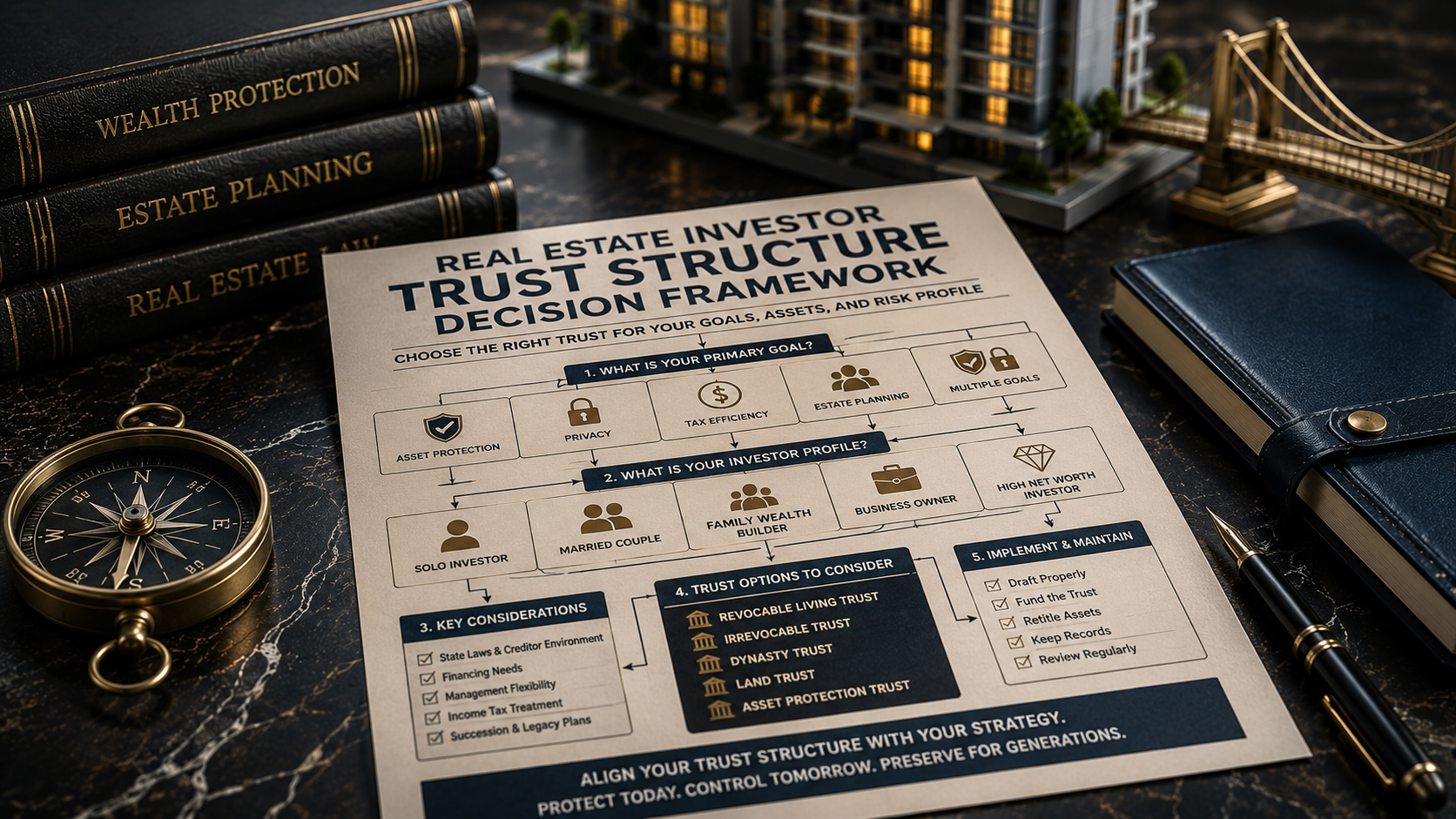
The Real Estate Investor Trust Structure Decision Framework
Step 1: Identify your primary goal
The first step in choosing a trust structure is not choosing the trust.
The first step is identifying the goal.
Real estate investors often start with the tool. They hear about revocable trusts, irrevocable trusts, land trusts, spendthrift provisions, Domestic Asset Protection Trusts, Delaware Statutory Trusts, and trust-owned LLCs, then try to decide which one sounds strongest.
That is backward.
The structure should follow the goal.
If the investor’s main goal is avoiding probate, a revocable living trust may be a strong starting point. The investor may want property or LLC membership interests to pass outside of court, with a successor trustee ready to act after death or incapacity.
If the main goal is incapacity planning, the trust must clearly say who can step in, manage the property, collect rent, pay expenses, sign documents, work with property managers, and communicate with lenders or insurance companies.
If the main goal is privacy, a land trust may be considered in states where that structure makes sense. But the investor must remember that privacy is not the same as asset protection.
If the main goal is liability separation, the conversation may start with insurance and LLCs before it starts with trusts. A trust may help organize ownership, but a rental property lawsuit usually requires a risk-management plan that includes insurance, safe operations, and possibly entity planning.
If the main goal is beneficiary protection, the investor may need trust language that controls distributions, limits access, protects heirs from poor decisions, and keeps the real estate from being sold too quickly.
If the main goal is estate tax planning, the investor may need to consider irrevocable trust planning, valuation, gift tax consequences, basis issues, and long-term transfer strategy.
If the main goal is passive real estate ownership after selling appreciated property, a Delaware Statutory Trust may be part of a 1031 exchange conversation.
If the main goal is charitable planning, a charitable remainder trust may be discussed, but that is a specialized tax and estate planning structure that requires careful professional review.
The investor should be able to describe the goal in one sentence.
For example:
I want my rental properties to avoid probate.
I want someone to manage the portfolio if I become incapacitated.
I want my children to benefit from the rental income without receiving direct control too early.
I want privacy in public records.
I want liability separation for each rental property.
I want to sell appreciated property and explore passive replacement options.
I want to reduce future estate tax exposure.
I want a structure that combines LLC protection with trust-based succession.
Once the goal is clear, the next step becomes easier.
Without a clear goal, the investor may buy the wrong structure, transfer property incorrectly, create unnecessary complexity, or believe a trust is doing something it was never designed to do.
Step 2: Match the goal to a possible structure
After the goal is clear, the investor can begin matching that goal to a possible structure.
For basic estate planning, probate avoidance, and continuity, the likely starting point is a revocable living trust. This structure may allow the investor to keep control during life while naming a successor trustee to act after death or incapacity.
For rental property liability separation, the likely starting point is not the trust itself. It may be an LLC, landlord insurance, umbrella coverage, proper leases, clean operations, and safe property management. The trust may then own the LLC membership interest so the investor’s estate plan controls what happens to the ownership interest.
For privacy in public records, a land trust may be considered. In some situations, the land trust holds title while the beneficial interest is owned by an LLC. That may help combine title privacy with liability separation. But the investor should not assume a land trust alone protects against lawsuits.
For beneficiary protection, the trust may include spendthrift provisions or continuing trust terms. This can help prevent heirs from selling, pledging, wasting, or losing the real estate interest too quickly. The trust can define how income is distributed, who manages the asset, and when beneficiaries receive access.
For advanced estate tax planning, irrevocable trusts may enter the conversation. These structures may move assets or future appreciation outside of the investor’s taxable estate, depending on the design. But they usually require giving up control and accepting more tax and legal complexity.
For creditor planning, Domestic Asset Protection Trusts may be discussed in certain states and certain circumstances. These are advanced, state-specific, timing-sensitive structures. They are not appropriate for investors trying to move property after a legal problem already exists.
For passive 1031 exchange planning, a Delaware Statutory Trust may be considered. A DST may allow an investor to exchange into a fractional interest in larger, professionally managed real estate. This may help investors who want real estate exposure without direct management, but it comes with illiquidity, sponsor risk, fees, and lack of control.
For charitable planning, a charitable remainder trust may be considered when an investor owns highly appreciated real estate and wants to combine income, tax deferral, and charitable intent. This is not a general replacement for every 1031 exchange. It is a specific planning tool with strict rules.
For multigenerational wealth planning, dynasty trust concepts may become relevant. These structures are designed to preserve wealth across generations, but they are highly dependent on state law, estate tax planning, generation-skipping transfer tax issues, trustee selection, and long-term administration.
For investors who already use LLCs, the possible structure may be a trust-owned LLC model.
In that model, the LLC owns the property.
The trust owns the LLC membership interest.
The LLC helps with property-level liability separation.
The trust helps with succession, probate avoidance, incapacity planning, and beneficiary control.
This is one of the most practical structures for many growing real estate investors because it avoids the false choice between trusts and LLCs.
The goal is not to use every structure.
The goal is to use the right structure for the right reason.
Step 3: Test the structure against real-world friction
A trust structure may sound good on paper and still fail in the real world.
That is why every proposed structure should be tested before property is transferred.
The first test is financing.
Can the property be transferred without creating due-on-sale risk?
Does the loan allow the transfer?
Is the property owner-occupied or non-owner-occupied?
Will the lender require notice or approval?
Will the investor need to refinance soon?
Will the lender accept trust or LLC ownership?
A structure that creates financing problems may not be practical, even if it looks good legally.
The second test is insurance.
Will the insurance carrier cover the property under the new ownership structure?
Does the policy name the correct insured party?
Should the trust, trustee, LLC, or other party be added?
Does umbrella coverage still apply?
Does the property use match the policy?
If the deed changes but the policy does not, the investor may create a serious coverage gap.
The third test is title.
Can the title company close a sale or refinance with this structure?
Will the trustee have authority to sign?
Will the trust document or certificate of trust satisfy title requirements?
Will the deed be accepted for recording?
Will transfer taxes, documentary taxes, or local rules apply?
A structure that creates title confusion can delay future transactions.
The fourth test is tax reporting.
Who reports rental income?
Who claims depreciation?
Who reports a sale?
Does the trust need Form 1041?
Is the trust a grantor or non-grantor trust?
Does the LLC tax classification match the plan?
Will a transfer create gift tax, estate tax, basis, or capital gains consequences?
A trust should never be created without understanding the tax result.
The fifth test is management.
Who signs leases?
Who collects rent?
Who pays expenses?
Who approves repairs?
Who hires property managers?
Who handles security deposits?
Who communicates with tenants?
Who manages the property if the investor becomes incapacitated?
If the structure makes management unclear, it needs to be fixed.
The sixth test is beneficiary practicality.
Can the successor trustee actually manage the portfolio?
Do the beneficiaries understand enough to avoid confusion?
Will the trust create family conflict?
Are the distribution rules realistic?
Will the trust preserve the property or create pressure to sell?
A structure should work for the people who must live with it later.
The seventh test is state law.
Where is the property located?
Where does the investor live?
Where is the trust created?
Where is the trustee located?
Where is the LLC formed?
Does the structure rely on protections that the property state may not recognize?
This matters because real estate is tied closely to the law of the state where the property physically sits.
The eighth test is maintenance.
Can the investor keep the structure current?
Will new properties be added correctly?
Will insurance be updated?
Will LLC records be maintained?
Will the trust be reviewed after family changes?
Will the CPA understand the structure each year?
A trust structure that cannot be maintained may eventually become a problem.
The investor should not ask only, “Is this structure legal?”
They should ask, “Can this structure actually work with my lenders, insurance policies, title companies, tax filings, property managers, heirs, and future transactions?”
That is the real test.
Step 4: Build the team before moving the deed
The final step is building the team before transferring the property.
This is where investors protect themselves from expensive mistakes.
The estate planning attorney should help design the trust around death, incapacity, succession, beneficiaries, trustee powers, and family goals.
The real estate attorney should help review the deed, title issues, state law, lender concerns, and property-specific risks.
The CPA should review tax treatment, reporting requirements, depreciation, passive losses, basis, gift tax, estate tax, capital gains, and future sale planning.
The lender should be considered before any transfer involving mortgaged property. In some cases, the investor may need direct lender consent. In others, the attorney may help review the risk. Either way, the investor should not ignore the loan documents.
The insurance agent should review the ownership structure before and after the transfer. The policy should match the deed, LLC structure, trust structure, property use, and liability exposure.
The title company should confirm what documentation will be needed for future sale, refinance, or transfer.
The property manager should know who owns the property, who has signing authority, who approves repairs, who receives notices, and what happens if a successor trustee takes over.
The successor trustee should understand the role before an emergency happens. They should know where documents are stored, who the professionals are, what properties exist, how rent is collected, and what authority the trust gives them.
This team approach is not overkill.
It is risk control.
A trust transfer can affect legal ownership, loan terms, insurance coverage, tax reporting, property management, estate administration, and family succession. One professional may not see every issue.
The investor’s job is to make sure the pieces work together.
The structure should be understandable.
The documents should match.
The deed should match the plan.
The insurance should match the deed.
The LLC records should match the trust.
The tax reporting should match the ownership.
The lender should not be surprised.
The successor trustee should not be lost.
That is how trust planning becomes useful.
A real estate investor does not need the most complicated structure.
They need the structure that solves the right problem, survives real-world friction, and can be maintained over time.
The decision framework is simple:
Identify the goal.
Match the structure.
Test the friction.
Build the team.
Then move the property only when the plan is clear.
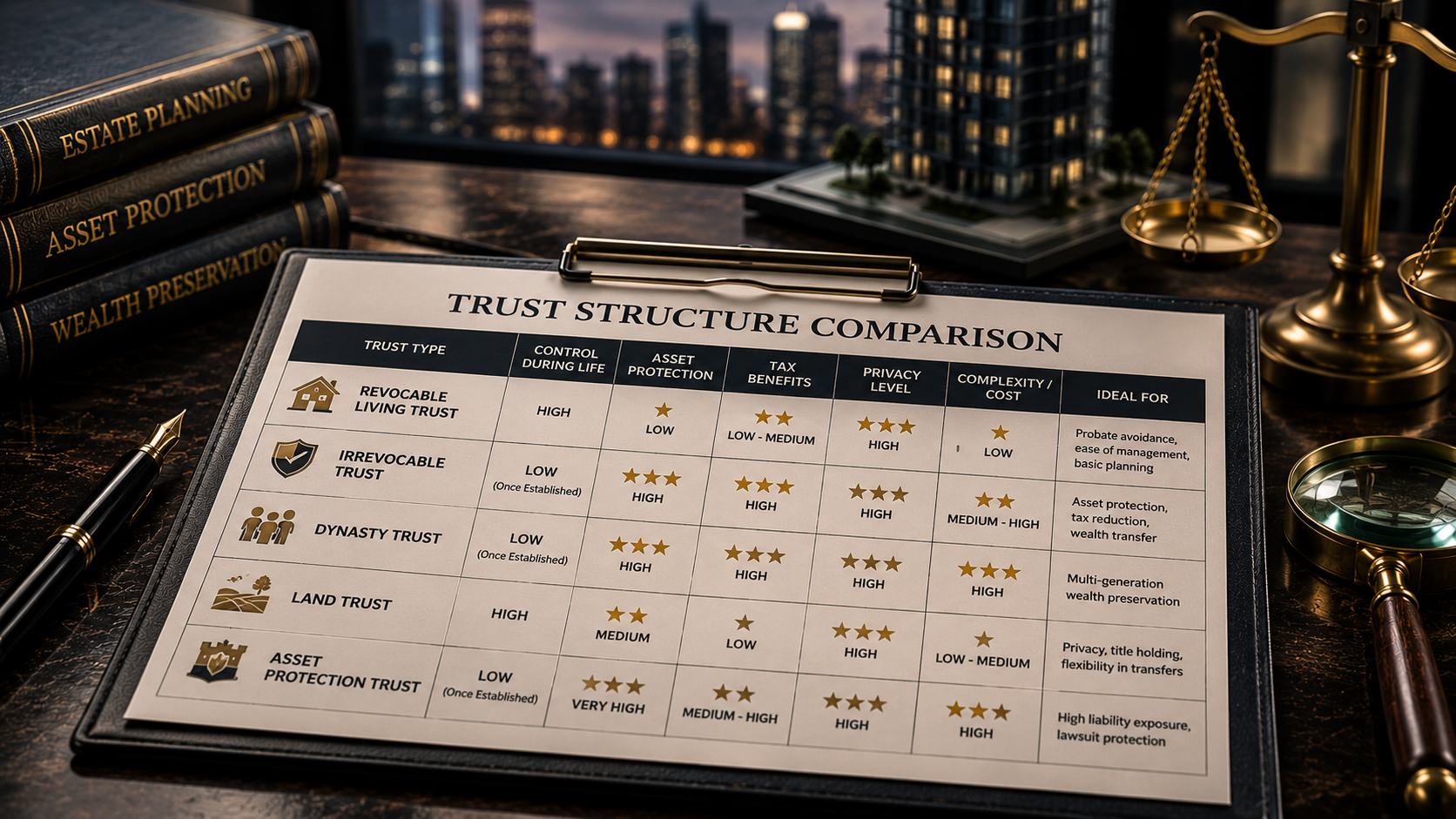
| Trust Structure | Primary Purpose | Control and Privacy | Protection Reality | Tax and Financing Friction | Best-Fit Investor |
|---|---|---|---|---|---|
| Revocable Living Trust | Probate avoidance, incapacity planning, estate organization and smoother succession. | High investor control during life. Moderate privacy, depending on how title appears in public records. | Weak for asset protection. It generally does not protect the investor from personal creditors. | Usually low to moderate tax complexity during life. Lenders, title companies and insurers may still require trust documentation. | Investors who want continuity, probate planning and a clear successor trustee. |
| Irrevocable Trust | Advanced estate planning, wealth transfer, beneficiary control and possible creditor planning. | Lower investor control because assets are usually moved outside direct personal ownership. Privacy depends on structure and state law. | Potentially stronger than a revocable trust when properly structured, funded and timed, but not automatic. | High tax and legal complexity. Financing and refinancing may become more difficult because lenders may require deeper review. | Higher-net-worth investors with estate tax, family wealth or long-term beneficiary planning concerns. |
| Land Trust | Title privacy and public-record ownership presentation. | Can provide strong public-record privacy in states where land trusts are commonly used. Control depends on trustee and beneficiary structure. | Weak by itself. Privacy is not the same as lawsuit protection, and beneficial ownership may still be discovered. | Tax treatment depends on beneficial ownership. Lenders and title companies may require extra documentation or may be unfamiliar with the structure. | Investors seeking privacy who understand that a land trust does not replace an LLC or insurance. |
| Spendthrift Trust Provision | Beneficiary protection, controlled distributions and long-term family wealth planning. | Beneficiaries usually have limited direct control. Privacy depends on the overall trust and property ownership setup. | Can help protect beneficiaries in certain situations, but it is not automatic protection for the grantor. | Tax complexity depends on whether the trust is grantor or non-grantor. Financing can become more complex if property or LLC interests stay in trust. | Investors planning for children, heirs, financially vulnerable beneficiaries or multigenerational wealth. |
| Domestic Asset Protection Trust | Advanced future creditor planning in states with specific asset protection trust laws. | Investor control must usually be limited enough for the structure to have credibility. Privacy depends on jurisdiction, trustee and records. | Potentially strong with proper timing, clean facts and applicable state law, but not guaranteed. | High tax, legal and administrative complexity. Real property remains strongly tied to the law where it is located. | High-net-worth investors with elevated liability exposure and no existing creditor problem. |
| Offshore Asset Protection Trust | Highly advanced creditor planning, usually for significant wealth or international planning needs. | Investor control is usually restricted. Offshore trustees and strict administration may be required. | Potentially strong in limited situations, but expensive, complex and not invisible to U.S. courts, tax rules or reporting systems. | Very high tax, legal and compliance complexity. U.S. property remains subject to U.S. state law. | Very high-net-worth investors with sophisticated legal, tax and compliance teams. |
| Delaware Statutory Trust | Passive ownership and possible 1031 exchange replacement property planning. | Low investor control. Investors rely on the sponsor and trustee structure. | Not primarily an asset protection structure. The main value is passive ownership and potential 1031 exchange use. | Moderate to high tax and investment complexity. Offering documents, fees, debt, sponsor quality and exchange rules must be reviewed. | Investors selling appreciated property who want passive replacement-property exposure. |
| Trust-Owned LLC Structure | Combining LLC liability separation with trust-based succession and estate planning. | Can preserve high control during life when structured through a revocable trust and controlled LLC. Privacy depends on state filings and title records. | Potentially useful for property-level liability when the LLC is properly maintained, insured and coordinated with the trust. | Moderate to high complexity. Lender approval, refinancing, title, insurance and tax reporting must be coordinated. | Investors with multiple rentals who want both liability separation and estate continuity. |
Use this table as a starting point, not as a final decision. Each trust structure serves a different purpose, and the right choice depends on the investor’s goals, property type, debt, tax picture, insurance coverage, state law, and long-term succession plan.

Trust Structures Are Tools, Not Shortcuts
Final Value
Trust structures can be powerful for real estate investors, but only when they are used for the right reason.
A trust is not a magic shield.
It is not a secret tax loophole.
It is not a substitute for insurance.
It is not a replacement for an LLC.
It is not a way to ignore lenders.
It is not a way to hide property from legitimate legal, tax, title, or compliance review.
A trust is a planning tool.
That distinction matters.
A revocable living trust may help an investor avoid probate, plan for incapacity, name a successor trustee, and create a smoother path for heirs. But it generally does not protect the investor’s assets from the investor’s own creditors while the investor keeps control.
An irrevocable trust may support advanced estate planning, beneficiary protection, or long-term wealth transfer. But it usually requires giving up control, accepting more complexity, and working closely with legal and tax professionals.
A land trust may help with privacy in public records. But privacy is not the same as asset protection. A land trust does not automatically stop lawsuits, replace insurance, or make ownership impossible to discover.
A spendthrift provision may help protect beneficiaries from poor decisions, creditors, divorce pressure, or premature access. But it should not be described as a universal shield for the investor personally.
An asset protection trust may be worth exploring for certain high-net-worth investors with elevated risk, but these structures are advanced, state-specific, timing-sensitive, and not guaranteed.
A Delaware Statutory Trust may help certain investors move from active ownership into passive 1031 exchange replacement property. But a DST also comes with lack of control, illiquidity, sponsor risk, fees, and real estate market risk.
An LLC may help contain property-level liability. But an LLC does not replace estate planning.
Insurance may help respond to covered claims. But insurance does not decide who inherits the property.
A trust may control succession. But a trust does not fix unsafe operations, poor bookkeeping, bad lending decisions, or weak insurance coverage.
For most real estate investors, the real answer is not one structure.
It is coordination.
The deed must match the plan.
The trust must match the estate goal.
The LLC must match the liability strategy.
The insurance must match the owner.
The lender must not be ignored.
The CPA must understand the tax treatment.
The title company must understand who can sign.
The successor trustee must know what to do.
The property manager must know who has authority.
The beneficiaries must be protected by clear instructions.
That is how trust planning becomes useful.
The smartest investors do not ask, “Which trust is best?”
They ask better questions.
What problem am I solving?
What asset am I trying to protect?
Who should control the property if I cannot?
Who should benefit from the property after I die?
Should my heirs receive the asset outright or under rules?
Does this structure affect my loan?
Does this structure affect my insurance?
Does this structure affect my taxes?
Does this structure work in the state where the property is located?
Does this structure coordinate with my LLC?
Does this structure still work if I buy more property later?
Those questions lead to better planning.
Trusts can help real estate investors build cleaner ownership, smoother succession, stronger family instructions, more privacy, and more durable long-term wealth strategies.
But trusts only work when they are treated with seriousness.
The goal is not to sound sophisticated.
The goal is to build a structure that actually works when life, death, taxes, lenders, tenants, title companies, insurance carriers, heirs, and courts test it.
That is the difference between paperwork and planning.
Preparation for Security
Before moving any property into a trust, slow down and map the structure.
Start with the goal.
Are you trying to avoid probate?
Protect heirs?
Create privacy?
Reduce family conflict?
Plan for incapacity?
Prepare for a 1031 exchange?
Coordinate rental property with an LLC?
Build a long-term generational wealth plan?
Then identify the friction.
Will the lender allow the transfer?
Will the insurance policy still cover the property?
Will the title company accept the trustee’s authority?
Will the CPA know how to report the income?
Will the property manager know who can sign?
Will your successor trustee know where the documents are?
Will your beneficiaries understand the plan?
The right trust structure should make ownership clearer, not more confusing.
It should make succession smoother, not harder.
It should reduce risk, not create hidden problems.
It should match the investor’s real life, not just a legal template.
If you are considering a trust for rental property, start with a professional review. Speak with a qualified estate planning attorney, real estate attorney, CPA, lender, title professional, and insurance professional before recording a deed, assigning an LLC interest, or relying on any trust structure.
Trust structures can help real estate investors protect the plan they are building.
But the trust itself is not the finish line.
The real goal is a portfolio that can survive growth, risk, incapacity, death, taxes, financing, and family transition without falling into chaos.
That is what good structure is for.
Legal, Tax, and Professional Advice Disclaimer
This guide is provided for educational and informational purposes only. It does not provide legal, tax, financial, investment, asset-protection, estate planning, lending, insurance, title, or compliance advice.
Trust structures can create significant legal, tax, title, financing, insurance, compliance, and estate planning consequences. Real estate investors should not create, fund, modify, transfer property into, rely on, or make decisions based on any trust structure without first consulting qualified professionals.
Trust law varies by state. Real estate law varies by state. Tax treatment depends on the specific facts, ownership structure, trust language, property type, income activity, transfer history, and applicable federal and state law. Lender treatment depends on the loan documents and lender requirements. Insurance treatment depends on the policy language, named insured parties, ownership structure, property use, and carrier requirements. Title treatment depends on the property, deed, trust document, trustee authority, recording rules, and local title standards.
No article can determine which trust structure is appropriate for every investor.
A revocable living trust may be appropriate for one investor and incomplete for another. An irrevocable trust may support advanced planning for one family and create unnecessary loss of control for another. A land trust may be useful for privacy in one state and less practical in another. A Delaware Statutory Trust may help one investor complete a passive 1031 exchange and be unsuitable for another investor who needs liquidity or control. A Domestic Asset Protection Trust may be worth exploring for one high-net-worth investor and inappropriate for another.
The details matter.
An investor’s state of residence, property location, property type, debt structure, family situation, net worth, tax position, liability exposure, estate plan, investment goals, and long-term ownership strategy can all affect whether a trust structure is appropriate.
Trust structures may help with probate avoidance, incapacity planning, privacy, beneficiary control, succession, tax planning, 1031 exchange planning, or long-term wealth transfer, depending on the structure and facts. However, a trust can also create problems if it is drafted poorly, funded incorrectly, coordinated improperly, or used for the wrong purpose.
A trust does not automatically protect rental property from lawsuits. A trust does not automatically eliminate taxes. A trust does not automatically avoid lender restrictions. A trust does not automatically preserve insurance coverage. A trust does not automatically make ownership invisible. A trust does not automatically work the same way in every state.
Investors should be especially cautious of aggressive trust promoters. Any claim that a trust can eliminate income taxes, convert personal living expenses into deductions, hide assets from legitimate creditors, defeat all lawsuits, bypass all lender restrictions, or provide total anonymity should be reviewed carefully with a licensed attorney and CPA.
Before creating, funding, modifying, transferring property into, or relying on any trust structure, real estate investors should consult a qualified estate planning attorney, real estate attorney, CPA, lender, title professional, insurance professional, and any other appropriate advisors.
This guide should be used as a framework for understanding concepts, identifying risks, asking better questions, and preparing for professional review. It should not be used as a substitute for individualized legal, tax, financial, lending, insurance, title, or estate planning advice.
No related posts.