


Key Takeaways
- Real GDP grew at a 4.3% annual rate in the third quarter of 2026, the Bureau of Economic Analysis said in its second estimate on November 25, revised up 0.9 percentage point from the 3.4% advance estimate and up from 2.2% in the second quarter.
- Reuters called 4.3% the fastest pace in three years, and economists polled by Reuters had expected a revision to only 3.5%.
- Housing went the other way. Residential investment fell 3.4% in the third quarter after rising 2.8% in the second quarter, even as business investment rose 16.1%.
- Underlying demand was stronger than the headline. Real final sales to private domestic purchasers rose 5.8%, revised up from 4.9%, which Reuters noted was the fastest since the second quarter of 2021.
The U.S. economy did not just grow in the third quarter. It grew much faster than the government first reported, and housing was one of the few parts of it that shrank.
The second estimate from the Bureau of Economic Analysis, released November 25, 2026, puts real gross domestic product growth at a 4.3% annual rate for July, August, and September. That is a 1.1% gain at a quarterly rate, and it is nearly double the second quarter’s 2.2% pace.
For real estate investors, the number that matters most is buried inside that strong headline. Residential investment, the GDP component that covers home construction and brokers’ commissions, fell while almost everything around it accelerated.
The Economy Grew Faster Than Anyone First Reported
BEA said real GDP was revised up 0.9 percentage point from the advance estimate, primarily reflecting upward revisions to investment and consumer spending. Current-dollar GDP rose 6.2%, up from 5.6% in the advance estimate.
Consumer spending did much of the work. Reuters reported that growth in consumer spending, which accounts for more than two-thirds of the economy, was revised up to a 4.2% rate from the previously reported 3.8% pace.
Business investment was the other engine. Business spending on equipment increased at a 21.8% rate, an upgrade from the 20.9% rate estimated last month, and Reuters noted that business investment has posted three straight quarters of double-digit growth.
| Measure, Q3 2026 | Advance estimate | Second estimate |
|---|---|---|
| Real GDP | 3.4% | 4.3% |
| Current-dollar GDP | 5.6% | 6.2% |
| Real final sales to private domestic purchasers | 4.9% | 5.8% |
| Consumer spending growth | 3.8% | 4.2% |
| Business equipment spending growth | 20.9% | 21.8% |
| Price index for gross domestic purchases | 3.0% | 2.7% |
BEA said the contributors to the increase in real GDP were increases in investment, consumer spending, and government spending, partly offset by a decrease in exports. Imports, which are a subtraction in the calculation of GDP, increased.
Compared with the second quarter, BEA said the acceleration primarily reflected an acceleration in investment and an upturn in government spending, partly offset by a downturn in exports. Imports increased more in the third quarter than in the second quarter.
The income side told the same story. Real gross domestic income increased 4.4% in the third quarter, compared with an increase of 2.3% in the second quarter, and the average of real GDP and real GDI also increased 4.4%.
Profits from current production increased $206.0 billion in the third quarter. That is a smaller gain than the $384.0 billion increase in the second quarter, so companies made more money, just at a slower clip.
Housing Shrank Inside a Booming Economy
Residential investment fell 3.4% in the third quarter, according to the BEA data tables as reported by TD Economics and Briefing.com. That reverses the second quarter, when residential investment rose 2.8%.
Business investment, by contrast, rose 16.1%, up from the 12.7% pace in the advance estimate, with gains across equipment, intellectual property products, and structures. TD Economics attributed the residential decline to weaker sales and construction activity.
That split is the fresh insight in this release. A weak housing sector inside a weak economy usually means rate relief is coming, because the Federal Reserve eases to rescue growth.
A weak housing sector inside the fastest-growing economy in three years means something different. Growth this strong gives the Fed no reason to hurry, which is consistent with purchase demand behaving the way it did last week, when purchase applications jumped 10% even as the 30-year rate hit 7.38%.
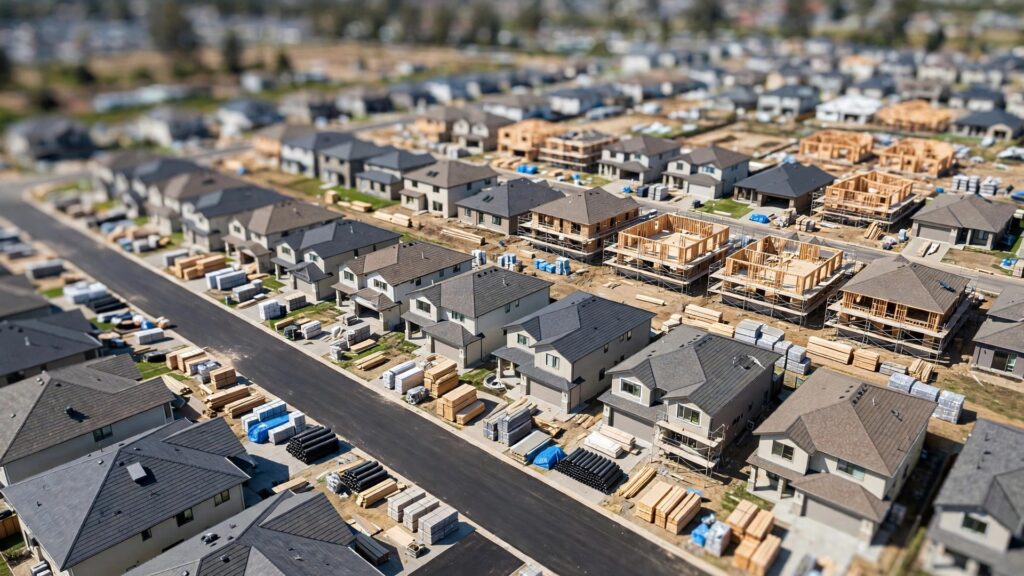
Builders are working around the rate problem rather than waiting it out. New-home sales jumped 14.2% to 701,000 in October, a result the Census Bureau reported the same day, while the existing-home side stayed stuck.
The revision details also show where the extra growth came from. BEA said the revision to investment was led by an upward revision to intellectual property products, notably software, while the revision to consumer spending reflected an upward revision to goods that was partly offset by a downward revision to services.
- Investment revision: led by intellectual property products, notably software, based primarily on revisions to the Bureau of Labor Statistics Producer Price Index for system and application software publishing.
- Goods revision: led by other nondurable goods, mainly pharmaceuticals, plus recreational goods and vehicles, mainly computer software and accessories, and gasoline and other energy goods.
- Services revision: the largest contributor to the downward revision was health care, covering both hospital and nursing home services and outpatient services.
Prices inside the GDP report moved the other way from growth. The price index for gross domestic purchases increased 2.7% in the third quarter, revised down 0.3 percentage point from the previous estimate, while the PCE price index increased 2.1% and the core PCE price index, excluding food and energy, increased 2.5%, both the same as previously estimated.


What Beginner Investors Should Do With a 4.3% Print
A strong GDP print is not a buy signal by itself. It is a signal about which assumptions in a deal are safe and which ones are wishes.
- Stop underwriting a rate rescue. With real GDP at 4.3% and underlying private demand at 5.8%, the economy is not asking for lower rates. Freddie Mac’s average dipped to 7.21% this week, and a deal should work at that level, not at a hoped-for 6%.
- Treat residential weakness as a supply story, not a collapse story. Residential investment fell 3.4% while consumer spending rose 4.2%. Demand exists; the constraint is the cost of money and the cost of building, which supports rents and values on homes that already exist.
- Watch builders, not headlines, for entry points. Business investment rose 16.1% while residential investment fell, and builders still moved 701,000 new homes at an annual rate in October. Builder incentives and rate buydowns remain the most realistic discount channel for a beginner buying new.
- Keep an eye on profits, not just growth. Corporate profits rose $206.0 billion after rising $384.0 billion in the second quarter. Slower profit growth alongside fast GDP growth is an early sign to be pickier about rent growth assumptions in a pro forma.
- Mark December 23 on the calendar. BEA’s next release, the third estimate for the third quarter, arrives December 23, 2026, at 8:30 a.m. EST. A second large revision would change how much weight this 4.3% figure deserves.
The plain read is that the economy is strong and housing is the exception, not the rule. Investors who price deals off the rates and construction costs that exist today, rather than off a slowdown that this report says is not happening, are working from the numbers BEA actually published.
Data source: U.S. Bureau of Economic Analysis, GDP (Second Estimate) and Corporate Profits, 3rd Quarter 2026, released November 25, 2026; residential investment and business investment detail from the BEA data tables as reported by TD Economics and Briefing.com on November 25, 2026, and fastest-pace and forecast context from Reuters on November 25, 2026.