
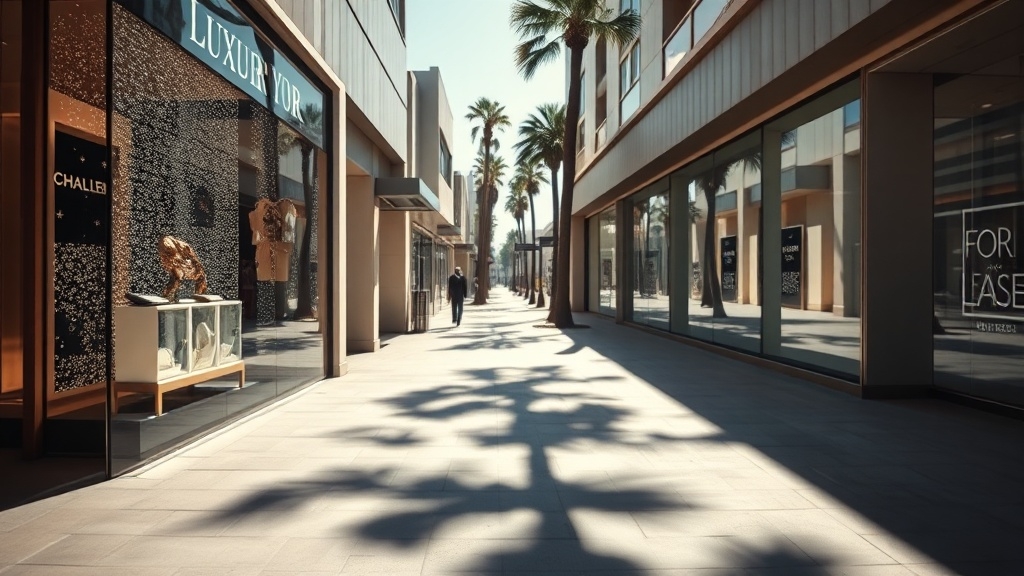
Navigating Fluctuating Rent Dynamics
The Los Angeles retail market is facing fluctuating rent dynamics. This situation requires careful navigation by stakeholders.
Average asking rates have decreased by 25.8% year-over-year. This makes rental negotiations essential.
Retailers must optimize location benefits. They need to do this without financially over-committing.
Meanwhile, high-demand areas see modest but notable growth in prime lease rates. Prime retail locations remain in high demand despite store closures.
The recent decrease in retail rental rates mirrors similar trends seen in Philadelphia, where real estate listings have plummeted due to market uncertainties.
Stakeholders must evaluate location-specific trends. These trends show resilience in live-work-play districts.
Dense populations and good connectivity contribute to rent stability in these districts.
Landlords are offering concessions to attract and retain tenants amid market fluctuations.
Adopting flexible occupancy strategies is crucial. Doing so allows capitalizing on prime urban areas.
These areas benefit from strong connectivity and consumer demand. This is despite higher rent levels.
Vacancy Rates and Space Availability Insights
Navigating the shifting rent dynamics in Los Angeles reveals the complex landscape of the retail sector. Vacancy rates and space availability insights highlight an environment filled with both opportunities and challenges.
The retail vacancy rate experienced significant variations, sitting at 10.3% in early 2025. However, there is potential for recovery with a decrease to between 5.3% and 5.9% by mid-year.
These mixed trends illustrate market challenges, with areas like downtown Los Angeles and Santa Monica facing high vacancy rates. Despite a 6.1% increase in space offerings, net absorption remains negative. Over 507,000 square feet of retail space have been vacated. The total sales volume increased by $811 million, which is below the 10-year average, highlighting the ongoing adjustments in market performance.
The influx of retail space delivery, coupled with new geographical shifts, underscores the ever-changing nature of supply and demand. Economic headwinds continue to test resilience in Los Angeles’ retail environment.
Tenant Trends and Retail Space Absorption
Amidst the evolving economic backdrop, tenant trends within Los Angeles’ retail sector illuminate a market in flux.
A noticeable shift in tenant preferences emerges, as retailers gravitate towards prime locations within urban corridors such as Downtown Los Angeles and Beverly Hills.
Demand shifts highlight a preference for flexible retail environments that adeptly integrate offline and online experiences. This reflects adaptations to growing e-commerce influences.
Additionally, Los Angeles demonstrates strategic retail space absorption despite national declines. Although 3.1 million sq.ft. were vacated, absorption is more favorable in prime submarkets, with signs of stabilization.
Emerging neighborhoods benefit from the influx of residents, bolstering retail leasing activity.
The industrial sector’s strength showcases a contrast with the challenges facing retail markets, highlighting diversified interest in different property classes.
The increasing focus on quality and strategic absorption underscores market resilience amid challenges.
Variation in Retail District Performance
Los Angeles’ retail districts display a wide range of performance levels. This is due to varying locations and shifts in consumer behavior.
High-street areas, such as Downtown LA, continue to face challenges. Elevated vacancy rates persist despite high demand for prime locations, especially in regions affected by wildfires.
The recovery struggle post-pandemic is ongoing. Foot traffic and tourist numbers haven’t fully rebounded, highlighting issues in these premium areas.
In contrast, suburban regions paint a different picture. Areas like Santa Clarita Valley and South San Gabriel Valley show lower vacancy rates.
This is attributed to burgeoning residential development. Retailers are targeting these regions due to population growth driving demand.
The localized residential expansion supports retail resilience. This is proving to be more effective than current urban high-street models. Furthermore, the intense competition among investors for prime spaces mirrors the fierce dynamics in Miami’s industrial market.
Economic Influences on the Retail Sector
The varying performance across Los Angeles’ retail districts highlights the broader economic influences transforming the retail sector.
Inflation is eroding consumer confidence as it reduces purchasing power. Consumers are prioritizing essential goods over discretionary spending.
Retailers are adapting by altering pricing strategies, using promotions and loyalty programs to engage customers.
Rising interest rates add to these challenges. Increased borrowing costs and higher consumer loan payments limit spending capacity.
The cost of living is surging ahead of wage growth, squeezing household budgets further. This particularly affects the retail market for non-essential goods.
Approximately 1 million FHA mortgages are currently in default, mirroring broader market challenges beyond just retail.
Economic uncertainties, fueled by policy debates, impact both consumer behavior and confidence.
Retailers must navigate this complex landscape. They need to balance pricing strategies with evolving economic conditions.
Assessment
The Los Angeles retail market is experiencing volatility. Declining rent prices and increasing vacancy rates are reshaping the landscape.
Retail districts show varied performances. Some areas suffer more than others.
Fluctuating tenant trends contribute to uncertainty. This challenges stakeholders to adapt.
Economic pressures exacerbate the turmoil. Strategic navigation becomes essential.
This situation demands close monitoring. The city’s retail environment teeters on the brink of transformation.





















4 Responses
Interesting, but doesnt this LA rent drop just reflect an overdue correction in an overvalued market? Could actually be healthy for local economy, no?
Interesting article, but isnt the 9% drop just a correction of overpriced LA retail rents? Maybe its the market naturally balancing itself out? 🤔💭
Maybe so, but isnt overpricing a symptom of a distorted market to begin with? 🎯💥
Dropping 9% seems drastic, but isnt this just a correction, considering LAs inflated retail rents? Maybe its a wake-up call for landlords!