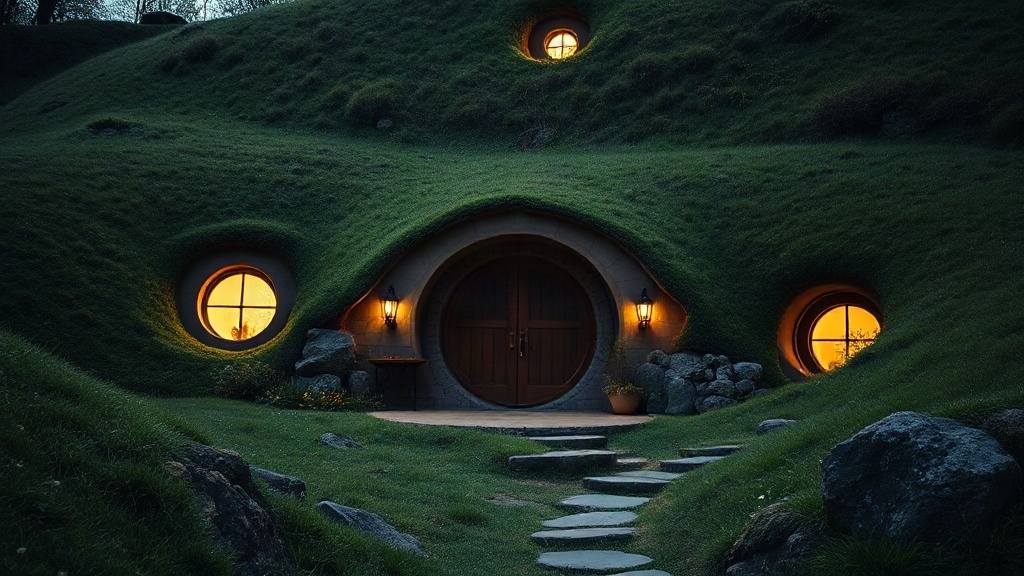


What Is the Ohio Hobbit Home?
A storybook label defines the Ohio Hobbit Home as a subterranean, earth-sheltered residence in Ohio. It is marketed for its hill-built, Tolkien-style appearance. The listing places the property on nearly 8 acres along the Huron River in Huron, Northeast Ohio, emphasizing its riverfront setting.
The name functions mainly as a real estate label, not a formal architectural classification.
It refers to a whimsical underground home whose design emphasizes earth-sheltered architecture and a distinctive, buried profile. Like other housing discussions, interest in long-term durability and sustainable designs often shapes how unusual properties are evaluated.
Design Profile
Listing details describe a ranch-style home built into a hillside. Much of the living area sits below ground level.
The interior is presented with an open-concept layout, about 2,100 square feet, three bedrooms, and two bathrooms.
A wood-burning fireplace anchors the living room. The kitchen includes standard appliances.


Market Identity
The property is framed as a rare lifestyle offering.
Its storm-resilient construction and terrain integration strategies strengthen its image as a one-of-a-kind luxury residence.
Where Is the Huron Hobbit House Located?
Set in Erie County at 10510 Mudbrook Road, the Huron Hobbit House is located in Huron, Ohio, on a secluded rural parcel along the Huron River.
This Huron location places the property in northern Ohio near the Lake Erie shoreline region, though it is in the town of Huron, not Huron County.
The site spans about 7.93 acres with wooded riverbank terrain and roughly 250 feet of direct water frontage.
Its secluded setting contrasts with urban districts like Chicago’s West Loop, where demand for flexible workspaces and mixed-use amenities is reshaping commercial real estate.
| Detail | Location Fact |
|---|---|
| Address | 10510 Mudbrook Road |
| Town | Huron, Ohio |
| County | Erie County |
| Waterfront | Huron River frontage |
The river-adjacent setting is central to the listing’s appeal.
Coverage highlights riverfront privacy, scenic surroundings, and a private parcel outside the city core. Access is tied to local Huron roads and Mudbrook Road.
What’s Inside the $850K Underground Home?
Behind the riverfront privacy, the interior feels more like a conventional ranch-style home than a bunker.
About 2,100 square feet is arranged in an open-concept layout.
The main living, dining, and kitchen areas resemble a standard ranch residence.
Earth-sheltered construction shapes the home, but it avoids a cave-like feel.
Windows on two sides and multiple skylights bring in natural light.
That keeps the central rooms unexpectedly bright.
Three bedrooms and two bathrooms support a practical floor plan.
A wood-burning fireplace and accent wall help define the living room.
Views of the yard, patio, and gazebo soften the underground setting.
Functional Rooms
The kitchen measures 12.7 by 17.11.
It includes a dishwasher, range, and refrigerator.
One bedroom has no windows and relies on artificial light.
Hidden storage is integrated subtly within the home’s otherwise conventional feel.
Why Is the Ohio Hobbit Home Priced at $850K?
With no meaningful local comparables to anchor the valuation, the $850,000 asking price reflects a property judged outside normal northern Ohio pricing models.
Pricing Pressure
Agent Laurie Brill said the home could not be measured against nearby sales, so the pricing strategy leaned on broader national comparisons.
That reflects how standard appraisal methods become less useful when a residence is 90 percent underground and built into a hillside.
Land and Build Costs
The land value also appears central.
About eight acres along the Huron River add substantial worth beyond the house itself, especially in a scenic natural setting.
The custom earth-sheltered construction likely increased excavation, engineering, and replacement costs.
Its energy-efficient, durable design further supports the figure, while strong buyer interest suggests the seller is testing a premium market.
How Rare Is a Home Like This in the U.S.?
Just how uncommon these properties are becomes clear in the numbers.
Older estimates suggested only 5,000 to 7,000 underground homes existed nationwide by the late 1990s. Even then, reliable statistics were hard to find.
That makes a hobbit-style listing an extreme case of market rarity within an already tiny niche.
Why the Market Struggles
Earth-sheltered homes use specialized construction rarely seen in standard suburban inventory.
Hobbit-style versions appear as scattered one-off listings across only a handful of states. Many attract national attention because novelty, not volume, defines their presence.
Even during the energy-conscious building surge of the late 1970s, total construction remained modest compared with the broader housing market.
A 1999 estimate said only about 100 earth-covered houses were being built at any given time.
That scarcity also creates valuation challenges. In many areas, there simply are no nearby comparable sales.
Assessment
The Ohio hobbit home stands out as a rare underground listing in a market dominated by conventional housing.
Its $850,000 price reflects scarce design, extensive custom construction, and the privacy of a highly unusual residence near Huron.
Properties of this type remain exceptionally uncommon in the United States, limiting direct comparisons and reinforcing niche-market value.
The listing underscores how distinctive architecture can command attention, even as buyers weigh function, maintenance, and long-term resale risk.