


Key Takeaways
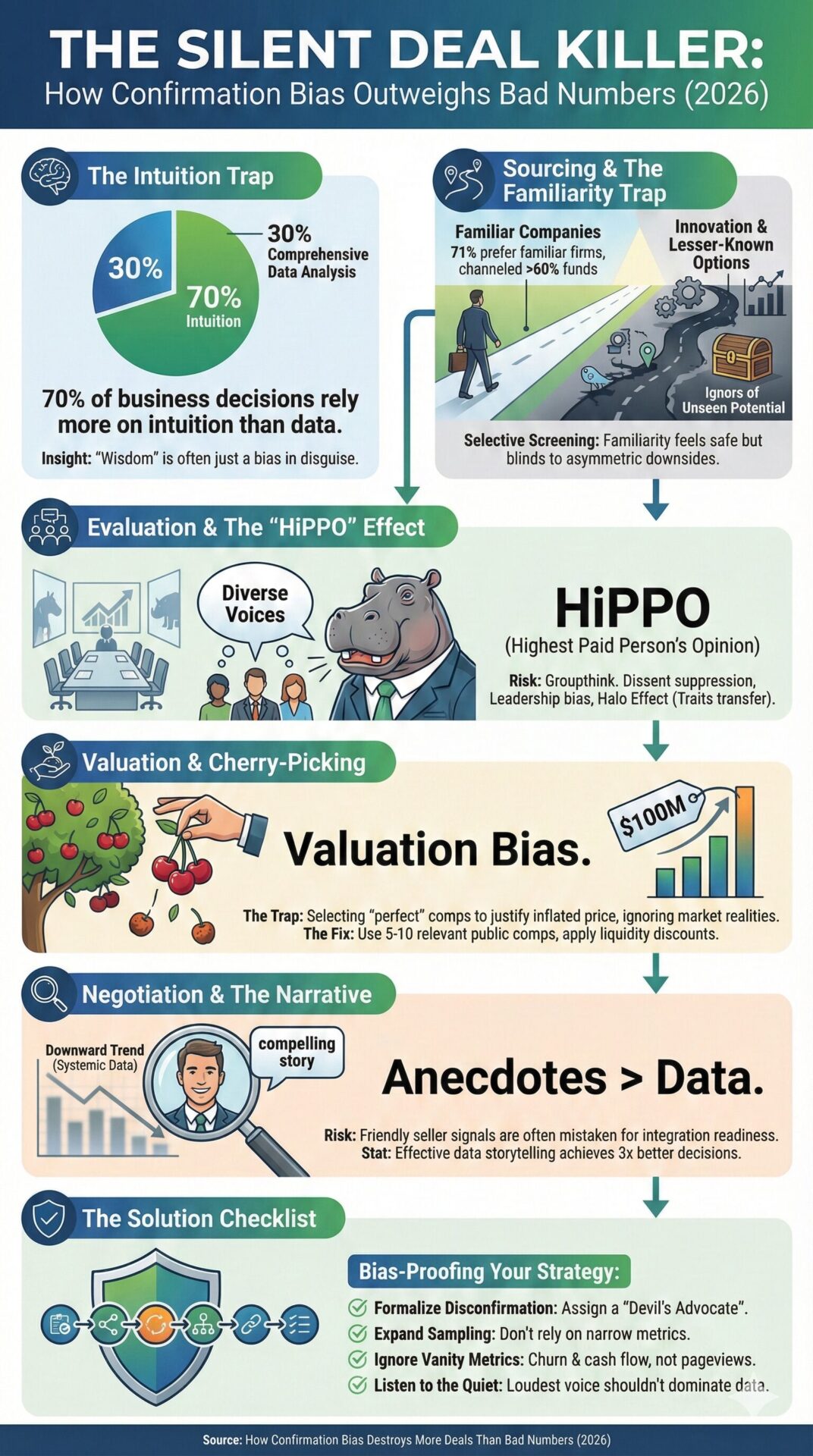
- 70% of business decisions rely more on intuition than on comprehensive data analysis.
- Confirmation bias in decision-making can lead to overlooked opportunities and ignored red flags.
- Evaluating both numbers and cognitive biases is crucial for sound business decisions.
The Hidden Pitfalls of Intuition in Business Decisions
When you’re inside a boardroom, this tendency can be a major pitfall. You might think it’s just the numbers that need to be checked, but often it’s your own brain playing tricks on you through confirmation bias.
It’s not just caution about wrong spreadsheets that should worry you—it’s the ignored red flags and the overlooked opportunities.
What if your wisdom isn’t as wise as you think?
Impact of Familiarity on Deal Sourcing
Let’s plunge into how familiarity affects deal sourcing. You might think investment behavior is purely logical, yet familiarity influence can steer even seasoned investors.
In the U.S., about 71% of early-stage investors prefer familiar companies, channeling over 60% of their funds to them. Why? Familiarity gives a deceptive sense of security.
Familiarity reduces the learning curve and increases confidence in platforms, allowing investors to navigate effortlessly within recognizable elements.
Despite the cognitive ease, this tendency overlooks innovative opportunities, such as blockchain-enhanced real estate, which are gaining traction and challenging traditional investing norms.
Long-term and short-term investors alike fall into this comfort zone. Many believe familiar equities have inherent strength, often overlooking potential returns from lesser-known options.
This pattern isn’t just a quirk. It reflects a deep-seated bias towards what’s known and trusted. Your decisions mirror this too, favoring stocks with perceived trust.
However, welcoming the unfamiliar could reveal unseen potential, possibly transforming your investment terrain.


The Risk of Selective Screening in Pipeline Evaluation
Familiarity feels safe, but it can blind us to the real risks in deal sourcing. Selective screening presents several pitfalls:
- Screening pitfalls: Ignoring broad criteria leads to pipeline bias, amplifying false correlations and evaluation distortion.
- Decision metrics: Narrow metric focus skews true potential, causing poor selection thresholds that overlook predictive noise.
- Selective evidence: Adjusting rules post-outcome inflates success signals, damaging data integrity and creating false positives.
- Evaluation distortion: With unsupervised steps, standard cross-validation falters, misrepresenting p-values unless selective inference is applied.
When you rely too heavily on familiar paths, you risk exploring potential deals in your evaluation process.
Inaccurate decision metrics result in misguided choices, harming long-term growth and diversity in your pipeline.
The Pitfalls of Relying on Vanity Metrics
While chasing flashy numbers might seem appealing, it’s like picking candy instead of healthy food—you might think it satisfies you, but it doesn’t help you grow. Vanity metrics can mislead you with false success, giving misleading signals about your progress.
These shiny stats, like high follower counts or pageviews, don’t always align with core business objectives. They don’t show if people are actually buying or sticking around.
Relying on these numbers can have serious vanity metrics consequences. You’ll allocate resources poorly, based on numbers that don’t reflect true value, potentially harming your bottom line.
It’s easy to get caught up in numbers that are simple to inflate or game, leading to short-term satisfaction. Instead, focus on metrics that drive meaningful growth and alignment with your core goals.
Group Endorsement and Its Dangers to Deal Evaluation
Ever felt the excitement of being in a group where everyone seems to be on the same page?
It’s a great feeling, but let’s pause for a moment and chat about the potential pitfalls of groupthink when evaluating deals.
The opinion of the Highest Paid Person in the room, often referred to as HIPPO, can sometimes dominate the conversation, overshadowing other valuable insights and leading to decisions that aren’t as well-considered as they should be.
And let’s not forget about the halo effect—it’s easy to get swayed by a group’s stellar reputation, but that doesn’t guarantee their endorsements will always be in your best interest.
Speaking of which, let’s now delve into…
Risks of Groupthink
Even though working with a team can seem powerful, groupthink can quietly sneak in and make deal evaluations risky. It undermines decision quality by suppressing dissent and encouraging consensus pressure.
When leadership bias dominates, critical appraisal suffers, and cognitive dissonance takes over.
Consider these four risks:
- Dissent suppression: Pressure to agree stifles minority opinions and blinds teams to essential insights.
- Leadership bias: Dominant voices push the group toward specific conclusions, shutting down dialogue norms.
- Homogeneous team composition: Similar backgrounds create a narrow focus, reducing decision effectiveness.
- Lack of external validation: Ignoring outside perspectives means confirmatory evidence goes unchecked.
Stay aware! This vigilance promotes better outcomes and avoids escalation of commitment to flawed deals.
Influence of HIPPO
Groupthink isn’t the only thing that can cause problems in a team. HiPPO dynamics can severely skew decision making. When the highest-paid person’s opinion dominates, authority bias makes you defer to them without question.
This influence unwittingly silences diverse voices, and social pressure amplifies conformity. Teams bring only information that aligns with senior views, sidelining hard data.
Imagine a meeting where colleagues nod in agreement, but not because they truly believe the opinion is right—it’s about playing safe. These HiPPO-led decisions can crush objective evaluation, leaving deals misjudged and risks unseen.
HiPPO authority limits creative solutions and sidelines vital input, diminishing deal quality. To truly excel, empower all voices to plunge the pattern of misplaced authority.
Halo Effect Pitfalls
While evaluating deals, you might fall into the trap of the halo effect without even realizing it. This halo bias often arises through cognitive distortions, making one impressive trait seem to enhance unrelated areas.
In group settings, endorsement by respected individuals can lead to alignment with skewed views.
Here’s how this might look:
- Trait Transfer: A strong reputation can mislead you into overlooking poor financial performance.
- Impression Management: Admiration for influential figures pressures you to conform, dampening critical analysis.
- Echoed Opinions: Group endorsement leads to homogenous views, masking a deal’s weaknesses.
- Blind Spots: Halo-induced biases prevent noticing areas needing improvement, derailing sound deal evaluation.
Recognize these traps to make wiser business choices.
Neglecting Contrarian Hypotheses in Sourcing
In the world of deal sourcing, it’s essential to explore contrarian hypotheses to avoid costly mistakes. You need to challenge assumptions and apply analytical rigor during hypothesis testing. Without contrarian sourcing, you risk overlooking asymmetric downsides.
| Process | Consequence | Solution |
|---|---|---|
| No devil’s advocate | Missed failure detection | Formalize disconfirmation |
| No red-team reviews | Post-deal surprises | Structured reviews |
| Over-reliance on anecdotes | False confidence | Evidence evaluation |
| No contrarian checks | Longer exits, frequent write-downs | Pre-screen with rigor |
Make critical thinking a priority. Risk assessment should involve downside detection by evaluating evidence thoroughly. Don’t let social proof bias cloud your judgment. Seek diverse insights, and remember: rigorous challenge of assumptions strengthens your deal pipeline and decreases surprise elements.
Valuation Bias Through Supporting Data Overweight
Let’s say you’re crafting a deal, and you catch yourself clinging to only the data that supports your rosy valuation, brushing off any contradictory information as if it doesn’t exist.
This tendency to lean on cherry-picked data can lead you down the path of inflating metrics and relying too heavily on perfect scenarios.
So, take a moment to ask yourself: Am I missing any critical evidence that could challenge my viewpoint?
Addressing this bias can be the key to making more sound and reliable decisions.
Speaking of sound decisions, let’s dive into the next topic: tackling communication hurdles in team projects.
Supporting Data Oversight
Envision this: You’re part of a deal team working on an exciting valuation. Your diligence process is intense, ensuring valuation integrity isn’t compromised by cognitive distortions.
However, the allure of supporting data can skew your judgment.
Accuracy is essential, but overweighting data that backs your hypothesis undermines it.
Consider these steps to mitigate bias:
- Expand Sampling: Diversify your data sources to avoid a narrow focus.
- Embark on Rigor: Maintain analysis rigor by questioning evidence weighting and demanding data accuracy.
- Emphasize Documentation: Keep thorough documentation practices to monitor performance scrutiny.
- Outcome Check: Avoid over-reliance on early positive signals, ensuring feedback loops correct course if needed.
Contradictory Evidence Neglect
Why do we sometimes ignore the facts right in front of us?
It happens when confirmation neglect kicks in. You focus on what fits your story, leading to evidence dismissal.
Picture it: you’re choosing between investment opportunities. Statistics scream success, but you recall a negative anecdote. That nagging story—borne from a visceral connection—nudges you the other way, despite clear data.
In the U.S., decision-makers fall prey to this bias, even with clear statistical evidence. You’ve seen it affect budget choices, insurance selections, and even forensic judgments.
It creates blind spots, making us ignore what contradicts our beliefs. By recognizing this tendency, you can protect your decisions from being swayed by confirmation bias. Addressing it’s the first step toward better outcomes.
The Flaws in Confirmation-Driven Questionnaires
When creating questionnaires, it’s vital to make certain they’re designed to collect unbiased data. Misleading question phrasing can lead respondents toward specific answers, increasing confirmation bias. To mitigate this, focus on clear and neutral language.
Consider these steps to improve your questionnaires:
- Diversify Question Types: Mixing open-ended and closed questions reduces pattern biases.
- Review for Bias: Regularly audit questions to identify unintentional leading prompts.
- Balance Data Collection: Include metrics like conversion rates instead of only emphasizing engagement to prevent incomplete datasets.
- Encourage Perspective Variation: Involve diverse team members in survey design to avoid echo chambers.
These enhancements guarantee your data’s integrity, helping to create trustworthy insights without assumptions clouding your judgment.
Ignoring Contradictory Customer Feedback
Although it might be tempting to brush off negative feedback, doing so can severely impact your business. When you ignore customer complaints, deals often stall. Customer reluctance grows when feedback is dismissed, dragging out sales cycles and causing missed opportunities. You’ll find that responding to feedback boosts your evaluation criteria and keeps customers engaged.
It’s essential to address reviews because leaving them unacknowledged increases churn risk by about 15%.
Moreover, your reputation suffers. Ignoring feedback can hurt local search visibility, shrinking your customer pool. Prospects notice silent brands and view them with distrust. Perception of neglect fuels negative sentiment online, causing 78% of customers to avoid purchases.
Talking to your customers and addressing complaints can turn skeptics into loyal patrons.
Cherry-Picking Comps for Price Justification
You might feel like you’re nailing the pricing game by handpicking comps that match your goals, but be careful—that strategy can backfire.
Cherry-picking might tilt your valuation benchmarks and blow your bids out of proportion, leaving you in a tricky spot financially.
So, what’s the better play?
Aim for a well-rounded approach that makes sure your decisions hold up when they hit real-world conditions.
Ready to dive into the next part?
Let’s explore how to strike that perfect balance and avoid those pitfalls.
Selective Comparable Selection
Envision this: you’re setting the stage for a home sale, and the thrill of the deal gets you selective with your comps.
You’re tempted to cherry-pick, focusing only on high-value comparables. But watch out! Comparable quality and selective adjustments can lead to over-inflated valuations.
Consider these practices:
- Location Proximity: Choose comps close by, reflecting the neighborhood’s true market trends.
- Physical Similarity: Match size, bedrooms, and amenities for genuine comparable quality.
- Recent Sales: Stay within a 6-12 month range to avoid outdated data.
- Comprehensive Adjustments: Guarantee adjustments are based on the market, not arbitrary guesses.
Understanding this, you’re equipped to approach pricing with honesty and accuracy, guaranteeing fair transactions for all involved.
Skewed Valuation Benchmarks
When you’re setting a price for a property, the temptation to cherry-pick comps can be strong. This practice creates skewed benchmarks and results in valuation distortions.
You might think selecting the best comparables provides justification for a higher asking price. However, it leads to an inaccurate portrayal of the market.
Instead of an objective pricing decision, you make one based on favorable, yet unrepresentative data points. This creates a distorted view that undermines the fairness of the deal.
Comps should include a balanced selection that reflects the property’s factual market position. This guarantees a more accurate and fair valuation, giving a true representation of its value.
Being thorough and unbiased helps maintain integrity and supports successful negotiations.
Inflated Bid Considerations
If you’ve ever been in a deal, you know how tempting it can be to cherry-pick comps.
While searching for validation, you might grab the most appealing data points, leading to inflated expectations and competition. But this can backfire, skewing valuations and eroding trust.
To avoid inflating bids due to cherry-picking, consider these practices:
- Curate 5-10 Relevant Comps: Prioritize industry, stage, and business model similarity to maintain credibility.
- Use Public Comps: Consistent accounting standards provide fair valuation.
- Evaluate Key Metrics: Analyze size, revenue stream, and growth rate for an accurate picture.
- Apply Discounts: Account for the lack of marketability in private company comps.
Shortcomings in Scenario Analysis
Scenario analysis is a vital tool for making informed decisions in today’s complex U.S. market. However, when scenario limitations like data inconsistencies creep in, it can lead to misleading results.
If you place too much trust in data derived solely from internal sources, you’re setting up systemic blind spots. Likewise, model fragility means overly complex models can become unreliable and confuse decision-makers.
Relying heavily on assumptions without proper examination will make you miss critical insights.
Interpretive challenges arise when you treat scenarios as predictions instead of frameworks for decision support.
Strategic Bias in Deal Negotiations
Negotiating deals in today’s market requires not just skill but also vigilance against strategic biases that distort our views.
When it comes to strategic filtering, beware of common negotiation pitfalls:
- Overconfidence Parade: Your confidence is admirable, but avoid ignoring diverse thoughts. Engaging only with like-minded team members stunts growth.
- Data Misinterpretation: Don’t let self-serving biases color your interpretation of ambiguous data. Seek clarity beyond surface impressions.
- Supplier Tunnel Vision: If past reliability blinds you to current supplier issues, you risk overlooking delays or complaints.
- Argument Weighting: Balancing supportive and opposing arguments is critical. Give honest consideration to your counterpart’s valid points.
Misjudging Integration Challenges Due to Friendly Seller Signals
Steering through the complex world of deal negotiations requires not just sharp strategies but also awareness of biases that can sneak in. You might think friendly seller signals, like positive endorsements, indicate a smoother integration. But signal overreliance can lead to integration misjudgment.
Misalignment risks emerge when you overestimate readiness based on inaccurate assumptions formed from isolated signals.
| Signal Type | Risk | Solution |
|---|---|---|
| Friendly Signals | Overreliance | Cross-reference sources |
| Social Proof | False Positives | Integrate with intent |
| Soft Buying | Misalignment | Structure qualification |
| Behavioral | Inaccurate Assumptions | Aggregate at account level |
| Engagement | Integration Misjudgment | Holistic assessment |
This creates a slippery slope in your negotiations, potentially derailing successful integration and weakening potential deals. It’s essential to look beyond friendly signals for a realistic picture.
Framing Offers to Project a Win Narrative
While crafting a winning offer, remember how you frame it can make all the difference. You want your counterpart to see a win-win situation, using narrative framing to paint a positive outlook.
- Highlight Gains: Stressing gains, such as a 5% discount for early payment, reduces resistance and cultivates mutual benefit.
- Contextual Framing: Position the offer as an investment rather than an expense, helping shift focus onto long-term value.
- Anchoring Techniques: Use a high opening price as an anchor, then present reductions as irresistible deals.
- Tailored Emotional Framing: Adjust your framing to resonate with motivations—like emphasizing long-term stability for security-focused parties.
Each element molds the perception of the offer, ensuring your proposal stands as the obvious choice.
Aim for clarity and alignment, and your success rate will soar.
Overlooking Market Alternatives in Negotiation
Even though it may seem tempting to stick to what you know, focusing solely on your current strategy can blind you to other market possibilities. By not exploring diverse market alternatives, you risk locking into less favorable deals.
In negotiations, adopting new approaches and tactics can make or break a deal. You should always evaluate your options, just as a savvy buyer would. Consider this:
| Situation | Consequence | Opportunity |
|---|---|---|
| Ignoring Alternatives | Limited negotiation scope | Broadened market choices |
| Relying on Assumptions | Increased risk of no-decision | Informed decision-making |
| Delayed Action | Lost competitive edge | Gained market share |
These tactics not only help overcome biases but also enhance your negotiating prowess. With careful consideration of every possibility, your decision-making becomes more strategic, minimizing costly oversights.
Overvaluing Seller Anecdotes Versus Systemic Insights
You know, it’s easy to get caught up in seller anecdotes because they’re so memorable and relatable, right?
They really pull at your emotions with those compelling stories. But here’s the thing: while these narratives are engaging, they can sometimes distract us from the systemic insights that really matter.
Anecdotes might lead us down the path of confirmation bias, making it hard to see the bigger picture.
Anecdotal Story Influence
In high-stakes deals, enthralling stories often overshadow the numbers, leading you to rely on seller anecdotes rather than systemic insights.
Anecdotal storytelling captivates through emotional resonance and narrative persuasion, influencing decision-making dynamics. You’re often swayed by cognitive bias and the representativeness heuristic, mistaking emotionally charged tales for truth.
Consider these factors:
- Anecdotal Power: Emotional anecdotes can bypass logical analysis, impacting how you perceive seller credibility and experiential learning.
- Storytelling Effectiveness: A compelling narrative becomes an influence strategy, outweighing hard data.
- Similarity Bias: When a story resembles your context, it can unjustly boost confidence in forecasts, ignoring that sample size might be just one.
- Resulting Choices: Decisions based on anecdotes can lead you astray from informed, systemic evaluations.
Systemic Warning Ignorance
Anecdotes can color your judgment, and when the stakes are high, systemic warnings often get ignored. You may find seller stories so compelling that they overshadow critical systemic insights. This leads to systemic negligence and warning dismissal in deal-making processes.
Organizations sometimes choose not to acknowledge systemic warnings to avoid responsibility for risky deals. You might focus more on immediate seller anecdotes due to pressures like market-share growth or revenue targets.
Regulatory structures can also enable this by overlooking systemic risk evidence. Encouraging anecdotes over evidence isn’t just risky—it’s dangerous.
Institutional incentives often reward deal closures over systemic awareness. They fuel narratives that promote ignorance.
You’re not alone; many face the challenge of discerning critical systemic signals amidst persuasive seller-created tales.
Narrative Vs. Data
While it’s easy to get caught up in compelling stories, you can’t let seller anecdotes overshadow the hard facts. Narrative impact shouldn’t eclipse the power of data visualization in decision-making.
Data storytelling enhances understanding and bridges analytical gaps. Here’s how:
- Accelerated Decision Processes: Data storytelling speeds up decisions by 40-60%.
- Improved Decision Rates: Organizations using data effectively achieve three times better decision-making.
- Connecting Insights to Action: Narratives give life to raw data, reducing uncertainty and aligning teams.
- Balance of Context and Facts: Effective narratives provide context, ensuring clarity over traditional reports.
For U.S. businesses, balancing narrative with systemic data insights fuels informed choices and empowers action, preventing costly missteps.
Don’t let anecdotes lead you astray.
Confirmation Bias in Post-Close Integration KPIs
When companies immerse themselves in post-close integration, choosing the right KPIs is vital. Confirmation bias often creeps in due to KPI manipulation and outcome misalignment. Metric selection matters; vanity metrics like clicks can mislead. Data interpretation suffers without clear governance, leading to cognitive biases.
Two main governance challenges arise: incentive structures favoring short-term gains and selective reporting. Analysts might bend data stories to fit expected outcomes. Measurement design could also be flawed, inviting bias through retrospective adjustments. Cross-functional governance is essential for clarity.
Be wary of siloed KPI interpretations. Align KPIs with the deal’s core thesis to avoid misleading narratives. Continuous monitoring and diverse perspectives in the U.S. can challenge entrenched beliefs, preventing confirmation bias from clouding success metrics.
Discounting Early Operational Warning Signs
Sometimes, ignoring early red flags can lead businesses down a rocky road. Operational neglect can sideline vital early warning signs, pushing companies towards financial trouble.
Here’s what you should watch out for:
- Cash flow issues: Struggling to cover expenses or having a cash runway under three months signals urgency. Don’t let negative cash flow wither your reserves.
- Declining revenue margins: Even with steady customers, a revenue drop silently erodes business health. Ignoring shrinking profit margins can cloud the view of your most profitable products.
- Inventory supply issues: Excess inventory ties up cash. Frequent supply disruptions cause missed sales, harming your revenue.
- Operational inefficiencies: Rising costs without efficiency gains raise alarm bells. Prolonged customer retention decline signals deeper problems.
Prevent these red flags, and your business thrives.
Selective Reporting of Supporting Metrics
Hey there, data diggers!
It’s so tempting to get lost in those dazzling numbers that scream success. Marketers love showcasing impressive growth stats, but let’s be real – sometimes they brush the not-so-shiny stats under the rug.
When we only focus on the good stuff, we can fall into the trap of survival bias, and that can steer us away from the full picture. So, let’s keep those eyes wide open and see what else the data might be trying to tell us!
Ready for what’s next?
Let’s dive in further!
Amplifying Positive Performance Indicators
In the world of marketing, selectively highlighting positive performance indicators can create a powerful but sometimes misleading narrative. You might get caught up in performance amplification, as agencies amplify the good while metric distortion occurs.
Focus on understanding these dynamics:
- Utilization Rates: A rate of 65% or more is essential, with clients often ranking it as their top performance metric.
- Growth Calculations: Positive growth metrics can highlight strategy success, like when sales revenue jumps from $11M to $12M, a 9.09% increase.
- Employee Satisfaction: Prioritizing this can boost morale, shown in surges from 8% in importance to 14% in 2023.
- Selective Reporting: Understand that over 90% of marketers face it, risking client trust with agencies.
Be aware. Stay informed.
Omitting Counterproductive Evidence
Imagine you’re reading through glowing reports and noticing only the shining achievements. But deep down, you wonder about the evidence gaps.
Are those glowing reports truly reflecting performance transparency?
When U.S. businesses engage in selective reporting, they choose to highlight successes while omitting counterproductive evidence. This skews perception and inflates outcomes, clouding true variability. You might think things are fantastic, but missing failures distorts reality.
You surely don’t want to fall for this. Marketers often face selective reporting, affecting trust. Openness is key in revealing true results. Ignoring underperformance not only hides problems but destroys trust with clients, who seek honesty.
Next time you look at a report, ask yourself: “What’s missing?”
Accept thorough data for real growth.
Encouraging Survival Bias
Believe it or not, survival bias often sneaks into how companies report metrics. U.S. businesses sometimes overlook failures, focusing on successes only. This can lead to faulty conclusions and unstable decisions.
When you perform a survivorship analysis, consider these aspects to guarantee data completeness:
- Include All Entities: Make sure to gather extensive datasets, considering both survivors and non-survivors in your analysis.
- Evaluate Historical Data: Verify that historical failures aren’t ignored. This helps in avoiding overly optimistic outcomes.
- Examine Sample Consistency: Check if changing sample sizes suggest that underperformers have been selectively excluded.
- Investigate Volatility: Unusually low variability in data might indicate selective reporting, missing out on essential details.
Cultural Alignment Assumptions Pre- and Post-Close
Although many see cultural alignment as obvious when planning a deal, it’s easy to miss hidden differences that can disrupt success. You might rely on cultural due diligence, using surveys and interviews to detect misalignments in behavioral norms early.
However, you can’t just assume surface-level signs, like similar office rituals, confirm deep compatibility. Dig deeper by evaluating “how work gets done,” such as decision rights and communication norms.
Pre-close, use metrics like employee engagement and turnover intent to predict potential issues. Avoid the pitfall of relying only on friendly meetings, which often lead to overconfidence.
Post-close, protect talent and guarantee clear governance to avoid disruption. When you critically assess and adapt, you’ll be more likely to achieve your objectives.
Organizational and Cultural Contributors to Confirmation Bias
When confirmation bias creeps into your organization, it’s like wearing blinders that prevent you from seeing the bigger picture.
Your team’s cultural perceptions and decision-making biases can seep into operations, clouding judgment.
- Groupthink Dynamics: Team members may adjust their views to fit in, creating a false consensus that leads to poor decisions.
- Hierarchical Influences: The highest-paid person’s opinion often gets undue weight, sidelining critical insights from others.
- Cultural Homogeneity: Lack of cultural diversity can stifle innovation and blind the company to alternative viewpoints.
- Multicultural Challenges: Miscommunication arises when assumptions about different cultures go unquestioned.
These factors conspire against clarity, diminishing your ability to see beyond preferential lenses.
Recognizing them helps prevent shortfalls in strategic decisions.
Avoid the trap by accepting diverse ideas and nurturing open dialogue.
Assessment
Let’s be real, fighting confirmation bias is like letting some sunshine in on a cloudy day. Welcoming diverse opinions is crucial. It’s like opening that window and letting the fresh air sweep through a stuffy room.
Instead of sticking to the usual suspects of ideas, give them a nudge and challenge them. When something seems off or doesn’t fit the mold, don’t just brush it aside. It’s super important to tackle these things head-on and early.
Especially in the U.S., where innovation is the name of the game, being open-minded isn’t just nice—it’s necessary for deal-making.
Seeing the big picture now?
Yeah, that’s your go-to move for making sure you hit that success mark every time.