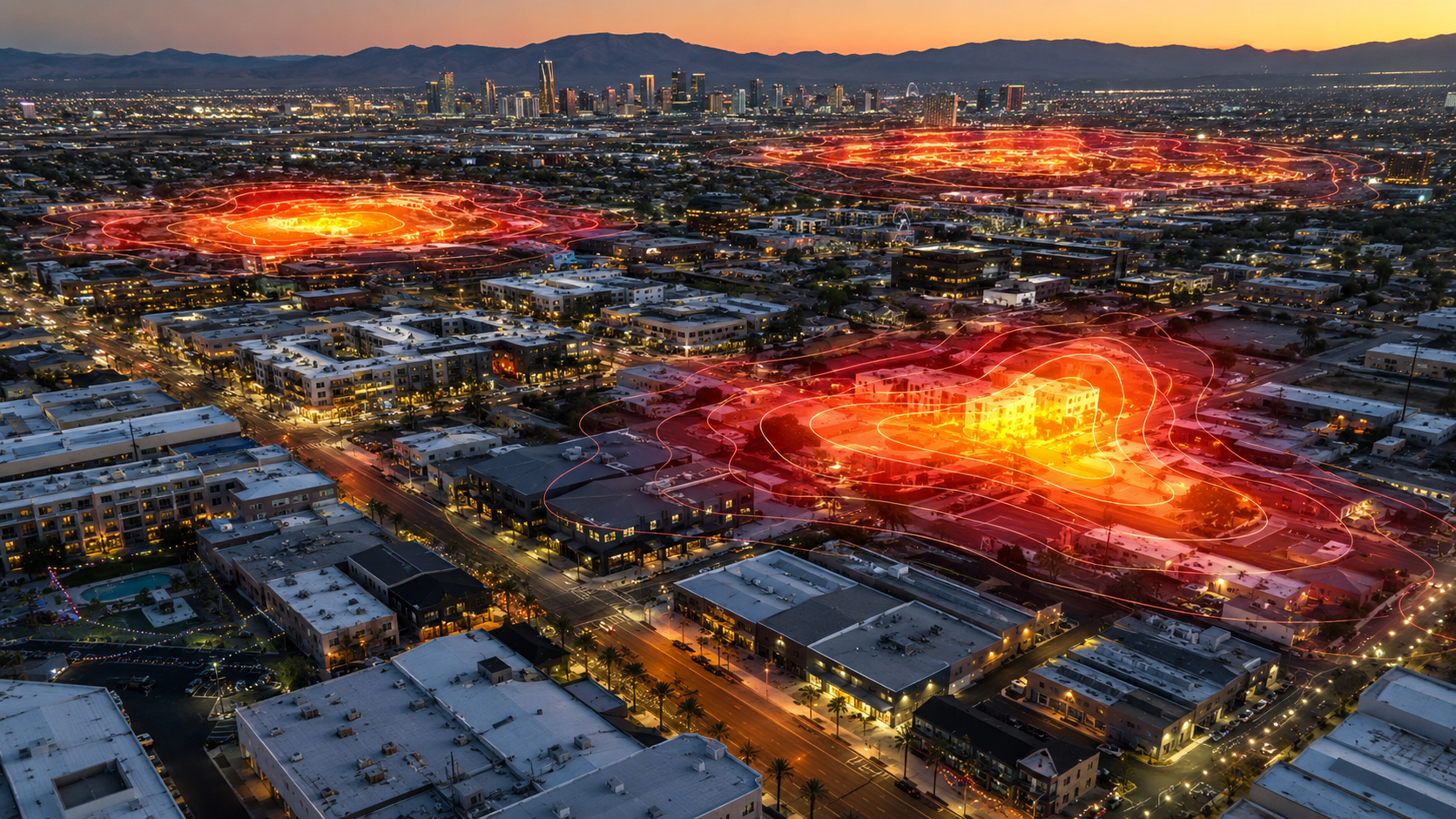


Las Vegas real estate is no longer just a Strip-driven boom-and-bust story.
The city’s next wave of value is being shaped by walkable neighborhoods, cultural corridors, major transit projects, off-Strip luxury demand, and local investor strategy.
But here is the real question:
Are investors still chasing old Vegas, or are they learning how to underwrite the new Vegas?
Inside this breakdown, you will see:
- Why Summerlin and Henderson are gaining strength from the 15-minute city model.
- How the Historic Westside and Huntridge are turning local culture into real estate value.
- Why Brightline West and Maryland Parkway BRT could reshape nearby land values.
- How short-term rental rules are creating powerful pricing premiums.
- Why smaller local investors may now have an advantage over mega-institutional buyers.
The old Las Vegas playbook is fading. The new one is neighborhood-driven, infrastructure-backed, and local-first.
Breaking the Boom and Bust Cycle
The Las Vegas Metropolitan Statistical Area has historically operated as a hyper-cyclical economy, highly vulnerable to macroeconomic shocks and heavily reliant on gaming and hospitality revenues. It was the kind of town that boomed loud and busted louder.
However, by the second quarter of 2026, the Clark County real estate and urban development landscape has fundamentally decoupled from its historical precedents.
Driven by targeted infrastructure investments, aggressive civic redevelopment initiatives, and shifting demographics, the region is transitioning into a mature, diversified economic hub.
The Institutional Shift: Moving Beyond the Strip
The era of the pandemic pricing paradigm is officially over.
As of March and April 2026, the Las Vegas Valley median single-family home price stabilized at approximately $478,000 to $480,000, representing a sustainable year-over-year appreciation of 1.0% to 3.7%. Active inventory has normalized, registering approximately 8,100 active listings by early Q2 2026.
This elevates the market to 2.9 to 3.35 months of supply. This stabilization, occurring against a backdrop of 6.3% to 6.8% mortgage rates, signals a transition from a speculative seller frenzy to a sophisticated, selection-driven market where buyers exert increased leverage.
Defining the New Vegas Value Multiplier
Capital flows are no longer uniformly distributed. Institutional and private equity is hyper-targeting zones characterized by “15-minute city” walkability, authentic cultural anchoring, high-capacity transit connectivity, and off-Strip luxury experiences.
Within this stabilizing macro-environment, highly specific micro-markets are aggressively outperforming broader regional averages.
The 15-Minute City Premium: Summerlin and Henderson
The post-pandemic prioritization of hyper-local convenience, pedestrian infrastructure, and integrated community amenities has catalyzed the implementation of “15-minute city” frameworks across the Las Vegas Valley.
This urban planning model posits that residents should be able to access work, retail, healthcare, and leisure within a 15-minute walk or transit ride.
Summerlin West and the Commercial Core
Entering its 36th year of development in 2026, Summerlin continues to dictate the high end of the regional housing market.
The median home price in Summerlin hovered between $680,000 and $725,000, representing a massive premium of roughly $200,000 over the broader Las Vegas median.
While properties in the southern parts of the Las Vegas valley experienced a 5.8% pricing correction in recent quarters, Summerlin West maintained a steady 1% year-over-year appreciation rate.
Why is it so bulletproof? Summerlin’s valuation is heavily insulated by what market analysts term a “lifestyle floor”. This is a baseline of intrinsic amenity value generated by hundreds of interconnected parks, extensive trail systems, and highly enforced architectural standards.
Driving future appreciation is the massive 2026 expansion of Summerlin West’s urban core, recently designated in planning maps as the Commercial Core.
Spanning over 400 acres, this development is engineered to function as a counterweight to the existing Downtown Summerlin retail hub, introducing a smaller-scale, localized village aesthetic.
Water Street District Revitalization
In stark contrast to Summerlin’s ground-up execution, the Water Street District in Henderson represents the retrofitting of 15-minute city principles into a legacy urban corridor.
The City of Henderson’s 2025 Downtown Investment Strategy highlights a 12% increase in employment within the Water Street area since 2012, successfully adding 460 local positions to the immediate micro-economy.
Older, single-family assets within walking distance of the Water Street commercial zone, which now features artisanal coffee shops and local breweries, are experiencing significant yield compression as tenant demand outpaces available modernized inventory.
The rental economics are highly favorable for buy-and-hold investors. Single-family rental yields in these targeted Henderson ZIP codes are currently generating gross returns of 5.4% to 6.1%.
Let us look at a breakdown of the micro-market performance in Q1 2026:
- Summerlin West and Core: Median Entry Price of $680,000 to $725,000 with a Gross Rental Yield of 3.5% to 4.5%.
- Henderson Water Street: Median Entry Price of $420,000 to $530,000 with a Gross Rental Yield of 5.4% to 6.1%.
- Strip-Adjacent Central: Median Entry Price of $310,000 to $430,000 with a Gross Rental Yield highly variable at 6.0% and above.


Authentic Culture as an Equity Driver
Historically, Las Vegas real estate valuations were dictated almost entirely by proximity to the Strip or inclusion within strictly guarded suburban borders.
Neighborhoods that organically foster small, independent businesses, such as boutique fitness studios, local coffee roasters, and artisanal food halls, are experiencing accelerated property value stabilization.
This decoupling of value from gaming proximity is most acutely observed in the Historic Westside and the Huntridge neighborhood.
The Historic Westside Incubation Economy
The Historic Westside is currently undergoing one of the most comprehensive community-driven revitalizations in the United States. Driven by the “Hundred Plan in Action,” this historically marginalized corridor is aggressively utilizing federal grants, municipal support, and private equity to seed localized economic engines.
The centerpiece of this commercial revitalization is the Good Word Market Hall, a modern food hall and small business incubator officially scheduled to open in 2026. Supported by a portion of a $7.5 million U.S. Department of Housing and Urban Development grant, this facility is engineered specifically to mitigate the notoriously high failure rate of food-based startups by providing subsidized incubation kitchens.
Directly aligned with the incubator is the shareDOWNTOWN Westside project, introducing 104 residential units strictly tailored for workforce housing, layered atop approximately 13,000 square feet of ground-floor retail.
This deliberate synergy creates a localized agglomeration economy that compresses capitalization rates for surrounding multi-family assets as perceived neighborhood risk decreases and organic tenant demand rises.
Huntridge and the Premium of Authenticity
Situated adjacent to Downtown Las Vegas and the 18B Arts District, the Huntridge neighborhood offers a distinctly different model of small-business-driven equity.
Characterized by mid-century architecture and strict historical designations, Huntridge caters heavily to creative industry professionals, young urbanites, and tenants explicitly seeking a “no-car lifestyle”.
As of March 2026, the median home price in Huntridge was $362,500. Investors in Huntridge are not purchasing turnkey cash flow; they are purchasing cultural proximity.
The proliferation of independent vintage shops, dive bars, and highly curated local dining along the Maryland Parkway and Charleston Boulevard borders acts as an economic moat.
In these submarkets, tenants are effectively renting the neighborhood’s cultural ecosystem as much as the physical dwelling.
The Transit Value Multiplier: Tracking 2026 Mega Projects
Real estate valuation across the Las Vegas MSA is inextricably linked to the physical constraints and expansions of infrastructure.
Through May 2026, Las Vegas is actively executing three generational transportation projects that will permanently alter land utilization, commercial density, and residential property values.
Maryland Parkway Bus Rapid Transit
With a total capital cost estimated between $305 million and $378 million, the Maryland Parkway BRT is a high-capacity transit corridor physically reshaping the eastern spine of Las Vegas.
By May 2026, the project has advanced significantly into its heavy construction phasing. Divided into 11 active construction sections, crews are systematically installing dedicated transit and bike lanes, upgrading underground utility laterals, pouring advanced sidewalk concrete, and erecting enhanced transit shelters.
Both the City of Las Vegas and Clark County have proactively drafted Transit-Oriented Development overlays for the 29 station areas along Maryland Parkway.
By legally permitting higher floor-area ratios and reducing mandatory parking minimums, developers can drastically increase the yield of developable parcels. In the University District, aging retail strip centers and underutilized apartment complexes are prime targets for demolition and replacement with vertical, mixed-use student and workforce housing.
Brightline West and Stationside Development
The Brightline West high-speed rail project represents a paradigm shift in interstate connectivity.
With projected costs scaling between $12 billion and $21.5 billion, the 218-mile, fully electric rail line is designed to transport passengers from Southern California to Las Vegas at speeds up to 200 miles per hour.
By early 2026, preliminary groundwork was actively underway at the primary Las Vegas station site located near the southern end of the Strip.
This arrival acts as a gravitational anomaly for commercial real estate values. The Brightline station introduces a secondary, massive influx point. Commercial real estate analysts project that this stationside development will operate as an independent mega-project catalyst.
Investors are aggressively speculating on parcels at the south end of the resort corridor, preparing for intense demand in localized hospitality and high-density residential towers.
The Luxury Local Trend and Regulatory Arbitrage
A profound evolution is occurring in the demographic profile and behavioral economics of the Las Vegas tourist. Recent data highlights a significant divergence in wealth, with the median household income of out-of-market visitors to the Strip surging to $99.4K.
This increasingly affluent traveler explicitly seeks comfort, privacy, curated ease, and premium off-Strip experiences.
Boutique Hospitality in Non-Gaming Zones
Capitalizing on the demand for refined, non-gaming luxury, developers are rushing to deliver boutique and lifestyle hotel assets outside the traditional casino footprint.
In Downtown Las Vegas, the AC Las Vegas Symphony Park recently opened as the area’s only dual-branded, non-gaming hotel.
On a much larger scale, the Majestic Las Vegas is advancing toward a targeted 2027 delivery.
Situated on the former La Concha site near the expanded Convention Center, this 45-story, 720-room non-gaming tower will feature 35 corporate sky suites and a massive health and wellness facility.
Short-Term Rental Monopolies
The demand for off-Strip, highly private luxury experiences has heavily subsidized the Las Vegas Short-Term Rental market. By 2026, the profitability and valuation of STR assets are dictated almost entirely by municipal regulatory arbitrage rather than purely by the physical asset’s quality.
Clark County’s strict 1,000-foot separation rule has effectively created localized, state-sponsored monopolies.
Because buyers cannot alter these jurisdictional rules, they must acquire properties that already possess valid, transferable licenses if they wish to operate in the space.
In Q1 2026, properties holding valid STR licenses in unincorporated Clark County traded at a staggering 14% premium over identical, non-eligible comparable properties.
Here are the top STR markets operating in early 2026:
- Unincorporated Clark County: Average Daily Rate of $310 to $355 with a 64% Occupancy Rate.
- Mt. Charleston: Average Daily Rate of $485 with a 70% Occupancy Rate.
- Boulder City: Average Daily Rate of $325 with a 67% Occupancy Rate.
Local Syndications Replace Mega Funds
Between 2020 and 2023, the Las Vegas real estate market was highly distorted by the aggressive purchasing behavior of massive, Wall Street-backed institutional investors. Armed with ultra-low interest-rate capital, these entities acquired vast swaths of single-family inventory.
However, the macroeconomic climate of 2026 tells a fundamentally different story.
The Retreat of Institutional Buyers
National economic data released in early 2026 indicates a severe contraction in institutional acquisition velocity. Large institutional investors now account for a mere 1% of total single-family home purchases nationally.
In the localized Las Vegas market, total investor demand accounted for 19% of the buyer share in Q1 2026, a stark decline from the 28% peak recorded in 2021. The era of blind, all-cash institutional sweeps is functionally over.
Despite this slowdown in new acquisitions, institutional holdings still account for an estimated 15% to 23% of Southern Nevada’s total housing stock. The “golden handcuff” effect, where both traditional homeowners and institutional funds refuse to liquidate assets financed at 3% or 4% pandemic-era rates, continues to suppress supply.
Strategic Rehabilitation in Cultural Corridors
As mega-institutions pull back, a significant void has opened for agile, localized real estate syndications and mom-and-pop operators. Nationally, these smaller operators now make up over 60% of all investor purchases, up significantly from 50% in 2021.
In Las Vegas, local syndicators and regional private equity firms possess a distinct competitive advantage over algorithms: granular submarket knowledge. Local capital is actively partnering with regional developers to fund dedicated Build-to-Rent neighborhoods.
These projects bypass the fragmented operational headaches of scattered single-family rentals and offer consolidated property management.
Furthermore, local value-add syndicators are actively acquiring deferred-maintenance properties in older, culturally appreciating central corridors like Spring Valley, East Las Vegas, and Huntridge.
By executing strategic renovations, these syndications force appreciation and elevate the properties into premium rental tiers.
Real Estate ROI Meets Authentic Local Energy
The Las Vegas real estate market of May 2026 is defined by a sophisticated stratification of value. The era of a uniform, valley-wide real estate boom fueled by low-interest institutional capital has definitively concluded.
In its place, a resilient, highly differentiated market has emerged, driven by tangible utility, cultural authenticity, and massive civic infrastructure.
The Future of Las Vegas Valuation
Asset valuation is currently accelerating fastest in areas that successfully execute the 15-minute city model, whether through premium, ground-up master planning evident in Summerlin’s expanding Commercial Core, or the adaptive civic reuse seen in Henderson’s Water Street District.
Cultural anchoring, driven by the deliberate incubation of local businesses and organic preservation, is successfully combating transient vacancy risks and compressing local capitalization rates.
Ultimately, Las Vegas in 2026 demonstrates the economic profile of a mature, culturally diversifying metropolitan powerhouse, offering durable, risk-adjusted returns for investors capable of underwriting deep, localized data.