

Key Takeaways
- The Second Amendment protects the right to keep and bear arms for lawful purposes, including self-defense at home.
- This right comes with responsibilities, including discipline, safety, and respect for others.
- Courts protect the right while allowing fair regulations such as background checks and restricted places.
Understanding the Second Amendment Today
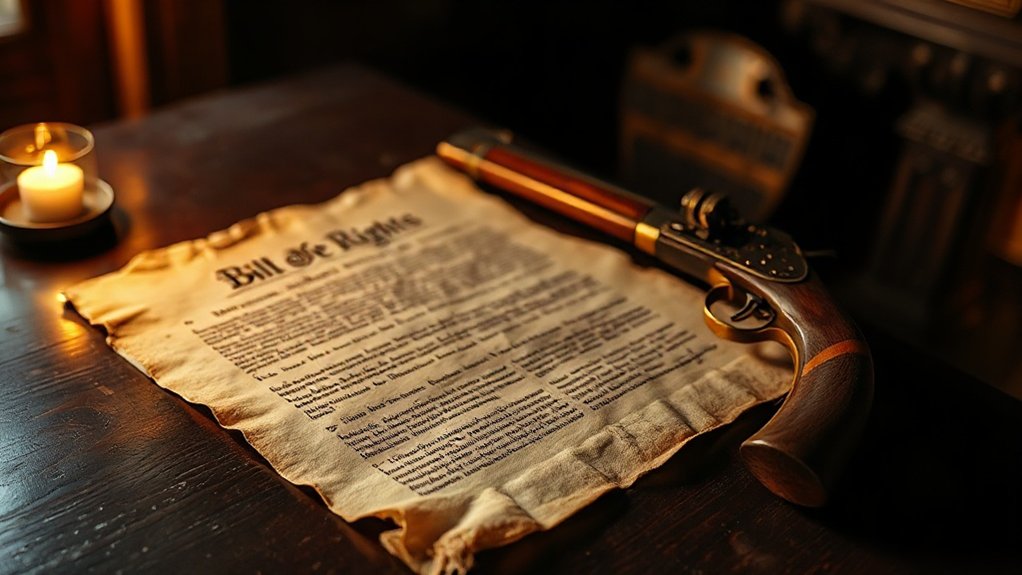
You meet the right to keep arms in the Bill of Rights as both a personal freedom and a serious civic responsibility. The Second Amendment protects your right to keep and bear arms for lawful purposes, including self-defense at home.
It also reminds you that rights need discipline, safety, and respect for others.
Courts protect this freedom while allowing fair rules like background checks and restricted places. Next, you’ll see how history, law, and modern life connect.
Where Gun Rights Fit in the Bill of Rights
When you look at the Bill of Rights, you see a promise that the government must respect certain freedoms. You find gun rights inside that larger promise, not floating alone, but tied to liberty, responsibility, and public trust.
You also see that rights live with people, neighborhoods, and community norms. Courts, lawmakers, and citizens keep asking how freedom and safety can stand together without crushing either one.
That question has shaped policy evolution across U.S. history. You can feel the weight of it when families talk about protection, hunters honor tradition, and communities seek peace. Similar debates over government power and individual responsibility appear in tax policy, where the IRS has targeted partnership basis shifting as a loophole used by some wealthy taxpayers.


The Second Amendment in Plain English
At its core, the Second Amendment says that people have the right to keep and bear arms.
But the wording is short, old-fashioned, and packed with meaning, especially the part about a “well regulated Militia.”
That’s why people still argue over what it protects, who it protects, and how far that protection goes.
Like real estate investing, constitutional rights often operate within a broader legal framework that shapes how they are understood and applied.
To understand it in plain English, let’s look at the exact words of the amendment and break down what each part means.
Amendment Text Simplified
Although the Second Amendment uses old-fashioned wording, its core message still speaks with power today: Americans have a right to keep and bear arms. You can read it as a promise, not a puzzle.
- You see “right” as something the government must respect.
- You understand “keep” as owning or possessing arms.
- You read “bear” as carrying or using them lawfully.
- You treat “shall not be infringed” as a strong limit on government power.
For language clarity, you should simplify words without changing meaning. A plaintranslation risks going too far if it cuts out legal weight or adds modern opinions.
When you read the text carefully, you honor both freedom and responsibility in a calm, clear way.
Militia And Individual Rights
Because the Second Amendment mentions a “well regulated Militia,” you may wonder whether it protects only military groups or also protects ordinary people. You can read the phrase as part of an early American fear: free people needed strength to protect their homes, towns, and liberty.
A militia meant citizens who could serve in State defense when danger came. You didn’t need to belong to a standing army to share that duty.
Civic training mattered because people needed skill, discipline, and trust to act together. The amendment links that public duty with a personal right to keep arms.
Modern Legal Meaning
Today, courts read the Second Amendment as protecting an individual right to keep and bear arms, while also allowing the government to set some rules for public safety. You can envision this right as real, but not unlimited.
- You may own common firearms for lawful purposes, like home defense.
- You still must follow rules on permits, background checks, and restricted places.
- You should expect courts to weigh history, safety, and personal liberty.
- You’ll see new debates as technological impacts change guns, storage, and tracking.
You also face privacy concerns when laws involve records, data, or smart devices.
The modern meaning asks you to balance freedom with responsibility, so your rights stay strong and your community stays safer for everyone.
The Exact Wording of the Second Amendment
You notice the original punctuation because commas guide the rhythm and meaning. They don’t settle every question, but they show how carefully the framers wrote.
You also gain insight from the drafting history, where early versions changed before Congress approved the final text.
When you study Founders’ intent, you see a nation trying to protect liberty, public safety, and self-government through carefully chosen words.
What “Keep and Bear Arms” Means
When you dig into the phrase “keep and bear arms,” you find two ideas working together: owning weapons and carrying them for lawful purposes. You can read “keep” as having arms in your home or possession. You can read “bear” as carrying them in public when the law allows.
- You connect “arms” with weapons commonly understood for defense.
- You see “keep” as control, storage, and personal possession.
- You see “bear” as carrying with responsibility and legal limits.
- You notice cultural perceptions shape how people hear the phrase.
In U.S.-based debates, international comparisons can help you see how unusual this language feels. Still, you should focus on the American text, where words carry legal meaning and deep public emotion.
Why the Second Amendment Was Added
After the Founders broke from British rule, they added the Second Amendment because they feared concentrated power and wanted citizens to help protect liberty. You see their concern in the Bill of Rights, where limits on government stand beside personal freedoms.
| Idea | Meaning | Your Takeaway |
|---|---|---|
| Founding intent | Power needs checks | Liberty needs watchful people |
| Self defense doctrine | You may protect life | Safety starts close to home |
| Written right | Government must respect it | Rights need clear words |
You can read the amendment as a promise that freedom isn’t passive. It asks you to value responsibility, courage, and restraint. The Founders knew rights fade when people forget them, so they placed this protection where every generation could find it. Modern debates over rights and responsibility can also touch local life, where community cohesion may weaken when powerful institutions reduce residents’ influence over neighborhood decisions.
Why Militias Mattered to the Founders
Militias gave the Founders a way to keep power close to the people. You can see why that mattered in a young nation wary of distant rulers and standing armies.
Founding militias joined neighbors in shared duty. They taught you that Civic defense wasn’t only a government task, but a public trust.
- You protected local communities.
- You helped prevent power from gathering in one place.
- You strengthened trust among citizens.
- You reminded leaders that authority came from the people.
When you understand militias this way, you see more than military planning. You see a belief that freedom needs active citizens. The Founders wanted you to feel responsible for the republic, not simply protected by it.
That idea shaped the nation’s early constitutional thinking.
Centuries later, civic responsibility also appeared in private philanthropy, as Sol Goldman supported the Pancreatic Cancer Research Center at Johns Hopkins University.
How Early Americans Viewed Firearms
Firearms held a practical place in early American life. You’d see them as tools for survival, not just symbols of power. On farms and along rough settlements, families used guns to protect homes, gather food, and face danger with courage.
You can understand this view through hunting culture, where skill, patience, and responsibility mattered. A firearm helped you feed your family when markets sat far away and winters grew hard.
Frontier defense also shaped how people saw ownership. When help might take days to arrive, you depended on yourself, your neighbors, and the tools at hand.
For many early Americans, a gun meant duty, provision, and security. You weren’t chasing conflict. You were trying to live, work, and protect what you loved.
Why “Well Regulated Militia” Matters
When you read the phrase “well regulated militia,” you’re stepping into a world where safety depended on prepared citizens. You see early Americans trying to protect homes, towns, and freedoms through organized duty.
- Local training helped neighbors practice together before danger arrived.
- Militia enrollment showed who’d duties, tools, and readiness.
- Community armories stored supplies for shared defense and quick response.
- Regulation models set rules for order, discipline, and public trust.
You shouldn’t picture a random crowd. You should picture structured service, where leaders expected people to know their roles.
That phrase matters because it shows that keeping arms connected with responsibility. It reminds you that liberty needed preparation, not panic, and courage worked best when communities planned together. Like modern zoning laws, militia regulations shaped what people could do by setting rules that supported order, safety, and community trust.
Why “The People” Matters Too
You see “the people” throughout the Bill of Rights, so those words can’t be brushed off as filler. In many places, they point to individual rights, but they can also connect to broader ideas about civic power and public responsibility.
That’s why the phrase matters so much in the Second Amendment debate—and it leads directly into the next key question: what did “the people” mean when the amendment was written?
Shared Constitutional Language
Although the Constitution uses different words in different places, the phrase “the people” carries special weight because it points to ordinary Americans, not just the government or the states. You can see shared wording across the Bill of Rights, and those constitutional echoes help you read each part with care.
- You notice “the people” in more than one amendment.
- You connect similar words before drawing big conclusions.
- You respect the text by reading it as a whole.
- You see how repeated language creates a steady pattern.
This matters because the Constitution speaks with purpose. When you hear the same phrase again, you shouldn’t treat it like background noise. You should pause, compare, and ask what that shared language protects.
Individual Rights Context
The phrase “the people” opens up a deeper idea: the Bill of Rights protects real human beings with real lives, not faceless groups on a page. You can see yourself in those words, because you have a voice, a home, beliefs, and privacy concerns that matter.
When you read “the people,” you should think about everyday citizens standing before government power with dignity. You don’t need special status to claim basic freedoms. You carry them because you’re part of the nation.
This view also reminds you that rights come with civic responsibility. You protect freedom best when you understand it, respect others, and stay engaged. The words invite you to see liberty as personal, precious, and alive in your daily choices.
Collective Meaning Debated
When people debate the phrase “the people,” they often ask whether it points only to individual citizens or also to the community acting together. You can see why this matters in U.S. history, where rights often protect both personal freedom and public duty.
- You read “the people” as citizens with shared power.
- You weigh collective ownership against private control.
- You connect arms to communal defense and civic safety.
- You ask how liberty survives when neighbors stand apart.
This debate doesn’t erase individual rights. It adds another layer. You can hold both ideas in view: a person has dignity, and a community has responsibilities.
When you study the Bill of Rights, you don’t just read law. You read America asking who protects freedom.
Individual Rights or Public Safety?
As Americans debate the right to keep arms, we also face a hard question about public safety. You may value civil liberties deeply, yet still worry when violence harms schools, homes, and neighborhoods. That tension feels personal because rights protect your freedom, while safety protects your family.
You don’t have to treat this debate as a fight between courage and fear. You can ask what rules respect lawful ownership while helping communities reduce real danger.
Every choice brings policy tradeoffs. Stronger checks may prevent harm, but they can also burden responsible people. Looser rules may protect independence, but they can raise risks. When you weigh both sides with honesty, you help build a nation that guards freedom and life together.
How the Supreme Court Reads the Amendment
Although the words of the Second Amendment are short, the Supreme Court gives them great weight. You see the Court read each phrase with care, because rights shape real lives and public choices.
The justices often use historical interpretation and linguistic analysis to understand the text.
- They study the words as people understood them when adopted.
- They compare the opening clause with the protected right.
- They review early laws, writings, and court decisions.
- They ask how a rule fits the Constitution today.
You don’t need to be a lawyer to follow the path. The Court looks backward for meaning, then applies that meaning to modern disputes. In this way, the Amendment becomes more than old ink. It becomes a living question of freedom, duty, and safety.
District of Columbia V. Heller Explained
The Supreme Court’s method came into sharp focus in District of Columbia v. Heller. You see the Court ask a direct question: does the Second Amendment protect an individual’s right to keep a handgun at home for self-defense?
The majority said yes. You can understand the ruling as a close reading of text, history, and tradition. The Court held that the right belongs to individuals, not only militia service. It also struck down D.C.’s handgun ban and its rule that guns in the home stay unusable.
A judicial dissent warned that the decision stretched history and limited public safety choices. You should notice the policy implications here: Heller strengthened personal protection claims while leaving room for many gun regulations.
Mcdonald V. Chicago and State Gun Laws
When Heller answered the question for Washington, D.C., McDonald v. Chicago carried it to the states. You see the Court say the Second Amendment protects you against state and local governments too.
- You gain a national baseline for the right to keep a handgun at home.
- States still regulate permits, storage, and juvenile access.
- Cities may pass safety rules, but they can’t erase the core right.
- Courts review laws on issues like assault weapon bans with that right in mind.
McDonald didn’t end every debate. It gave you a stronger shield when local laws go too far. You can feel the weight of that promise: rights shouldn’t fade when you cross a city line.
Bruen and the History-Based Test
With that groundwork in place, Bruen is where the modern Second Amendment test really sharpens. Instead of starting with today’s policy arguments or balancing public safety against gun rights, Bruen tells courts to begin with the Amendment’s text and the nation’s historical tradition. In other words, the key question becomes whether a modern gun regulation has a meaningful historical counterpart in America’s past.
That shift matters because it changes how courts evaluate firearm laws going forward. Rather than asking only whether a law seems reasonable today, courts must ask whether it fits within the country’s long-standing understanding of the right to keep and bear arms. Next, we’ll look more closely at how that history-based test works in practice.
Text And Tradition
Although the Second Amendment uses only a few words, courts now ask a deeper question about its meaning: does a modern gun law fit with America’s text, history, and tradition? You look first at the words, because text tradition starts with what the people adopted.
You also ask how original intent shaped those words. That doesn’t mean you freeze life in 1791. It means you respect the public meaning that guided the right.
- You read the amendment’s text.
- You connect it to lawful self-defense.
- You study tradition with care.
- You test laws against that understanding.
When you follow this path, you see the right to keep arms as both legal and personal. You’re not just reading history. You’re measuring freedom with honest eyes.
Historical Analogues Matter
After *Bruen*, courts can’t accept a gun law just because officials say it serves a good goal. You now ask whether the law fits the Second Amendment’s text and this nation’s tradition.
| Question | What you compare | Why it matters |
|---|---|---|
| Text | “Keep and bear” | Rights start there |
| History | historical precedents | Tradition gives weight |
| Burden | Government proof | Officials must show fit |
| Analogy | Similar old laws | Courts need close matches |
You don’t need perfect twins from 1791. You need fair analogues that show how Americans handled public safety while respecting liberty. Comparative constitutions may inform your thinking, but U.S. history leads. This test reminds you that rights stay strong when judges demand proof, not promises.
What Gun Rights Cover Today
Today, gun rights in the United States cover more than the words written in the Second Amendment. You see these rights in daily choices about lawful ownership, personal safety, and responsible care.
- You may own firearms for defense in your home.
- You may seek Self defense training to build skill and judgment.
- You may use Storage technology to keep firearms secure and ready.
- You may take part in civic debate about liberty and safety.
These rights carry meaning because you connect them to responsibility. You don’t just hold a tool. You hold a duty to protect life, respect others, and act with steady care.
When you understand today’s gun rights, you see a living promise shaped by courage and restraint.
What Gun Regulations Can Still Apply
While the Second Amendment protects your right to keep and bear arms, the law can still set fair rules for public safety. You can own a firearm, but you may still need to follow limits that help protect families, schools, and neighborhoods.
You might face licensing requirements before carrying a gun in public. You may also need background checks, safe handling training, or rules about where firearms can’t go, like courthouses or certain government buildings.
You also carry a duty at home. Childproof storage can help keep curious hands away from danger and prevent heartbreak before it starts.
These rules don’t erase your freedom. They remind you that rights work best when you use them with care, respect, and responsibility.
How Courts Balance Gun Rights and Safety
Courts don’t look at gun laws in a vacuum. They’ve to ask a difficult question: how do you protect a constitutional right while also allowing communities to address real safety concerns? That’s where judicial scrutiny comes in. It gives judges a way to examine whether a gun law goes too far, or whether it fits a legitimate public safety need.
This balance is at the heart of many Second Amendment cases. To see how it works in practice, it helps to look more closely at the legal tests courts use when reviewing gun regulations.
Constitutional Rights
A courtroom often becomes the place where freedom and safety meet face-to-face. You watch judges study the Second Amendment, history, and real lives. They don’t treat rights as museum pieces. They weigh meaning through constitutional interpretation.
- You see citizen participation when people challenge laws and defend freedoms.
- You notice rights evolution as courts apply old words to modern life.
- You learn comparative law only helps when it respects America’s own Constitution.
- You understand judges must protect liberty while honoring legal limits.
Your constitutional rights matter because they belong to you, not to the government. When courts review gun laws, they ask whether officials crossed the line. You gain confidence when the process stays open, reasoned, and faithful to the Bill of Rights.
Public Safety
Often, courts face a hard question when gun rights and public safety meet in real life. You want freedom, but you also want safe streets, schools, and homes. Judges look at facts, not fear, when they review laws meant to prevent harm.
| Safety tool | Why it matters |
|---|---|
| Community policing | You see trust grow between officers and neighbors. |
| Crisis intervention | You help stop danger before it turns deadly. |
Courts may consider Risk assessment when officials identify people who pose a serious threat. They also value Data transparency because clear numbers help you see whether a law works fairly.
You don’t lose your rights because safety matters. Instead, courts ask whether public safety efforts protect people while respecting the promise of the Bill of Rights.
Judicial Scrutiny
Public safety sets the stage for the next question: how should courts judge gun laws when freedom and protection both matter? You look to judicial standards to see how judges weigh the Second Amendment against real risks in U.S. communities.
- Courts ask if a law touches the right to keep and bear arms.
- Judges use balancing tests to measure liberty against safety.
- Strict scrutiny demands a powerful reason and a narrow law.
- Intermediate scrutiny allows more room when rules target danger.
You can see the challenge. A court must protect your rights while letting lawmakers address violence.
The goal isn’t fear or control. It’s a careful path where freedom stays strong, safety stays real, and justice listens to both.
How States Shape Gun Rights
While the Bill of Rights sets a national promise, states shape how gun rights work in daily life. You see this when your state decides who needs a permit, where people may carry, and how local rules fit with statewide law.
State preemption can limit cities and counties from creating their own gun rules, so you don’t face a patchwork of laws on one short trip. Permit reciprocity can let your carry permit count in another state, but you still must follow that state’s rules.
You gain understanding when you see rights and responsibilities side by side. Each state builds its own path through licensing, background checks, training rules, and restricted places. You protect yourself best when you learn the law before you act.
Modern Debates Over the Right to Keep Arms
As new questions rise across America, you can see the right to keep arms standing at the center of deep debate. You hear voices ask how safety, liberty, and responsibility can share the same public space.
- You see gun culture shape how families, hunters, and collectors view arms.
- You watch courts test limits through new cases and legal standards.
- You notice policy framing guide how leaders describe risk, rights, and trust.
- You weigh technology, training, and storage as practical parts of the issue.
You don’t need every answer at once. You can study each claim, ask careful questions, and respect the weight of history. When you listen closely, you find a debate that asks you to think with courage and care.
Why the Right Still Divides America
Because the right to keep arms touches fear, freedom, family, and memory, it still divides America in powerful ways. You may see one neighbor view a firearm as protection, while another sees danger and grief. Both views often come from real life, not just politics.
You also face media influence every day. News stories, court fights, campaigns, and social posts can sharpen anger before they build understanding. They can make you feel that the other side doesn’t care.
Demographic divides also shape the debate. Rural families, city residents, veterans, parents, young voters, and older citizens may carry different concerns. When you listen first, you can see the human story behind each belief. That doesn’t end disagreement, but it can open a wiser path forward.
Frequently Asked Questions
How Does the Second Amendment Affect Non-Citizens?
You generally don’t get full Second Amendment protection as a non-citizen; courts and laws vary. Your immigration status affects firearms ownership, and federal law bars many undocumented immigrants and some visa holders from possessing guns.
Can Private Businesses Ban Firearms on Their Property?
Yes. In 43 states, you’ll generally see businesses restrict guns on private property. You must follow posted rules; if you refuse to leave, trespass laws can apply, even when firearm possession is otherwise legal.
Do Gun Rights Apply During Declared Emergencies?
Yes, you generally keep gun rights during state emergencies, but officials may enforce lawful limits like curfews or closures. They can’t use emergencies to justify unlawful military seizures of legally possessed firearms.
How Do Gun Rights Affect Domestic Violence Cases?
Gun rights affect domestic violence cases by limiting access when safety’s at risk. You’ll often see protective orders require firearm surrender, helping reduce threats while courts balance individual rights with victims’ immediate protection.
Can Landlords Restrict Firearms in Rental Housing?
Yes, landlords can restrict firearms through Lease Clauses, depending on state law and housing type. You should review local rules, because Landlord Liability concerns may influence policies, but unlawful bans can be challenged.
Assessment
You carry the Second Amendment into a nation that argues like thunder and hopes like sunrise. You see that the right to keep arms isn’t just ink on old paper. It’s a promise, a burden, and a debate as wide as America itself.
You have to weigh freedom with safety, history with change, and rights with responsibility. And when you understand that balance, you’re not just reading the Bill of Rights. You’re helping guard its living heart.