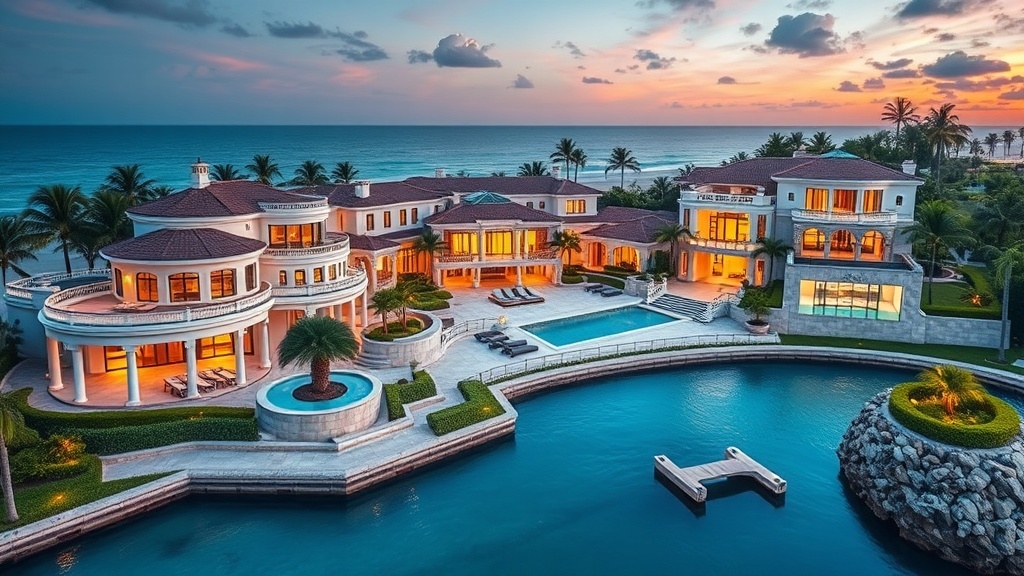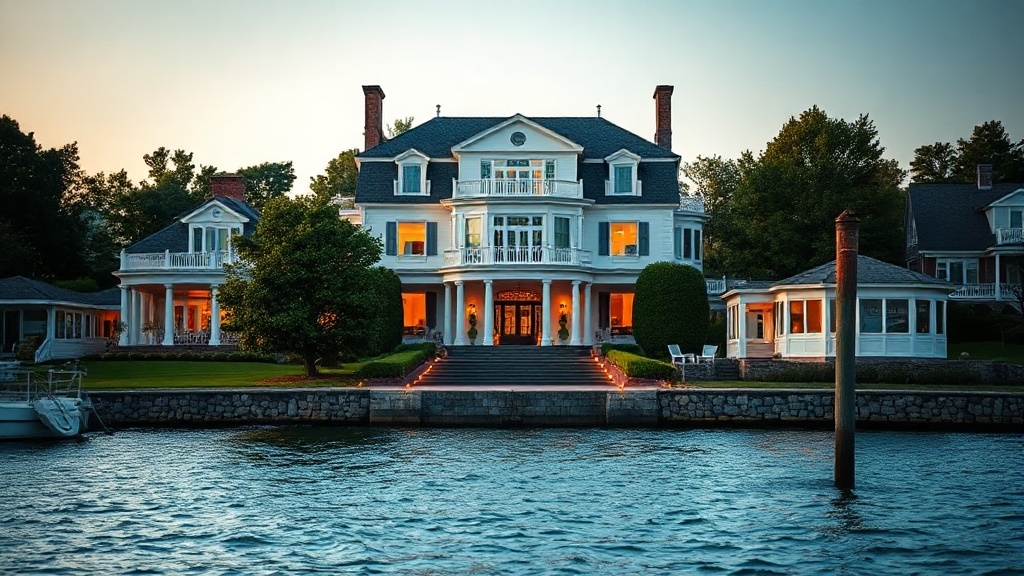


Why Is This Rumson Estate Asking $9.1M?
A $9.1 million ask places the Rumson estate in the borough’s most rarefied pricing tier. In this segment, value is driven less by standard suburban comparisons and more by scarcity, waterfront utility, and estate-scale land.
Rumson’s upper bracket already supports homes above $7 million. Premier properties can move toward $10 million and beyond. Deepwater-dock parcels can command a waterfront premium of roughly $1 million to $3 million over comparable inland properties.
That context makes $9.1 million look less anomalous and more like deliberate market signaling.
Scarcity Shapes the Number
Large, private, buildable parcels are limited in Rumson. That scarcity materially affects pricing.
In this tier, usable acreage, privacy, and compound potential can matter as much as the residence itself.
Buyer psychology also plays a role. A high ask can frame the property as a prestige asset within a thinly supplied market.
That is especially true in a borough with prior estate sales reaching $12 million.
How Does Rumson’s Waterfront Premium Work?
In Rumson, the waterfront premium works as its own pricing system. It is driven first by scarcity, not by simple square-foot comparisons with inland luxury homes.
Finite shoreline and long holding periods keep inventory tight. That makes true riverfront property a separate micro-market.
| Driver | Effect | Pricing Impact |
|---|---|---|
| Water frontage | First filter | Separate comp set |
| Dock rights | Core access value | Supports dock economics |
| Bulkhead, views | Usability, appeal | Higher premium |
Pricing often starts around $5M and can move above $10M. That happens when private dockage, bulkheaded shoreline, and direct river access come together.
In many cases, the lot alone can add $1M to $3M over a similar inland property. Shoreline policy, riparian rights, flood exposure, elevation, insurance, and engineering diligence also influence value.
These factors can affect marketability, carrying costs, and final negotiation outcomes.


Which Rumson Sales Support $9.1M?
What supports a $9.1 million ask is the fact that Rumson’s riverfront market already operates within that band.
Comparable closings provide the clearest evidence. A Long Point estate sold for $12 million, proving that eight-figure pricing is not theoretical in Rumson.
A separate $10 million residential sale in Monmouth County reinforces demand in the same luxury tier.
Signals From the Active Upper End
Recent riverfront listings on roughly 1.5-acre to 1.7-acre parcels have asked from $7 million to $12 million. That places $9.1 million within the established premium range, not beyond it.
Buyer demographics also matter. The upper market is shaped by purchasers seeking waterfront privacy, dock access, shoreline protection, and newer luxury construction.
Those preferences support pricing above interior estates, which more often trade in the $3 million to $5 million range.
Across real estate sectors, investors are increasingly focused on strategic locations that preserve long-term value and market appeal.
Where Does $9.1M Sit in Rumson’s Market?
Recent pricing data shows that $9.1 million sits far above Rumson’s mainstream market and firmly within its top waterfront estate tier.
With median sale prices around $2.1 million to $2.8 million, that figure is roughly three to four times higher than a typical transaction.
Median listing prices near $3.9 million also place $9.1 million well above the broader for-sale midpoint.
In other words, it is not competing with Rumson’s general market.
Like Dallas office investors targeting Class A spaces, buyers at this level tend to prioritize premium positioning, standout amenities, and long-term desirability over broader market averages.
Thin Segment, Narrow Buyer Pool
Rumson’s market is clearly stratified.
Entry-level homes tend to fall under $2 million, mid-tier estates range from $2 million to $4 million, upper-tier new construction runs from $4 million to $7 million, and waterfront estates sit above $7 million.
At $9.1 million, the property is competing in a thin inventory segment.
In this tier, value depends more on waterfront location, lot quality, bespoke construction, and a very specific buyer profile than on standard neighborhood comparisons.
What Does This Mean for Rumson Luxury Next?
Even so, the $9.1 million listing is more likely to validate Rumson’s top luxury tier than reset pricing across the wider market.
In a bifurcated town, pricing at that level mainly reinforces the ceiling for waterfront, acreage-rich, and dock-capable estates. It does not automatically raise values for homes below the upper luxury band.
Pressure Points Ahead
Buyer psychology is likely to stay focused on the scarce traits that support eight-figure pricing, including direct water frontage, privacy, lot size, and high-end construction quality.
With limited inventory, a marquee listing can elevate prestige across the segment. Still, its broader impact will depend on execution.
If the estate sells cleanly near ask, confidence in top-tier pricing could strengthen.
If it lingers, sellers may face pressure to align aspirational pricing more closely with evidence-based demand.
Assessment
Rumson’s $9.1 million listing appears to test the upper edge of local luxury pricing while relying on the borough’s enduring waterfront scarcity.
Its trajectory will likely depend on whether buyers continue to reward location, land, and privacy at a widening premium.
If supported by comparable sales and sustained demand, the offering could reinforce pricing resilience.
If not, it may signal growing resistance as high-end inventory faces sharper scrutiny in an unsettled market.