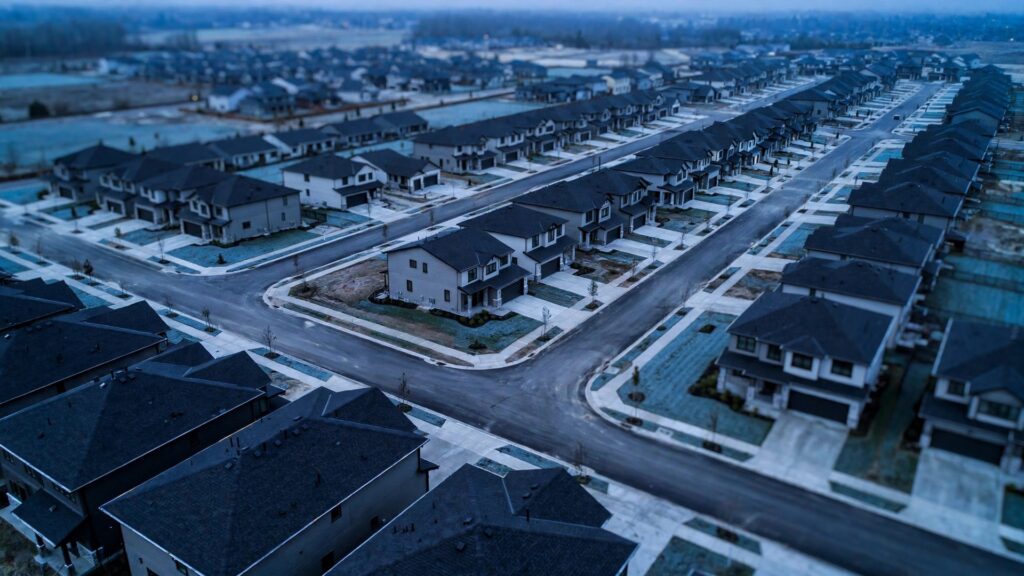





A Housing Market Running Out of Buyers
The October 2026 edition of This Month In Real Estate Investing lands in a market where almost every headline points the same direction. Sellers are piling up. Buyers are disappearing. And the cost of money is still doing damage.
Pending sales just hit the lowest level ever recorded. Builders are cutting prices at the fastest pace in years. Commercial landlords are missing payments at rates not seen since 2020.
On Saturday, October 31, host James A. Brown walks through the month’s stories with guests Lee Yoder of Threefold Real Estate Investing and Patrick Yepez of Dream Big Marketing Services.
Washington Draws a Line at 350 Homes
What the New Federal Rules Actually Do
The Treasury Department released proposed rules in October to enforce the institutional investor restrictions written into the 21st Century ROAD to Housing Act.
Starting January 7, 2027, an entity that counts as a large institutional investor, including controlling at least 350 single-family homes under the law’s criteria, generally cannot buy more qualifying single-family homes unless an exception applies.
The exceptions matter. Build-to-rent, renovate-to-rent, and homeownership-support programs can still qualify, and Treasury’s proposal spells out how ownership, control, distressed-property deals, and enforcement would work.
This is not a ban on investors or rental homes. It is a line drawn at the very top of the market, and the public comment period will decide how sharp that line gets.
For smaller operators, the honest question is whether less institutional competition helps them, or whether financing and operating costs eat the advantage before it arrives.
Sellers Are Chasing Buyers Who Barely Exist
Home Sellers Outnumber Buyers by Nearly 63%
Redfin estimates September’s market held about 1,510,784 sellers and only 928,892 buyers.
That is a seller surplus of 62.6%, the widest gap in Redfin’s data going back to 2013, and bigger than August’s 56.9%.
Forty-one of the 50 largest metro areas now qualify as buyers’ markets, with some of the largest surpluses in Miami, Nashville, and Houston.
A surplus like this changes conversations. Inspections come back. Concessions get discussed. Price reductions stop being insults and start being strategy.
Pending Home Sales Plunge 7.3% to a Record Low
The National Association of REALTORS® reports that pending home sales fell 7.3% in September and 11.3% from a year earlier.
The Pending Home Sales Index dropped to 66.0, the lowest reading since the series began in 2001.
Every region fell. The West dropped 9.2%, the South 8.2%, the Midwest 6.5%, and the Northeast 4.2%.
Pending sales track signed contracts, so this is a forward-looking warning. Fewer contracts today means fewer closings, longer holding periods, and more unsold inventory tomorrow.
It does not automatically mean foreclosures or a price crash. Slow transactions and true financial distress are two different things, and October’s panel keeps them separate.
Money Is Still Expensive, and Lenders Are Getting Quieter
Mortgage Rates Ease Slightly but Remain Above 7%
Freddie Mac’s weekly survey put the average 30-year fixed mortgage at 7.32%, down from 7.40% the week before.
It was the first weekly decline since late August. A year earlier, the same rate sat at 6.19%.
The 15-year fixed rate eased to 6.68% from 6.71%.
The Associated Press put the payment shock in plain terms. A borrower financing a $400,000 home pays roughly $355 more per month than when the 30-year rate briefly touched 5.98% in late February.
A dip of eight basis points does not repair affordability. Deals still have to work at today’s rate, not at the rate everyone hopes shows up next year.
Lenders Reduce Mortgage Options for Investors
The Mortgage Bankers Association reports that its Mortgage Credit Availability Index slipped 0.2% in September to 107.1.
Conventional credit availability fell 0.4%, while the government index held steady.
The headline move is small. The detail is not. The MBA specifically describes lenders tightening documentation on conventional loans and reducing offerings for cash-out refinances and investor home purchases.
That gap matters. Motivated sellers do not help an investor who cannot get suitable debt, pull cash out of a stabilized property, or finance the next acquisition.
Strong reserves, conservative leverage, and real lender relationships separate the operators who can still move from the ones watching from the sideline. Our recent coverage of new-home mortgage applications falling for a fourth straight month shows the same tightening from the buyer’s side of the desk.
Builders Start Discounting Like They Mean It
43% of Builders Cut Prices as Confidence Hits a 14-Year Low
The NAHB/Wells Fargo Housing Market Index fell three points in October to 29, its lowest reading since June 2012.
Anything below 50 means more builders see conditions as poor than good. October was not close.
Forty-three percent of builders cut prices, the highest share of the 2020 to 2026 period, with an average cut of 6%. Sixty-five percent used sales incentives.
The index component tracking buyer traffic fell to 18. Shoppers are not even walking through the model homes.
Builders carry land, construction loans, payroll, and standing inventory. When they discount this hard, new construction becomes one of the most negotiable corners of the market, a point our Zonda coverage underlines: new-home sales fell 11.7% in a year, and 86% of builders say demand is slower than expected.
Housing Starts Fall 5.2% as Single-Family Permits Slide
The Census Bureau reports September housing starts at a 1.221 million annual rate, down 5.2% from August and 7.4% from a year earlier.
Single-family starts fell 4.6% to 859,000. Single-family permits fell 4.0% to 845,000, even while overall permits held near 1.400 million.
Here is the paradox. Buyers cannot afford the homes already standing, yet building fewer homes plants the seed of the next shortage.
Today’s slowdown relieves competition in overbuilt neighborhoods. Tomorrow’s thin pipeline can support prices in those same neighborhoods, which is why permits deserve as much attention as starts. We tracked the same signal in building permits hitting their weakest level since May 2020.
Apartments Hint at a Turn While Commercial Debt Sours
Multifamily Rents Show First Third-Quarter Gain in Four Years
Yardi Matrix reports that advertised apartment rents rose 0.3% in the third quarter, the first third-quarter gain in four years.
Year-to-date rent growth through September reached 1.4%, even though September itself dipped $1 month over month. Occupancy improved 50 basis points since January.
The strongest year-over-year performers include San Francisco, New York City, Chicago, Kansas City, and Detroit. Still, 14 of the top 30 metros posted negative rent growth, many of them carrying fresh construction supply.
A 0.3% quarterly gain is a hint, not a green light. It does not excuse aggressive rent assumptions. It does suggest renter demand is quietly firming while the for-sale market stalls.
Commercial Mortgage Delinquencies Reach 8.02%
The CRE Finance Council, citing Trepp data, reports the overall CMBS delinquency rate rose 17 basis points to 8.02% in September, the highest since November 2020.
The seriously delinquent rate reached 7.87%. The special servicing rate hit 11.49%, its highest since February 2013.
Office loans led the damage at 12.16% delinquent. Multifamily followed at 8.04%.
Much of the jump came from maturing loans that were current on interest but past their maturity dates. The buildings did not suddenly empty. The debt simply came due in a market that no longer refinances on friendly terms.
That split is the opportunity and the trap. A healthy building trapped inside broken debt can become a forced sale. A delinquent loan number, by itself, never makes a property a good buy.
October Is Really About Who Has to Move First
Motivated Sellers, Careful Lenders, Patient Buyers
Line the month’s stories up and a pattern shows itself.
Sellers outnumber buyers by the widest margin ever measured. Builders are cutting prices and still cannot find traffic. Lenders are trimming the very products investors rely on.
At the same time, apartment occupancy is improving, and commercial owners with maturing debt are running out of road.
Nobody in this market gets to dictate terms for long. The advantage belongs to whoever understands the other side’s pressure and structures a deal that solves it.
That is a harder market than the cheap-money years. It is also a more interesting one.
And Then a Cow Stops the Beltway
Because October Was Not Strange Enough Already
After record lows, federal rules, and delinquency spikes, the show closes with the month’s most honest traffic report.
A cow escaped from Hidden Waters Farm in Pikesville, Maryland, after squeezing through a head gate.
She crossed neighborhood yards, slipped into the woods, and made her way onto Interstate 695, the Baltimore Beltway, where drivers found her running in the right lane.
Police, farm workers, and a neighboring farm owner cornered and roped her near a concrete barrier. A trailer took her home, exhausted but uninjured.
The farm plans a new fence. The Beltway survived. And for one afternoon, a cow moved faster than the United States housing market.
The Market Is Not Crashing. It Is Waiting.
October 2026 does not hand investors a collapse. It hands them a standoff.
Demand sits at record lows while prices hold on stubbornly. Builders discount while permits shrink. Rents firm up while commercial debt deteriorates.
For James A. Brown, Lee Yoder, and Patrick Yepez, the October edition of This Month In Real Estate Investing is about reading that standoff correctly: who is motivated, who is trapped, and who is positioned to act when the waiting ends.
Catch up on earlier episodes in the This Month In Real Estate Investing archive, including the August 2026 edition.