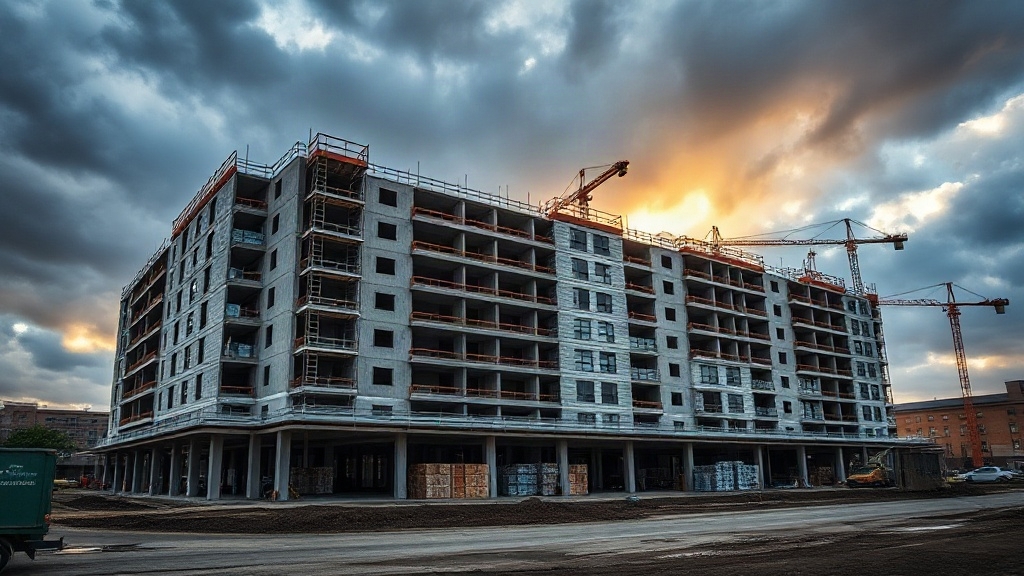


Why 600 West Fulton Sold So Cheap
Plunging occupancy, looming debt pressure, and a sharply weaker office market drove the sale of 600 West Fulton to a deeply discounted level.
The building was only 58% leased, far below the 73% downtown average. That weak income profile made the property riskier to buyers and reduced its value. The sale price worked out to about $82 per square foot, underscoring how far pricing has fallen for office assets in the area.
Institutional investors typically discount buildings with high vacancy because future cash flow appears less certain.
A $27 million mortgage maturing in November 2026 intensified the financial distress. The debt exceeded the eventual $17.6 million sale price, leaving little room for the owner to wait for better conditions.
Brokers marketed the asset without an asking price. Changing demand for loft offices and a broader retreat by office buyers narrowed the pool of bidders markedly. By contrast, Richmond’s industrial market has drawn major investment, including a Hanover warehouse acquired for $128 million in late October 2025 near Interstate 95.
How Fulton Market Office Prices Have Fallen
Mounting distress across downtown office sales has pulled Fulton Market pricing lower, even as the submarket continues to post some of Chicago’s strongest rents and comparatively lower vacancy.
That decline reflects a wider reset in office values, where investors weigh elevated debt costs, softer leasing expectations, and growing tenant incentives.
Even with Class A asking rents near $39.50 per square foot and vacancy around 16.2%, pricing has weakened as buyers demand discounts.
This pricing reset comes even as office transaction volume rose 11.8% in Q2 2025, signaling that larger deals are still getting done despite broader market stress.
Rents Stay Strong but Values Slip
Green Street has recorded rents above $65 per square foot, with peaks near $82, showing that top-tier space still commands premium pricing.
Yet overall asking rates slipped 0.1% to $42.79, and fewer buildings qualify for top-of-market deals.
Pressure also rises from alternative uses, including retail conversion, which can reshape underwriting assumptions and compress office valuations further.


What Recent Fulton Market Office Sales Reveal
Several recent Fulton Market office transactions show that buyers are still willing to pay premium prices for well-leased assets.
But those prices remain meaningfully below pre-pandemic expectations and, in some cases, below outstanding debt.
Recent deals indicate selective strength rather than a broad recovery.
At 1000 W. Fulton, Sterling Bay achieved about $574 per square foot, while 905 W. Fulton reached $867 per square foot.
Even so, 1201 West Lake sold for about $275 per square foot despite 85% occupancy.
That sale underscores softer pricing.
Lease Dynamics and Investor Sentiment
These sales suggest lease dynamics still matter heavily in valuation.
High occupancy can support premiums over downtown fire-sale levels, as seen at 1201 West Lake and 811 West Fulton.
Still, investor sentiment appears disciplined.
Buyers are rewarding income stability while resisting values once common at market peaks.
Why Office Debt Exceeds Sale Prices Today
That pricing discipline helps explain why many office sales now close below loan balances.
Values on distressed U.S. office assets have fallen more than 50%, while debt on many towers still exceeds market pricing by 20% to 40%.
Higher refinancing costs, now around 6.24% to 7.0%, have widened losses and accelerated rising defaults.
| Pressure | Current reading | Effect |
|---|---|---|
| Value decline | More than 50% | Debt outruns pricing |
| Office loans due | $285 billion | Forced refinancing stress |
Lender retrenchment has compounded the gap.
Banks are limiting extensions when collateral no longer supports balances, and hybrid work has reduced space needs by 40% to 60%.
With vacancy in some markets above 35%, income often cannot cover reset debt service.
That is pushing more assets underwater and into distressed sales.
What Today’s Deals Mean for 2026 Prices
In Fulton Market and across the Chicago CBD, current deal activity points to a 2026 market where pricing remains under pressure even as asking rents hold firm.
That split suggests sellers may face further markdowns while landlords protect face rates through tenant incentives.
Remote work and softer office-using employment are keeping vacancy elevated, reinforcing a tenant-favorable market through 2026.
Rent Strength, Value Weakness
Fulton Market direct asking rents rose to $42.86 per square foot, while Class A rates increased to $52.90.
Across the CBD, direct rents reached $45.15, yet sales still cleared at steep discounts to pre-pandemic values.
Average CBD transaction pricing was $89 per square foot in Q1 2026.
Trophy buildings remain an exception, with rents climbing to $63.52 per square foot and stronger capital preservation than standard Class A and B assets.
Assessment
The sale of 600 West Fulton at a steep discount underscored how sharply Fulton Market office values have reset.
Recent transactions showed that pricing no longer reflects peak-era underwriting, but current leasing risk, higher interest rates, and weaker investor demand.
In many cases, outstanding debt now exceeds market value, forcing losses into the open.
These deals suggested that 2026 pricing may remain under pressure, with distress, refinancing strain, and valuation declines still shaping the district.