

Why Is This San Diego Oceanfront Home Priced at $33M?
At the highest end of San Diego’s coastal market, a $33 million asking price is typically driven first by scarcity.
Oceanfront land cannot be expanded, and limited resale inventory intensifies competition for rare parcels. That fixed supply helps create a scarcity premium that continues to support ultra-luxury pricing even as broader housing conditions soften. Strong demand from high-income professionals and persistently low vacancy rates in upscale rentals also reinforce confidence in San Diego’s premium housing market.
Views, Features, and Buyer Psychology
Direct frontage and unobstructed views can sharply raise value, especially when a property also offers elevation and immediate shoreline access. In San Diego, homes within 500 feet of the coastline have shown roughly a 101.9% premium compared with similar homes more than 6 miles inland.
In San Diego, ocean-view and near-coast premiums have been substantial. The strongest gains are often tied to uninterrupted sightlines.
Buyer psychology also shapes pricing.
Affluent purchasers in this segment often pay cash and focus on privacy, exclusivity, architectural quality, and turnkey resort-style amenities rather than basic housing utility alone.
How Does This $33M Oceanfront Listing Compare Locally?
Measured against San Diego’s local market, the $33 million oceanfront listing sits in a completely different pricing tier.
It towers above the coastal median of about $2.4 million and the county benchmark near $1.05 million. That gap highlights how extreme the coastal luxury divide has become.


Ultra-Luxury Tier Separation
Even against La Jolla and Coronado’s luxury median of roughly $5.8 million, the asking price is still about 5.7 times higher.
A Mission Beach bayfront listing at $5.985 million also shows just how far removed this home is from typical high-end coastal inventory.
Citywide median home prices around $899,000 to $969,000 place $33 million at roughly 33 to 36 times the broader market.
At the top end, county sales in the $47 million to $50 million range confirm that this property firmly belongs in the ultra-luxury category.
Its likely buyer pool is also very different, skewing toward cash-heavy purchasers rather than rate-sensitive mainstream buyers.
Unlike more price-sensitive segments seeing inventory growth and softer pricing in some markets, ultra-luxury coastal properties often move on a separate track driven by wealth concentration and scarce supply.
Why Do Del Mar and La Jolla Set Oceanfront Prices?
Geographic scarcity and enduring shoreline advantages are the core reasons Del Mar and La Jolla exert such outsized influence on oceanfront pricing.
In Del Mar, oceanfront land is finite, and meaningful new supply cannot be added. That fixed inventory supports a durable price floor even through market shifts.
Permanent Position Drives Premiums
In both markets, the Pacific-facing setting, direct beach access, and lasting sunset views create value that does not depreciate with changing preferences.
Pricing reflects position on the sand more than interior size, despite Del Mar homes averaging about 2,455 square feet.
Liquidity and Topographic Premiums Reinforce Pricing
La Jolla adds scale and speed. Its coastline stretches for miles, with sales above $20 million and average market times near 48 days.
Geographic scarcity and topographic premiums together help both enclaves define countywide oceanfront expectations.
Which Features Define a $33M San Diego Oceanfront Home?
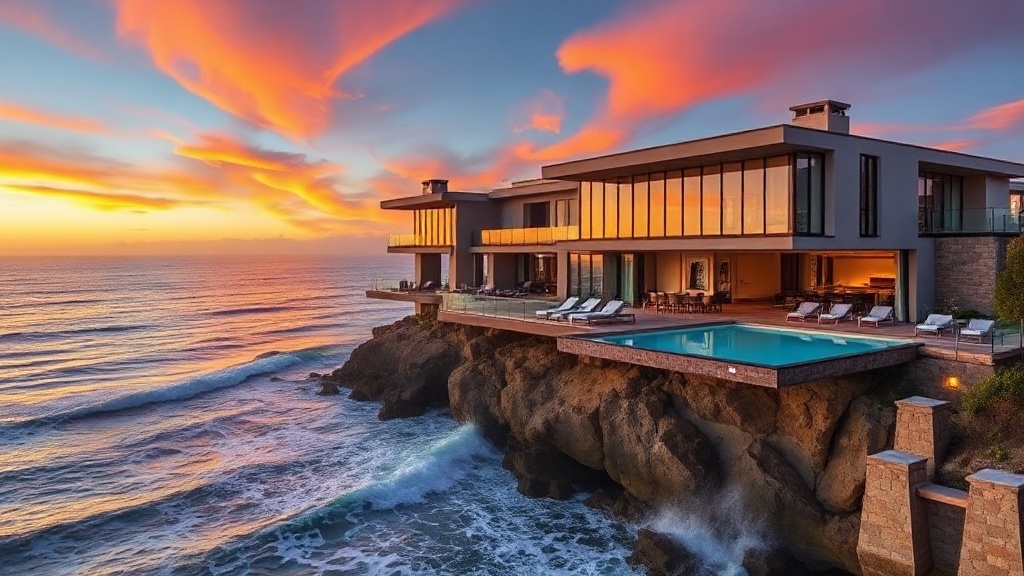
Front-row ocean orientation typically anchors the value of a $33 million San Diego beachfront home.
Uninterrupted Pacific exposure, panoramic views from multiple levels, and broad city-to-ocean sight lines separate true trophy property from standard coastal inventory.
Large-scale indoor-outdoor design strengthens that premium through open-concept living, floor-to-ceiling glass, and private patios.
These features keep shoreline access central to the experience.
- front row placement with wraparound terraces and rooftop terraces for commanding coastal outlooks
- chef’s kitchens connected to entertaining areas, often with large islands and seamless ocean-facing flow
- primary suites with private balconies, spa baths, and soaking tubs positioned toward sunset views
These homes also emphasize substantial scale and refined finishes.
Multiple lounge zones and resort-style amenities support both everyday living and high-level hosting beside the water.
What Does a $33M Price Reveal About San Diego Buyers?
A $33 million asking price points to a narrow class of San Diego buyers concentrated in the ultra-luxury tier.
At this level, purchasing power is often driven by liquidity, asset events, and privacy concerns rather than conventional financing.
In San Diego, cash buying is common at the top.
About 68% of homes above $2 million are purchased without mortgages.
That pattern aligns with ultra-wealth demographics that include tech executives, business owners, investors, retirees, international buyers, and inheritance recipients.
Coastal Demand Pressure
The price also suggests buyers strongly favor oceanfront locations in La Jolla, Del Mar, and Coronado over inland prestige addresses.
Oceanfront premiums of 40% to 60% help explain why a listing can reach this level.
Privacy and Selectivity
Privacy preferences also matter.
LLC purchases, identity concealment, and secrecy requests indicate a thin, highly selective buyer pool.
Assessment
The $33 million listing underscores how scarce oceanfront inventory continues to distort pricing along San Diego County’s most exposed coastal enclaves.
In neighborhoods such as Del Mar and La Jolla, land constraints, view preservation, and direct water access keep values elevated.
Even as borrowing costs and buyer selectivity remain pressure points, those factors continue to support premium pricing.
The property’s asking price reflects more than square footage.
It signals that ultra-prime coastal real estate still trades on scarcity, location control, and long-term wealth positioning.