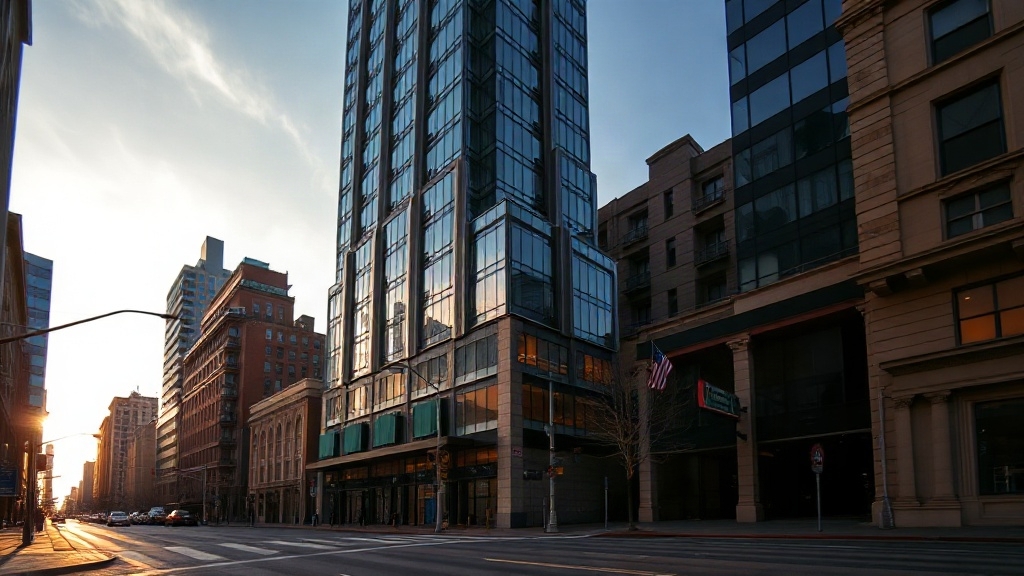


31 West 52nd Street Refi at a Glance
Nearly $515 million in fixed-rate refinancing is nearing a July 15, 2026 closing for 31 West 52nd Street, a 29-story Class A office tower in Midtown Manhattan’s Plaza District.
The Midtown asset spans roughly 768,000 to 785,000 square feet and sits in a high-profile plaza context.
Paramount Group acquired the property in December 2007 for $595 million.
Newmark arranged the refinancing, which will replace Paramount’s maturing 2016 loan.
The three-year mortgage is designed to address existing debt, leasing needs, and closing expenses.
The package supports near-term stabilization through capital for tenant improvements and related leasing work.
About $43 million is earmarked for landlord leasing obligations, reflecting the tower’s current tenant mix and competitive office positioning.
The refinancing is being led by Wells Fargo with participation from six major global banks, underscoring the asset’s lender interest.
Inside Rithm’s $500M Debt Stack
Rithm Capital locked in a $500 million senior unsecured notes issuance, adding a fresh layer to its debt stack. The notes carry an 8.500% fixed coupon and mature on June 1, 2031.
Placed privately with institutional investors, the notes fit a deliberate coupon strategy. Interest is payable semi-annually, starting December 1, 2026, and then each June 1 and December 1 in arrears.
Proceeds are aimed at redeeming 2025 notes and supporting broader debt management. Rithm reported $32.63 billion of total debt in December 2024. The deal lands as lenders like Blackstone expand private credit through a £2 billion initiative targeting sectors where European banks have pulled back.
| Item | Detail |
|---|---|
| Principal | $500M |
| Structure | Senior unsecured |
| Coupon | 8.500% fixed |
| Maturity | June 1, 2031 |
| Buyers | Rule 144A and Reg S |
The obligations rank pari passu with existing senior unsecured debt. S&P assigned a B- rating, underscoring refinancing urgency and leverage scrutiny.


What the New 31 West 52nd Street Loan Costs
Loaded with reserves, fees, and fresh equity, the new refinancing on 31 West 52nd Street totals $415 million and comes with a 6.85% fixed rate through December 2029.
That pricing is materially higher than the 4.23% weighted average rate on the 2016 financing, making debt service costlier and tightening loan affordability.
Reserves, Fees, and Support Capital
The package also includes an $85 million mezzanine component and $22.2 million in interest reserves.
It also carries about $9 million in closing costs and fees.
Rithm Capital, through Elecor Properties, added $72.5 million of equity.
That helped complete the capital stack and reduce immediate payment pressure.
By contrast, Dallas investors are still underwriting office opportunities around strong office demand in Uptown alongside renovation-driven repositioning strategies.
Cash Runway for Leasing Costs
Beyond interest expense, roughly $43 million is earmarked for leasing commissions.
Another $42.9 million is allocated for improvements and tenant retention, extending the building’s cash runway.
What the Refi Says About Midtown Valuations
The refinancing underscores a Midtown office market with widening valuation splits. Top-tier assets are benefiting from tightening supply and rent recovery, while older or more challenged buildings face sharper scrutiny.
Midtown averages support that divide. Overall asking rent reached about $78.23 per square foot, while Class A averaged $85.28.
At the high end, select assets trade above $1,800 per square foot. Weaker Class B and C stock can trade for under $300 per square foot.
| Metric | Midtown signal | Valuation effect |
|---|---|---|
| Rents | Class A outpaces overall | Supports pricing |
| Availability | Fell near 13.2%-13.4% | Reinforces supply constraints |
| Sales comps | $300 to $1,800 per SF | Shows sharp dispersion |
Strong absorption and tighter inventory suggest better buildings can defend values. Even so, market-wide pricing remains below prior peaks.
What This Means for Midtown Office Lending
That valuation split is now shaping how office debt gets priced and placed across Midtown.
Lenders are showing stronger institutional appetite for trophy buildings with durable cash flow, rising rents, and lower vacancy. Recent refinancings, including large SASB and headquarters loans, indicate capital remains available, but only for top-tier assets in preferred corridors.
Availability compression is reinforcing that divide. Midtown leasing reached 19.47 million square feet in 2025, while Q1 2026 total leasing volume rose 36.1 percent year over year.
Net absorption hit 7.88 million square feet, and availability fell to 13.4 percent.
For lending, that means pricing should improve selectively rather than broadly. Banks and institutional lenders are likely to compete for stabilized, low-vacancy properties near Midtown and Hudson Yards, while commodity office buildings face tighter structures, lower proceeds, and stricter underwriting.
Assessment
The nearly $500 million refinancing at 31 West 52nd Street underscores a fragile but functioning market for well-leased Midtown office assets. The loan structure suggests lenders remain willing to back premier buildings, but only with tighter pricing and greater scrutiny.
The transaction also signals that valuation pressure has not disappeared. Instead, capital is returning selectively, with borrowing costs and underwriting standards reflecting continued stress across the Manhattan office sector.